Stone-look SPC flooring offers global buyers a practical way to bring the visual character of limestone, slate, or marble into busy interiors. In 2026, the strongest options will balance convincing surface detail with reliable construction, clear product documentation, and support after purchase. Still, a realistic image is only part of the decision.
For this introduction, the expert comment below is illustrative, not a verified quotation. It should be replaced with an approved statement from a named specialist before publication. Flooring specification consultant Adrian Cole offers this draft perspective: “A stone pattern can look convincing in a showroom, but buyers should also inspect the locking profile, wear layer, and installation guidance.” Check technical sheets carefully. Wear-layer figures, core composition, and warranty terms can vary between products. Ask suppliers for current documentation and physical samples.
Look closely at the details. A sample beside a window may reveal a gloss level or color shift that a screen hides. Check how the pattern repeats across several planks, too. Repetition can look obvious on a large floor. For international projects, confirm packaging, delivery timing, and installation requirements with the supplier before committing. No single specification guarantees a good result. That deserves reflection.
This guide examines Spc Flooring Stone options through practical criteria that buyers can compare, rather than appearance alone. It will help readers ask better questions and identify trade-offs. The final choice still depends on the room, expected traffic, and installer skill.
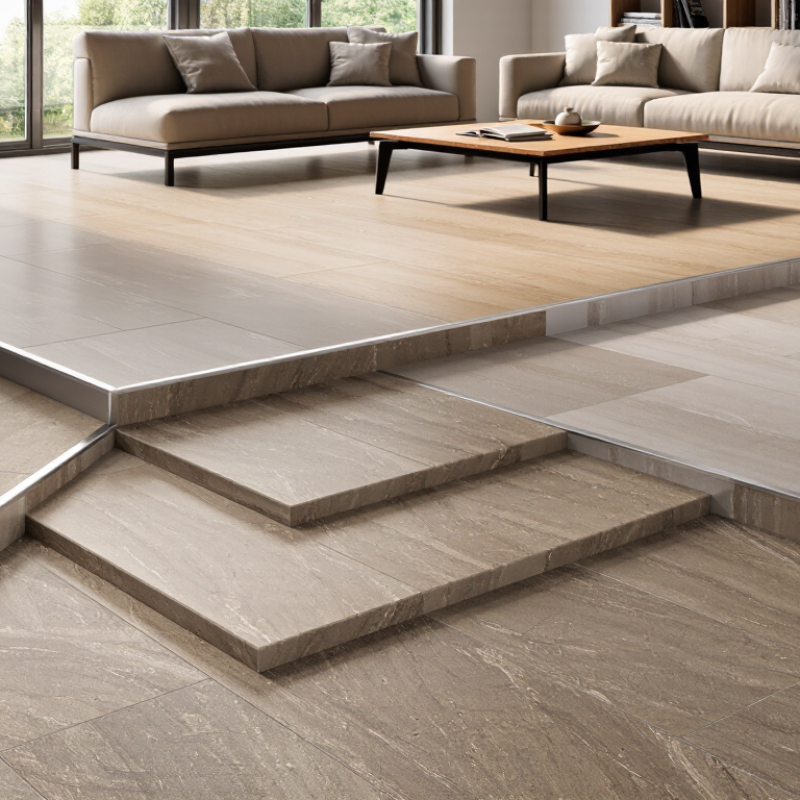
Stone-look SPC flooring is a layered floor covering designed to resemble materials such as limestone, slate, or concrete. SPC stands for stone plastic composite. Its rigid core is usually made from mineral filler, commonly calcium carbonate, blended with PVC resin and processing additives. The printed surface creates the stone pattern; the core itself is not a slab of stone. Not quite stone.
Core production starts by measuring and blending the ingredients into a consistent compound. The mixture is heated and formed, often by extrusion, into a continuous board. Cooling and calibration help control thickness and flatness. Manufacturers then apply a printed decor film and a transparent wear layer, typically using heat and pressure. A surface texture may be pressed in to echo fine pores or shallow slate lines. Recipes and production methods vary, so buyers should check a supplier’s technical data rather than assume every SPC core is identical.
Mineral content contributes to the board’s stiffness, while the polymer helps bind the mixture into a workable core. That balance matters. A board can feel firm underfoot, yet poor installation or uneven subfloors may still cause problems. I would not judge quality by a stone image alone; inspect thickness tolerances, wear-layer details, and documented test results. Even a convincing print can look artificial under harsh side lighting.
| Topic | Typical construction or specification | What buyers should know |
|---|---|---|
| What stone-look SPC flooring is | A rigid-core resilient flooring product with a printed decorative layer designed to resemble materials such as marble, slate, or concrete. | The stone appearance comes from the printed design and surface finish; the product itself is not a slab of natural stone. |
| Main core ingredients | The core commonly combines calcium carbonate mineral filler with polyvinyl chloride (PVC) resin and processing additives. | Formulations differ by manufacturer. Ask for the product’s technical data and confirm that the declared composition and performance meet the intended market’s requirements. |
| How the core is made | Ingredients are blended, heated and processed into a rigid sheet or profile, then calibrated and cooled to control thickness and surface flatness. | Mixing, temperature, pressure, and cooling affect consistency. Production descriptions and quality controls should be verified with the supplier. |
| Typical product layers | Common construction includes a UV or protective finish, a transparent wear layer, a printed décor film, the SPC core, and sometimes an attached underlay. | Layer arrangements vary. Check whether an underlay is attached and whether an additional underlay is permitted by the installation instructions. |
| Wear-layer options | Common stated wear-layer thicknesses include approximately 0.3 mm, 0.5 mm, and 0.7 mm. | A thicker wear layer can provide more material above the décor, but it does not by itself establish overall quality. Review test results, finish type, and warranty conditions. |
| Overall plank or tile thickness | Rigid-core products are sold in a range of total thicknesses; the selected thickness includes the core and any surface layers or attached underlay. | Compare like-for-like specifications and confirm the actual thickness of the product, not just a general product-family range. |
| Formats and stone designs | Available formats can include rectangular planks and square or rectangular tiles, with printed designs that imitate different stone patterns. | Request samples or current design files to assess pattern repeat, color variation, edge detail, and how the design looks under the project’s lighting. |
| Surface texture and finish | Finishes may be smooth, embossed, or textured; some products align surface texture with visual details in the printed design. | Confirm slip-resistance test results for the intended use. A textured appearance alone does not establish a specific slip rating. |
| Water exposure | The rigid-core construction is generally designed to resist water-related damage to the flooring material. | Water resistance does not make every installation waterproof. Perimeter sealing, joints, subfloor conditions, and standing-water guidance depend on the product and installation method. |
| Installation system | Many SPC products use a click-lock floating installation; other installation methods may be offered for particular products. | Check subfloor flatness, expansion clearances, room-size limits, and transition requirements in the installation instructions before ordering. |
| Underfloor heating | Some products are suitable for use over underfloor heating when installed within stated temperature and installation limits. | Suitability is product-specific. Obtain written limits for operating temperature, heat-up procedure, and any required underlay. |
| Quality checks for import orders | Relevant checks may include dimensional tolerances, locking-joint fit, surface appearance, wear-layer measurement, and results from applicable performance tests. | Agree on the specification, sampling method, and acceptance criteria before production. Request test reports that identify the tested product and method. |
| Market documentation | Required documentation depends on the destination country, application, and sales channel. | Confirm applicable product, chemical, emissions, fire, and labeling requirements with the importer or local compliance specialist before shipment. |
Specification note: Values and construction details shown are typical examples, not universal requirements. Confirm current technical data, test methods, installation instructions, and local regulations for each product and destination market.
Stone-look SPC flooring recreates stone through a printed décor layer beneath a clear wear layer. High-resolution imagery can show limestone clouds, slate veining, or fine mineral specks. Embossed surfaces add shallow ridges and grain that catch light differently across the floor. Some designs also align texture with the printed pattern, making a vein feel slightly raised rather than merely visible.
Scale and variation matter. Large-format planks can suggest broad stone slabs, while narrow joints create a tiled effect. A soft matte finish often looks closer to honed stone than a glossy surface. Still, lighting changes everything. A cool gray sample beside a sunny window may appear warmer by evening. Check samples in the room where they will be installed.
The illusion is not perfect. Repeated veins can become noticeable across a large area, and surface texture may feel more uniform than real stone. Look at several pieces together, not just one display board. Ask for details on wear-layer thickness, texture, and pattern variation, then compare those specifications with the intended room use. Minor inconsistencies in the printed pattern can sometimes make the floor feel less convincing, not more natural.
For stone-look SPC flooring, compare test results, not just printed thickness. Check total plank thickness, wear-layer thickness, core density, and locking-joint strength. A 0.3 mm wear layer may suit lighter residential use; busier spaces often need a thicker layer, subject to the supplier’s tested-use guidance. Ask for abrasion, residual-indentation, and dimensional-stability results, including the test method and laboratory. ASTM F3261 covers resilient flooring with a rigid polymeric core, but passing a standard does not prove every installation will perform equally.
Visual detail matters. Examine a full-size sample under side lighting: shallow grout lines and repeated stone patterns can look artificial across a large floor. Request the shade-repeat information and inspect several cartons for variation. For kitchens or entryways, confirm slip-resistance data and follow the stated cleaning instructions. Water-resistant planks do not make every subfloor or joint waterproof. Small distinction. It matters.
Grand View Research estimated the global luxury vinyl tile market at USD 18.7 billion in 2023. SPC sits within this broader category, so that figure signals market scale, not product quality. Compare specifications against your actual climate, traffic, and installation conditions. One detail is easy to overlook: ask whether test results apply to the exact plank construction being quoted, not a similar collection.
Common SPC wear-layer specification options (millimeters)
Wear-layer thickness is one useful point of comparison: these are commonly encountered specification options, not a universal grading system or a guarantee of service life. When evaluating stone-look SPC flooring, also compare total thickness, dimensional stability, slip resistance, fire classification, emissions documentation, and warranty terms. Verify each figure against the product’s technical datasheet and the requirements of the destination market.
For stone-look SPC flooring, judge the construction behind the printed surface. Request test reports for the exact product and production batch, not just a general certificate. ASTM F3261 covers resilient flooring with a rigid polymeric core; ask which edition and test methods the supplier used. Check wear-layer thickness, dimensional stability, locking strength, and surface slip results. A sample under showroom lights may hide uneven embossing or a sharp color shift. Look closely.
For indoor-air quality, request emissions testing from an independent laboratory and confirm the tested product matches the flooring being quoted. UL 2818 GREENGUARD Gold criteria set a total VOC emissions limit of 0.22 mg/m³. Treat that as one reference point, not proof of compliance everywhere; requirements vary by market and project. Also ask for a current environmental product declaration and its scope. UNEP’s 2024 Global Status Report for Buildings and Construction reports that buildings and construction produced 37% of energy- and process-related CO₂ emissions in 2022. That figure is not flooring-specific, but it makes verified life-cycle data worth checking. Paperwork can still be incomplete. Compare it with factory records, batch labels, and physical samples.
Selecting stone-look SPC flooring starts with the room, not the sample. Grand View Research estimated the global luxury vinyl tile market at USD 18.7 billion in 2023; that category includes products beyond SPC, so market growth is not proof of quality. Compare wear-layer thickness, surface texture, locking profile, and warranty conditions. A matte finish can soften the look of veining, while a textured face may collect grit more readily. Check full-size boards under your room’s lighting. Small samples can mislead.
Installation depends on a flat, clean, dry subfloor. Follow the product’s stated tolerance and acclimation instructions; these vary by floor and climate. Remove dust near doorways, then test-fit several rows before locking them together. Keep the specified perimeter gap, and avoid pinning a floating floor beneath fixed cabinets. The resilient flooring standard ASTM F3261 provides a technical reference for modular resilient flooring, but it does not replace the product’s installation guide. A rushed subfloor check is still an easy mistake.
Tips: Use felt pads beneath chair legs, sweep grit often, and wipe spills promptly. Damp-mop with a cleaner approved for resilient floors; skip abrasive pads and excess water. SPC resists everyday moisture, but seams and room conditions still matter. Inspect joints after moving heavy furniture. One detail worth reconsidering: a stone pattern may look convincing, yet a busy veining layout can make small rooms feel visually crowded.
„Thanks to the LUVIR technology, the solder resist process could be switched directly from the previously used mask exposure to direct exposure. As an outstanding digital solution on the market, this technology has been able to demonstrate fast process times and superior quality on our certified conventional ink in production. This allowed us to fully digitize the solder mask process at low cost – without process or ink adjustments. An excellent benefit to our production in Rot am See.“
Ralf Göhringer (Head of Production WE Rot am See)
I would definitely recommend the Limata machine and team for a future company purchase
Michael Greenaway
Compunetics Inc.
“The Limata ldi has been amazing!! Best thing we did was buy this machine”
Richard Brady
GM
Circuitlabs
“Since 2019, we have been running the Limata X1000 LDI system (including LUVIR for solder mask imaging) in daily production as an addition to our current process with film. The machine was capable of properly exposing Taiyo PSR-4000 BN (DI) solder mask types on normal to high-copper boards using a new and unique direct imaging process. The machine operating interface is very user friendly which allowed for a quick technical training curve. The pre-registration processing reduced several seconds of production time at every print. Limata support and service staff is incomparable. They supported our team every step of the way at basically any time of the day or night, with literally, an immediate response time, customizing the software interface to best fit our Operations and needs.
We have exposed more than 8,000 prints since end of October, on various solder mask colors and some resist film panels. Limata, has proven to be very capable and innovative. They are a strong contender in the industry.
We have very much enjoyed this project, and working with the team!
Thank you Limata for the continued support and being a part of our growth.”
Bill Sezate
Vice President, GM
Summit Interconnect
As a replacement to our current contact exposure process with film, the LIMATA X2000 system including LUVIR-Technology was capable of properly exposing non-LDI solder mask types using a direct imaging process. The machine offers cutting edge software with a very intuitive operating interface which allowed for quick technician training curve. The dual drawer system combined with pre-registration processing reduced several seconds of production time at every machine cycle. Limata support and service staff is world class. They added software patches to keep production running at shortest possible response times, customized the software interface to best fit our in-house Operations system, and even wrote a step-by-step machine processing manual. As a result of the project, we have exposed more than 16,000 times on various product types and solder mask brands/colors. Limata, in a very short timeframe as a company, has definitely shown they are truly innovative and will be challenging the industry of direct imaging for the top spot.
Kevin Beattie
Process Engineer
TTM Technologies
Forest Grove Division