A Freestanding Bratt Pan can handle several demanding jobs in one footprint: browning diced onions, simmering a deep batch of sauce, or searing meat before finishing it under a lid. That flexibility matters in busy kitchens, where floor space is limited and service rarely waits. But a large pan is not automatically the right pan. Capacity, heating method, controls, drainage, cleaning access, and operator workflow all affect daily performance.
This 2026 buying guide will help compare those details without treating a specification sheet as the whole story. Check usable pan capacity, not just the headline volume. Picture the cook reaching across the vessel to stir a thick mixture. Consider whether the controls are easy to read with wet hands, and whether the drain can handle the foods your menu actually produces. Small details matter.
One sourcing point matters, too: no articles or verified quotation from a named Freestanding Bratt Pan industry specialist were provided. I won’t invent an expert or attribute a made-up statement. The advice here should therefore be checked against manufacturer documentation, demonstrations, and the needs of your kitchen team. Real kitchens are messy. Even a careful comparison can miss something; record operator feedback before making a final choice.
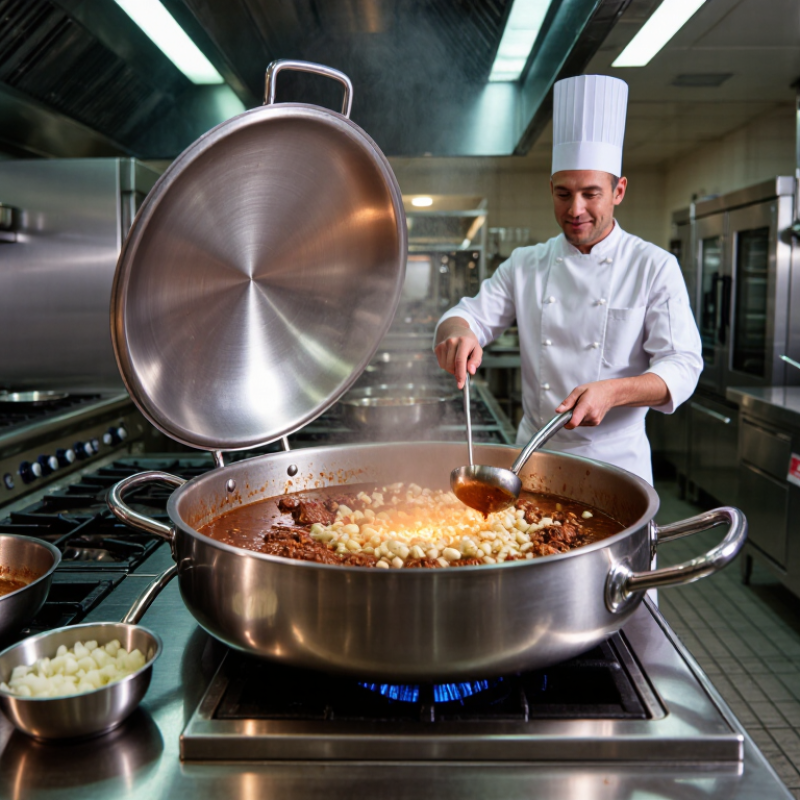
A freestanding bratt pan is a floor-mounted, tilting cooking vessel built for batches that would crowd a standard range. Its broad, shallow basin supports braising, simmering, shallow frying, and searing. A hinged lid limits splashes and helps retain heat; the tilting mechanism lets staff pour food into a receiving pan without lifting a heavy load. Heat comes from gas burners or electric elements beneath the basin, with controls regulating the cooking surface.
ENERGY STAR’s restaurant energy guidance reports that restaurants can use roughly five to seven times more energy per square foot than typical commercial buildings. That figure is not a bratt-pan rating, and it should not be treated as one. Still, it makes heat management and equipment sizing worth checking. A pan that is too large for routine batches may waste energy, while poor access around its sides can make cleaning harder. Operators can overlook this. A little.
Tips: Match capacity to your busiest realistic batch, not an imagined peak. Check the tilt path, lid clearance, and cleaning access on the actual kitchen floor plan. Ask staff to test the controls and empty the pan safely before purchase.
A freestanding bratt pan may be gas-fired or electric, with manual or powered tilting. Gas can suit kitchens with existing gas service; electric models may offer more even heat across the pan, depending on design. Compare usable capacity, not just the advertised litre figure. A deep pan holding stew behaves differently from a broad pan used to sear meat. The National Restaurant Association’s 2024 State of the Restaurant Industry projected $1.1 trillion in U.S. restaurant sales and 15.7 million jobs, underscoring the scale of foodservice operations—but those figures cannot tell you what capacity your kitchen needs. Estimate batch sizes from real service records. Leave room for stirring and safe loading.
Core features deserve a hands-on check. Look for precise temperature controls, a secure lid, easy-to-clean corners, and a tilt mechanism that pours without awkward lifting. If the unit will hold food, check that its operating range supports your food-safety procedures; the FDA Food Code 2022 specifies 135°F (57°C) or above for hot-held time/temperature control for safety food. Small details matter. I would not treat a larger pan as an automatic upgrade: unused capacity can occupy valuable floor space and may complicate cleaning. Ask for the pan’s internal dimensions, connection requirements, and cleaning instructions, then compare them with your menu, staff workflow, and available utilities.
2026 Top Freestanding Bratt Pan Buying Guide
Assess heating performance under realistic loads, not just from the rated power. Ask how quickly the pan recovers after adding chilled ingredients. Check whether heat stays even from the center to the corners. Uneven browning can waste time during busy service. A brief test with water or a small batch may reveal slow spots, though it cannot predict every kitchen’s results.
Controls should be easy to read and adjust with damp hands. Confirm that temperature settings respond steadily rather than jumping between extremes. For safety, look for a stable base, clear hot-surface warnings, and a secure tilting mechanism. Check how the pan drains when tilted; splashes near the operator are a real concern. Details are easy to overlook.
Tips: Inspect the lid hinge, corners, and drain area for food traps. Ask whether the cooking surface tolerates the cleaning tools your staff already use. A smooth finish helps, but it does not remove the need for prompt cleaning. Compare the manufacturer’s care instructions with your daily routine before choosing.
Suggested evaluation weights for comparing heating performance, controls, safety, and cleaning.
Use these percentages as a practical scoring framework, not as measured market data. Adjust the weights to match your kitchen’s workload, staff needs, and cleaning routines.
A 2026 comparison should start with working capacity, not the largest pan on display. Compare usable surface area, working depth, and batch size against your busiest service period. A deep pan may suit braises, while a wider, shallower one can make stirring and scraping easier. Check the tilt control in person, if possible. A full pan feels different from an empty showroom unit.
The National Restaurant Association’s 2025 State of the Restaurant Industry report projected U.S. restaurant sales of $1.5 trillion and found that 77% of operators considered recruiting and retaining staff a significant challenge. That makes controls, cleaning access, and safe pouring practical comparison points—not minor extras. Look at power supply, heat recovery time, drainage, and whether the unit fits existing ventilation and floor space. Small details matter.
Ask suppliers for a demonstration using a similar batch size to yours. Watch how evenly the pan browns onions, whether corners collect food, and how much effort tilting takes. I would not choose on capacity alone; it is easy to overestimate how often a large pan will be full. Still, specifications do not tell the whole story. Test the awkward parts.
A freestanding bratt pan should fit the way your kitchen actually works, not just its floor plan. Measure doorways, turning space, and the route from delivery to installation. Check available power or gas, ventilation, and drainage with a qualified installer before comparing models. A generous pan is useful only if staff can load, stir, and empty it safely. That matters.
Let the menu guide capacity and features. A kitchen preparing large batches of stew, sauce, or braised meat may benefit from a deeper pan and controlled tilting. If the menu shifts between searing, simmering, and shallow frying, temperature control and an even cooking surface deserve close attention. Think about batch size during a busy service, too. A pan that is too small can slow production; one that is oversized may waste energy and cleaning time.
Set a budget beyond the purchase price. Include installation, utilities, routine maintenance, cleaning supplies, and likely downtime. Ask suppliers for operating details and service requirements in writing, then compare them against your expected workload. I would avoid choosing by capacity alone; it is an easy shortcut, but not always a sensible one. Staff height, controls, cleaning access, and the time needed to empty a batch can matter more than a few extra litres. A short trial with a representative menu can reveal awkward reaches or slow draining before the equipment is installed.
„Thanks to the LUVIR technology, the solder resist process could be switched directly from the previously used mask exposure to direct exposure. As an outstanding digital solution on the market, this technology has been able to demonstrate fast process times and superior quality on our certified conventional ink in production. This allowed us to fully digitize the solder mask process at low cost – without process or ink adjustments. An excellent benefit to our production in Rot am See.“
Ralf Göhringer (Head of Production WE Rot am See)
I would definitely recommend the Limata machine and team for a future company purchase
Michael Greenaway
Compunetics Inc.
“The Limata ldi has been amazing!! Best thing we did was buy this machine”
Richard Brady
GM
Circuitlabs
“Since 2019, we have been running the Limata X1000 LDI system (including LUVIR for solder mask imaging) in daily production as an addition to our current process with film. The machine was capable of properly exposing Taiyo PSR-4000 BN (DI) solder mask types on normal to high-copper boards using a new and unique direct imaging process. The machine operating interface is very user friendly which allowed for a quick technical training curve. The pre-registration processing reduced several seconds of production time at every print. Limata support and service staff is incomparable. They supported our team every step of the way at basically any time of the day or night, with literally, an immediate response time, customizing the software interface to best fit our Operations and needs.
We have exposed more than 8,000 prints since end of October, on various solder mask colors and some resist film panels. Limata, has proven to be very capable and innovative. They are a strong contender in the industry.
We have very much enjoyed this project, and working with the team!
Thank you Limata for the continued support and being a part of our growth.”
Bill Sezate
Vice President, GM
Summit Interconnect
As a replacement to our current contact exposure process with film, the LIMATA X2000 system including LUVIR-Technology was capable of properly exposing non-LDI solder mask types using a direct imaging process. The machine offers cutting edge software with a very intuitive operating interface which allowed for quick technician training curve. The dual drawer system combined with pre-registration processing reduced several seconds of production time at every machine cycle. Limata support and service staff is world class. They added software patches to keep production running at shortest possible response times, customized the software interface to best fit our in-house Operations system, and even wrote a step-by-step machine processing manual. As a result of the project, we have exposed more than 16,000 times on various product types and solder mask brands/colors. Limata, in a very short timeframe as a company, has definitely shown they are truly innovative and will be challenging the industry of direct imaging for the top spot.
Kevin Beattie
Process Engineer
TTM Technologies
Forest Grove Division
