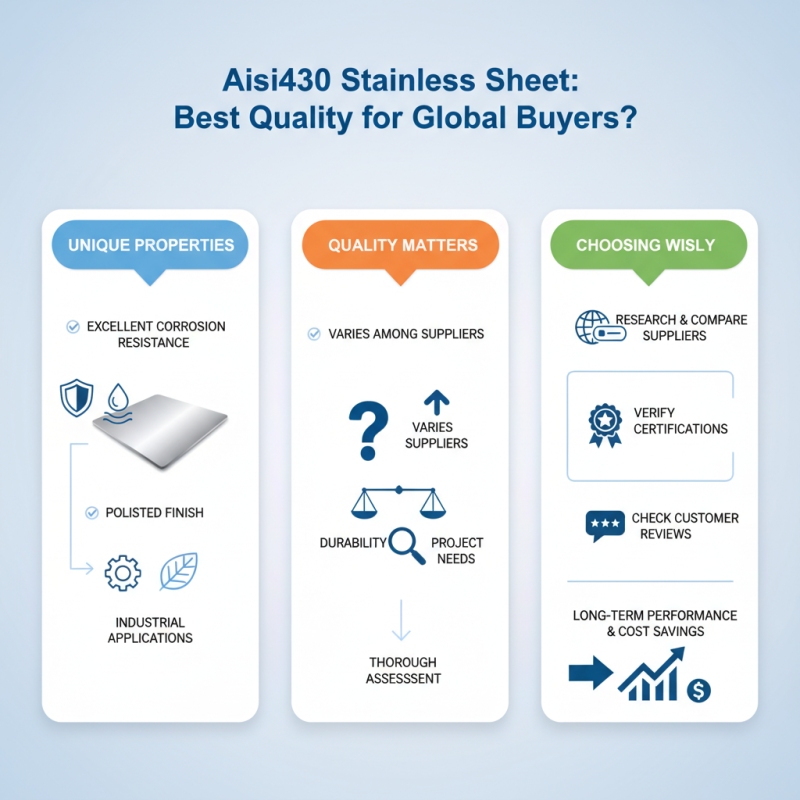
In the competitive world of stainless steel, the Aisi430 Stainless Sheet stands out for its unique properties. This type of stainless steel offers excellent corrosion resistance and a polished finish that appeals to many buyers. It is often selected for both industrial and decorative applications.
However, not all Aisi430 sheets are created equal. Quality may vary among suppliers, and buyers need to be vigilant. Understanding the specific needs of your project is crucial. For example, some applications require more durability than others, and therefore, a thorough assessment of sheet quality is essential.
Choosing the right supplier can be challenging. Researching and comparing options ensures you find reliable sources. Verifying certifications and customer reviews can enhance confidence in your choice. Ultimately, quality matters greatly in the long run, affecting both performance and cost.
Aisi430 stainless steel is often sought after for its unique properties. It’s a ferritic stainless steel, composed mainly of iron, chromium, and carbon. This composition gives it excellent corrosion resistance and moderate strength. A notable feature is its magnetic properties, which can be beneficial in various applications. Reports indicate that the chromium content typically ranges from 16% to 18%, allowing this steel to resist oxidation at elevated temperatures.
The mechanical properties of Aisi430 make it a versatile choice. It offers a tensile strength of around 450 MPa and a yield strength of about 250 MPa. These values vary slightly based on the sheet's thickness. While Aisi430 provides good formability, it does have limitations in welding compared to austenitic grades. Users often experience challenges in achieving consistent weld quality.
Some applications may require careful consideration. The service temperature limit for Aisi430 is around 800°C. However, excessive exposure to heat can lead to decreased performance. Ensuring that this steel meets the specific needs of projects is crucial. Testing and certification are vital. Without proper validation, buyers may encounter surprises after implementation. Therefore, understanding the specifications and properties is essential for global buyers.
Aisi430 stainless steel is widely used across various industries due to its unique properties. This alloy contains chromium, providing excellent corrosion resistance and durability. It is particularly valued in the food processing sector, where hygiene is critical. Kitchen equipment made from Aisi430 is easy to clean and maintain. This makes it a popular choice for restaurants and food manufacturers.
In the automotive industry, Aisi430 is often used for exhaust systems and decorative trims. Its heat resistance and aesthetic appeal add both function and style to vehicles. However, not all applications may benefit equally from this material. Some manufacturers may find it less suitable for extreme environments. This raises questions about the effectiveness of Aisi430 in certain scenarios.
The construction sector also utilizes Aisi430 stainless steel. It enhances both structural integrity and visual appeal in architectural designs. Yet, the weight and rigidity can pose challenges during installation. There is still much to learn about optimizing its use in various applications. Engaging with experts can uncover better practices. This ongoing dialogue will help industries make the most of Aisi430's potential.
Aisi430 stainless steel is known for its moderate corrosion resistance and excellent formability. It is a popular choice for kitchen equipment and automotive parts. However, when comparing Aisi430 to other stainless steels, there are significant differences worth noting. For instance, Aisi304 offers superior corrosion resistance due to its higher nickel content, making it ideal for environments with harsher conditions.
While Aisi430 has a lower cost, it may not perform well in all applications. The brittleness can be a concern in some areas. In contrast, Aisi316 is preferred in marine and chemical applications due to its resistance to pitting and crevice corrosion. Choosing the right stainless steel depends largely on the specific use case and environmental factors.
It’s important to weigh the advantages and disadvantages of each stainless steel type. Aisi430 might seem appealing for cost-effectiveness, but its limitations should not be overlooked. Decisions should be made based on informed evaluations rather than assumptions. Understanding the nuances of Aisi430 and other stainless steels can lead to better material choices for your projects.
When selecting Aisi430 stainless steel sheets, several key factors must be considered. The corrosion resistance is often highlighted, as Aisi430 is known for its performance in mildly corrosive environments. According to the International Stainless Steel Forum, this grade offers a significant advantage in applications requiring high oxidation resistance. The typical chromium content ranges from 16% to 18%, which enhances its durability.
Another essential factor is the sheet thickness. Common thicknesses range from 0.5mm to 3.0mm, impacting the sheet's application in various industries. Thicker sheets tend to be more robust but may compromise flexibility. Hence, buyers should align thickness with the intended use. A study by the World Steel Association indicates that precise thickness contributes to overall structural integrity and longevity.
Quality certification is also crucial. Look for compliance with industry standards such as ASTM. This ensures the material meets rigorous testing for reliability. Not all suppliers offer certifications, making it vital to inquire about this aspect. Attention to quality can significantly impact product performance. Striking a balance between cost and quality remains a challenge for many buyers in the global market.
Aisi430 stainless sheets are gaining attention in the global market. They are known for their corrosion resistance and affordability. This type of stainless steel is commonly used in kitchenware, automotive parts, and construction. As demand increases, manufacturers face challenges in meeting quality standards. This fluctuation affects pricing and availability.
Tips: Check the certifications of suppliers before purchasing Aisi430 sheets. Ensure they meet international standards for quality and reliability.
Market trends indicate a rise in demand for Aisi430 stainless sheets. Industries are looking for cost-effective materials without compromising quality. However, variations in supply may lead to higher costs. Buyers should stay informed about market shifts to make smart purchasing decisions.
Tips: Stay updated on global supply chain issues. Having contingency plans can help mitigate risks associated with material shortages.
While Aisi430 stainless sheets offer many benefits, relying solely on one material can be risky. Evaluate your specific needs carefully. Sometimes, exploring alternative materials may lead to better outcomes.
| Country | Demand (tons) | Market Growth Rate (%) | Key Applications |
|---|---|---|---|
| USA | 5000 | 4.5 | Automotive, Kitchenware |
| Germany | 3700 | 3.8 | Construction, Food Industry |
| China | 15000 | 6.2 | Electronics, Decorative Items |
| India | 8000 | 5.0 | Manufacturing, Appliances |
| Brazil | 2000 | 2.5 | Construction, Oil & Gas |
„Thanks to the LUVIR technology, the solder resist process could be switched directly from the previously used mask exposure to direct exposure. As an outstanding digital solution on the market, this technology has been able to demonstrate fast process times and superior quality on our certified conventional ink in production. This allowed us to fully digitize the solder mask process at low cost – without process or ink adjustments. An excellent benefit to our production in Rot am See.“
Ralf Göhringer (Head of Production WE Rot am See)
I would definitely recommend the Limata machine and team for a future company purchase
Michael Greenaway
Compunetics Inc.
“The Limata ldi has been amazing!! Best thing we did was buy this machine”
Richard Brady
GM
Circuitlabs
“Since 2019, we have been running the Limata X1000 LDI system (including LUVIR for solder mask imaging) in daily production as an addition to our current process with film. The machine was capable of properly exposing Taiyo PSR-4000 BN (DI) solder mask types on normal to high-copper boards using a new and unique direct imaging process. The machine operating interface is very user friendly which allowed for a quick technical training curve. The pre-registration processing reduced several seconds of production time at every print. Limata support and service staff is incomparable. They supported our team every step of the way at basically any time of the day or night, with literally, an immediate response time, customizing the software interface to best fit our Operations and needs.
We have exposed more than 8,000 prints since end of October, on various solder mask colors and some resist film panels. Limata, has proven to be very capable and innovative. They are a strong contender in the industry.
We have very much enjoyed this project, and working with the team!
Thank you Limata for the continued support and being a part of our growth.”
Bill Sezate
Vice President, GM
Summit Interconnect
As a replacement to our current contact exposure process with film, the LIMATA X2000 system including LUVIR-Technology was capable of properly exposing non-LDI solder mask types using a direct imaging process. The machine offers cutting edge software with a very intuitive operating interface which allowed for quick technician training curve. The dual drawer system combined with pre-registration processing reduced several seconds of production time at every machine cycle. Limata support and service staff is world class. They added software patches to keep production running at shortest possible response times, customized the software interface to best fit our in-house Operations system, and even wrote a step-by-step machine processing manual. As a result of the project, we have exposed more than 16,000 times on various product types and solder mask brands/colors. Limata, in a very short timeframe as a company, has definitely shown they are truly innovative and will be challenging the industry of direct imaging for the top spot.
Kevin Beattie
Process Engineer
TTM Technologies
Forest Grove Division
