A solar panel frame does more than hold glass in place. It supports the module, helps maintain its shape, and provides points for mounting it to a rail or structure. The Aluminum Profile For Solar Panel Frame is typically an extruded section shaped to meet these practical needs. Its cross-section may include channels, lips, or grooves for clamps and corner connectors. Small details matter.
The profile is often made from an aluminum alloy selected for strength, weight, and outdoor durability. Many products use anodized surfaces to improve resistance to weathering, though finish quality and performance vary by supplier and environment. A light frame can simplify handling on a rooftop, but low weight alone does not prove the design is suitable. Wall thickness, alloy temper, corner joints, fasteners, and module dimensions all affect performance. Check the product drawings and technical data.
This guide explains how these profiles are made, what their design features do, and which specifications deserve attention when comparing options. Real installations face wind, rain, temperature changes, and repeated handling. They are not identical. A profile that works for one module or mounting system may not fit another. That is worth remembering. Clear specifications and verified compatibility are more useful than a polished product claim.
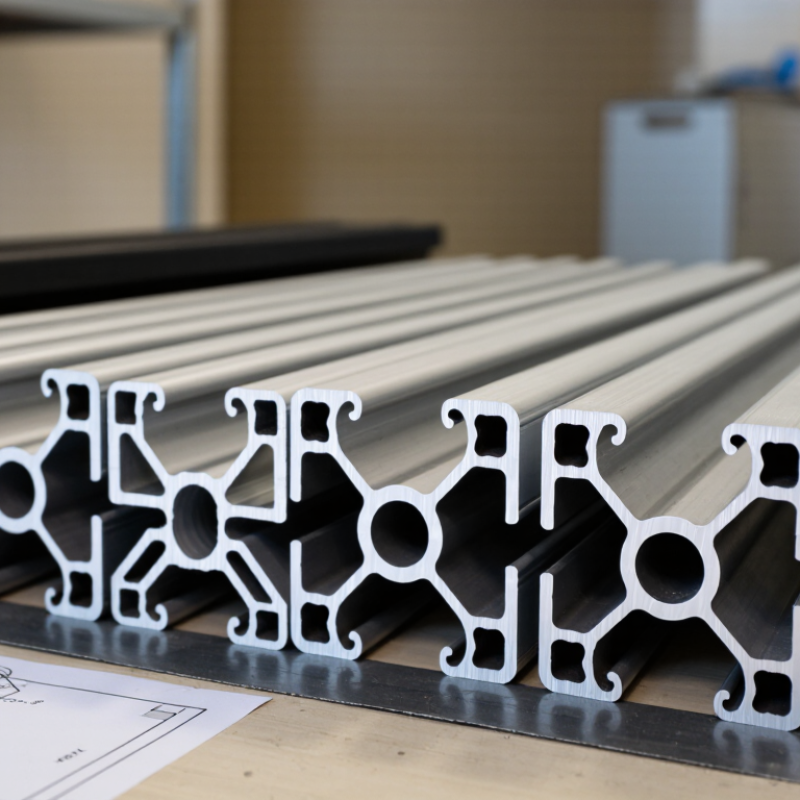
An aluminum profile is an extruded section that forms the perimeter frame of a solar panel module. It holds the glass, encapsulated cells, and backsheet together as a rigid assembly. Its shape is engineered, not decorative. A narrow lip supports the module edge, while grooves can connect clamps and mounting rails. Some profiles also include channels that help water drain rather than collect around the glass. Small details matter.
The frame helps transfer wind and handling loads from the module to its mounting points, while protecting vulnerable edges during transport and installation. IRENA’s Renewable Capacity Statistics 2024 reports 1,419 GW of solar capacity worldwide at the end of 2023, showing how widely these components are used. The International Aluminium Institute reports that recycling aluminum uses about 95% less energy than producing primary aluminum. That is relevant when selecting frame material, though recyclability alone does not guarantee responsible sourcing or recovery. In practice, a tidy-looking profile can still fit poorly if its dimensions do not match the module and clamps. Exact fit, drainage, and secure fastening deserve close checks.
A solar frame profile is an extruded rail that supports a panel’s edges and connects it to a mounting system. Many profiles use 6000-series aluminum alloys, commonly 6063, which combine magnesium and silicon for strength and corrosion resistance. Extrusion forms precise grooves and channels for glass, seals, and fasteners.
The Aluminum Association’s Aluminum Design Manual gives aluminum an elastic modulus of about 10,000 ksi, or 69 GPa—roughly one-third that of steel. Geometry matters. A well-shaped hollow section can provide stiffness without excessive weight, but thin walls still need careful design around clamps and screw points.
Aluminum’s density is about 2.7 g/cm³, making it practical for rooftop handling. Its natural oxide layer helps resist corrosion; anodizing or coating can add surface protection, though cut edges and drainage details still deserve attention.
The International Aluminium Institute reports that recycling aluminum uses about 5% of the energy required for primary production. That is a meaningful material advantage, not a substitute for checking recycled content and product quality.
Thermal movement also matters: aluminum expands about 23 micrometers per meter per degree Celsius. Long rails can shift with temperature, so joints and mounting slots need room to accommodate movement. It is easy to overlook.
An aluminum profile for a solar panel frame begins as a cross-section designed around the module’s size, edge thickness, and mounting needs. Engineers consider how the frame will support the panel while leaving room for corner keys, clamps, and drainage. Small details matter. A narrow channel can hold the glass securely, but it must not create a pocket where water collects. The profile also needs enough strength without adding unnecessary weight.
Manufacturing commonly starts by heating an aluminum billet and pressing it through a shaped steel die. The emerging profile is cooled, stretched to reduce distortion, and cut into specified lengths. Heat treatment can improve strength, while machining adds features such as screw slots or drainage holes. Surface finishing, including anodizing, helps protect the metal from weather exposure. Each stage needs checks for dimensions, straightness, and surface defects. A frame can look precise and still fit poorly if its corner cuts are inconsistent. That part deserves attention. Even a well-designed profile involves trade-offs between strength, cost, and ease of assembly; tolerances that work in a drawing may need adjustment after real production runs.
An aluminum profile gives a solar panel a firm perimeter and a defined place to connect with its mounting system. Its shaped channels hold the panel edges, while clamps help keep the module seated under changing wind and snow loads. A straight, well-fitted frame also reduces uneven pressure on the glass and laminate. Small details matter.
Profiles help protect vulnerable panel edges from knocks during handling and installation. Their raised lips can limit direct contact with nearby surfaces, but they are not a complete barrier against water or impact. Seals, drainage paths, and careful assembly also matter. If water becomes trapped in a channel, corrosion or freeze damage may follow, especially where coatings are scratched. A frame protects best when its design and installation work together.
Aluminum is light relative to many structural metals, and it can be formed into stiff sections with useful mounting grooves. Those grooves let installers position clamps and fasteners without drilling through the panel itself. Yet the frame must allow for thermal movement; aluminum expands as temperatures rise. Tightening every fastener as much as possible is not always wise. Correct clearances, compatible hardware, and specified torque help prevent stress on the module. Even a robust profile cannot compensate for a poorly supported rack or careless handling.
Solar-panel frame profiles commonly use a standard box section, a slimline section, or a reinforced section. Standard profiles suit many conventional modules, while slimline designs reduce frame weight and material use. Reinforced profiles provide more section depth where module dimensions or project load requirements call for added stiffness. The choice is not purely visual. A deeper channel can improve support, but it may add weight and cost.
Check the module maker’s clamp zones, frame dimensions, and tested wind and snow loads before specifying an extrusion. Anodized surfaces can help resist weathering, but coating quality and drainage details matter too. Small errors show up at the corners. The IEA PVPS Trends in Photovoltaic Applications 2024 report puts global cumulative solar capacity above 1.6 terawatts at the end of 2023, underscoring the scale of frame demand. The International Aluminium Institute reports that about 75% of all aluminium ever produced remains in use, a useful reminder to consider recycled content and end-of-life recovery. Still, recycled content alone does not guarantee a suitable profile; alloy, temper, wall thickness, and fabrication quality also affect performance. I would verify the actual load data rather than assume a heavier frame is automatically safer.
„Thanks to the LUVIR technology, the solder resist process could be switched directly from the previously used mask exposure to direct exposure. As an outstanding digital solution on the market, this technology has been able to demonstrate fast process times and superior quality on our certified conventional ink in production. This allowed us to fully digitize the solder mask process at low cost – without process or ink adjustments. An excellent benefit to our production in Rot am See.“
Ralf Göhringer (Head of Production WE Rot am See)
I would definitely recommend the Limata machine and team for a future company purchase
Michael Greenaway
Compunetics Inc.
“The Limata ldi has been amazing!! Best thing we did was buy this machine”
Richard Brady
GM
Circuitlabs
“Since 2019, we have been running the Limata X1000 LDI system (including LUVIR for solder mask imaging) in daily production as an addition to our current process with film. The machine was capable of properly exposing Taiyo PSR-4000 BN (DI) solder mask types on normal to high-copper boards using a new and unique direct imaging process. The machine operating interface is very user friendly which allowed for a quick technical training curve. The pre-registration processing reduced several seconds of production time at every print. Limata support and service staff is incomparable. They supported our team every step of the way at basically any time of the day or night, with literally, an immediate response time, customizing the software interface to best fit our Operations and needs.
We have exposed more than 8,000 prints since end of October, on various solder mask colors and some resist film panels. Limata, has proven to be very capable and innovative. They are a strong contender in the industry.
We have very much enjoyed this project, and working with the team!
Thank you Limata for the continued support and being a part of our growth.”
Bill Sezate
Vice President, GM
Summit Interconnect
As a replacement to our current contact exposure process with film, the LIMATA X2000 system including LUVIR-Technology was capable of properly exposing non-LDI solder mask types using a direct imaging process. The machine offers cutting edge software with a very intuitive operating interface which allowed for quick technician training curve. The dual drawer system combined with pre-registration processing reduced several seconds of production time at every machine cycle. Limata support and service staff is world class. They added software patches to keep production running at shortest possible response times, customized the software interface to best fit our in-house Operations system, and even wrote a step-by-step machine processing manual. As a result of the project, we have exposed more than 16,000 times on various product types and solder mask brands/colors. Limata, in a very short timeframe as a company, has definitely shown they are truly innovative and will be challenging the industry of direct imaging for the top spot.
Kevin Beattie
Process Engineer
TTM Technologies
Forest Grove Division