An Automatic Water Spray Retort Steam system is a batch-processing vessel designed to heat sealed products with circulating hot water. Steam usually supplies the heat, while spray nozzles distribute water across baskets of cans, jars, or flexible pouches. The goal is controlled heating—not simply a rising temperature display.
Inside the chamber, pumps keep the water moving over the packages. Sensors track temperature and pressure, while the programmed cycle manages heating, holding, and cooling. Small details matter. Basket loading, package size, and spray coverage can affect how evenly heat reaches the product. Dr. Juming Tang, a food-engineering researcher known for work on thermal processing, offers a relevant principle in paraphrase: a target temperature alone does not establish that every package received the intended treatment. The process must be validated for the specific product, container, and operating conditions.
This guide explains how the retort works, which components shape performance, and what operators should monitor during a cycle. It also considers the practical limits. A clean-looking control screen cannot replace careful calibration, sound records, or qualified process review. And a perfectly timed cycle may still deserve a second look if loading patterns change. Automatic control helps make operation repeatable; it does not remove the need for judgment.
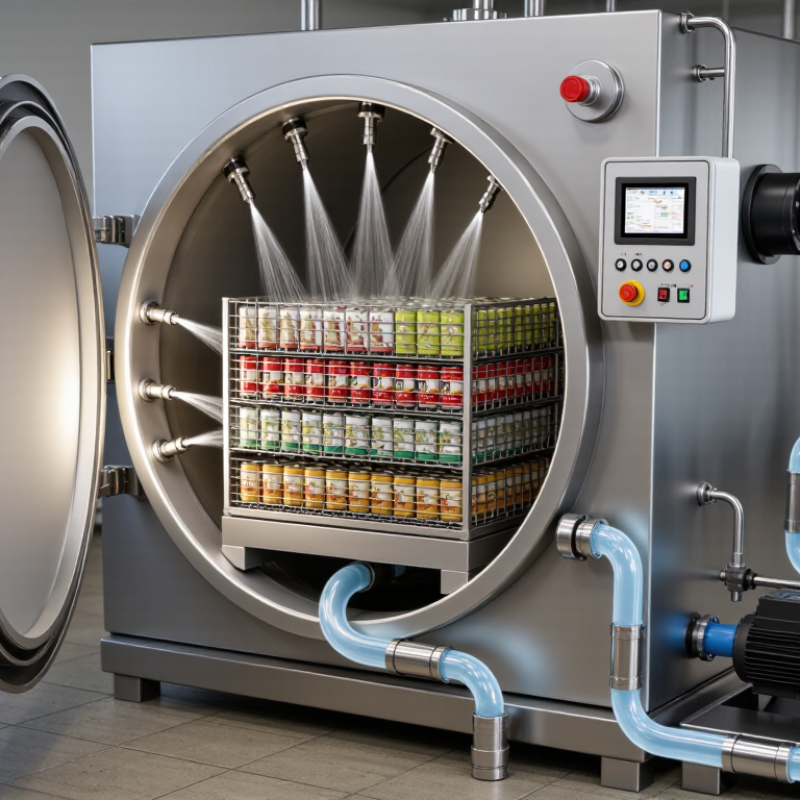
What Is an Automatic Water Spray Steam Retort?
An automatic water spray steam retort is a sealed vessel that heats packaged food with steam and circulating water. Steam supplies heat, while spray nozzles distribute hot water over containers such as cans, jars, or suitable pouches. Sensors and programmed controls manage temperature, pressure, and processing time. The goal is consistent heat treatment across the load.
Its purpose is to achieve commercial sterility: controlling microorganisms that could make food unsafe or spoil during normal storage. The exact process depends on the food, package size, container material, and how containers are arranged. A validated schedule matters. Automation can repeat settings, but it cannot correct a poorly developed process or blocked water circulation. Small details count. Operators should review records and check equipment performance; relying on a screen alone is not enough.
Tips: Confirm that packages are rated for retort conditions, and load them as specified. Watch for damaged seals, unusual pressure changes, or uneven spray patterns. When results seem inconsistent, pause and investigate rather than assuming the next cycle will fix the problem.
A retort is a pressure vessel used to heat-se process sealed containers. In a water-spray system, heated water is circulated over the containers while automatic controls regulate the process conditions.
Why temperature control matters: Thermal lethality rises rapidly with temperature. The chart shows relative lethality rates calculated using a 121.1°C reference temperature and an assumed z-value of 10°C. These are comparative values, not a retort schedule or a guarantee of product safety; validated processing conditions depend on the product, container, and process authority.
An automatic water spray steam retort uses heated water to transfer heat evenly to sealed food containers. Inside the pressure vessel, spray headers and nozzles distribute hot water over each basket. A circulation pump keeps the flow moving; blocked nozzles or uneven loading can still create cold spots. Small details matter.
Steam heats the circulating water through a heat exchanger or controlled injection system. Temperature sensors feed readings to the control system, which manages heating, holding, cooling, and valve sequences. Compressed air helps maintain pressure during processing and cooling, reducing the risk of package swelling or damage. The vessel door, seals, and safety interlocks contain pressure and prevent operation when conditions are unsafe.
Measurement needs careful attention. The U.S. FDA’s Low-Acid Canned Foods rule, 21 CFR 113.40, specifies accuracy within 1°F (about 0.6°C) for mercury-in-glass temperature-indicating devices. Under 21 CFR 113.83, a qualified person must establish the scheduled process for each product and container. A stable display alone is not proof of uniform heating. Operators still need to verify sensor placement, water circulation, and load arrangement. That check is easy to underestimate.
An automatic water spray steam retort processes sealed foods through controlled heating, holding, and cooling. Operators load pouches, trays, or cans into baskets, then close the vessel. Heated water sprays over the packages while steam and air help maintain temperature and pressure. The overpressure helps protect flexible packs from swelling or splitting.
Small details matter.
The controller tracks temperature and pressure throughout the cycle. It also manages heating and cooling, though the product’s coldest point may heat more slowly than the surrounding water. Package thickness, food texture, and basket loading can all affect heat transfer.
Holdsworth and Simpson’s Thermal Processing of Packaged Foods describes F₀ using a reference temperature of 121.1°C and a z-value of 10°C. This is a measurement convention, not a universal time-and-temperature recipe. Each product and package needs a validated scheduled process. FDA rules in 21 CFR Part 113 require documented controls for low-acid canned foods.
Still, the cycle is not perfectly uniform. A clean-looking pouch cannot show whether its cold spot received adequate treatment; process records and validation provide stronger evidence.
An automatic water spray steam retort uses heated water droplets to transfer heat to sealed containers while steam helps control the chamber environment. Its performance depends on more than reaching a target temperature. The spray must cover the load evenly, and the temperature sensor must represent conditions inside the retort. Small details matter.
Temperature, pressure, and timing work together. A programmed cycle typically heats the chamber, holds the validated process temperature, then cools the load under controlled pressure. Pressure helps protect flexible pouches and other containers from excessive expansion or damage. A sudden pressure change can be a warning, not just a number on the screen. Operators should compare readings with approved process limits and investigate unusual patterns.
Load arrangement affects water flow. Crowded baskets or blocked spray nozzles can create uneven heating, even when the display looks steady. That sounds simple. It isn’t. Routine checks of sensors, valves, spray coverage, and recording systems support reliable control. Each product and container combination needs a process established and reviewed by qualified specialists; one setting cannot safely fit every load. Keep process records clear, and treat unexplained deviations seriously. A neat trend line can still hide a problem.
An automatic water spray steam retort uses controlled heat, water spray, and steam to process sealed food packages. The system circulates hot water across the load while regulating temperature and pressure. Sensors and programmed controls help maintain repeatable conditions throughout each cycle.
Common applications include canned vegetables, ready meals, soups, sauces, and foods packed in pouches or trays. These packages can be sensitive to uneven heating or pressure changes. Careful control helps protect seals and product texture. It also supports consistent processing across different package sizes, provided the retort is properly configured.
The key benefits are uniform heat distribution, reduced manual handling, and reliable cycle records. Operators can monitor temperatures and pressure from a control panel instead of making frequent adjustments by hand. This can improve production consistency. Still, automation is not a substitute for a validated process. Product formulation, package shape, and load arrangement all affect heat transfer. That detail matters. A poorly arranged basket may create cold spots, even when the screen shows the target temperature. Routine calibration, maintenance, and process review remain essential. It is not magic, but it can make demanding thermal processing easier to manage.
„Thanks to the LUVIR technology, the solder resist process could be switched directly from the previously used mask exposure to direct exposure. As an outstanding digital solution on the market, this technology has been able to demonstrate fast process times and superior quality on our certified conventional ink in production. This allowed us to fully digitize the solder mask process at low cost – without process or ink adjustments. An excellent benefit to our production in Rot am See.“
Ralf Göhringer (Head of Production WE Rot am See)
I would definitely recommend the Limata machine and team for a future company purchase
Michael Greenaway
Compunetics Inc.
“The Limata ldi has been amazing!! Best thing we did was buy this machine”
Richard Brady
GM
Circuitlabs
“Since 2019, we have been running the Limata X1000 LDI system (including LUVIR for solder mask imaging) in daily production as an addition to our current process with film. The machine was capable of properly exposing Taiyo PSR-4000 BN (DI) solder mask types on normal to high-copper boards using a new and unique direct imaging process. The machine operating interface is very user friendly which allowed for a quick technical training curve. The pre-registration processing reduced several seconds of production time at every print. Limata support and service staff is incomparable. They supported our team every step of the way at basically any time of the day or night, with literally, an immediate response time, customizing the software interface to best fit our Operations and needs.
We have exposed more than 8,000 prints since end of October, on various solder mask colors and some resist film panels. Limata, has proven to be very capable and innovative. They are a strong contender in the industry.
We have very much enjoyed this project, and working with the team!
Thank you Limata for the continued support and being a part of our growth.”
Bill Sezate
Vice President, GM
Summit Interconnect
As a replacement to our current contact exposure process with film, the LIMATA X2000 system including LUVIR-Technology was capable of properly exposing non-LDI solder mask types using a direct imaging process. The machine offers cutting edge software with a very intuitive operating interface which allowed for quick technician training curve. The dual drawer system combined with pre-registration processing reduced several seconds of production time at every machine cycle. Limata support and service staff is world class. They added software patches to keep production running at shortest possible response times, customized the software interface to best fit our in-house Operations system, and even wrote a step-by-step machine processing manual. As a result of the project, we have exposed more than 16,000 times on various product types and solder mask brands/colors. Limata, in a very short timeframe as a company, has definitely shown they are truly innovative and will be challenging the industry of direct imaging for the top spot.
Kevin Beattie
Process Engineer
TTM Technologies
Forest Grove Division