Choosing a Bath Waste Push Button supplier involves more than comparing polished product photos. The button must work smoothly with its waste mechanism, fit the basin or bathtub design, and tolerate repeated daily use. Small details matter: a loose cable, rough plating, or unclear installation instructions can turn a neat bathroom fixture into a frustrating repair.
This guide introduces ten manufacturers in China and considers practical factors buyers can investigate, including product range, material options, customization, manufacturing experience, and quality-control practices. Some suppliers may offer stainless-steel or brass components, multiple finishes, and OEM services. These details should be confirmed directly, not assumed from a catalogue. Ask for drawings, samples, compatibility information, and clear descriptions of inspection procedures. Test the button with the intended drain assembly before placing a large order. It is a simple step, but easy to skip.
The list is a starting point, not a certified ranking or a guarantee of performance. Company capabilities, lead times, and product specifications can change. A supplier that suits one project may not suit another. Even a convincing sample cannot answer every question about long-term wear. Buyers should check references where possible and agree on specifications in writing. There is no perfect shortcut. Careful comparison helps reveal which manufacturers communicate clearly and can support the requirements of a real bathroom project.
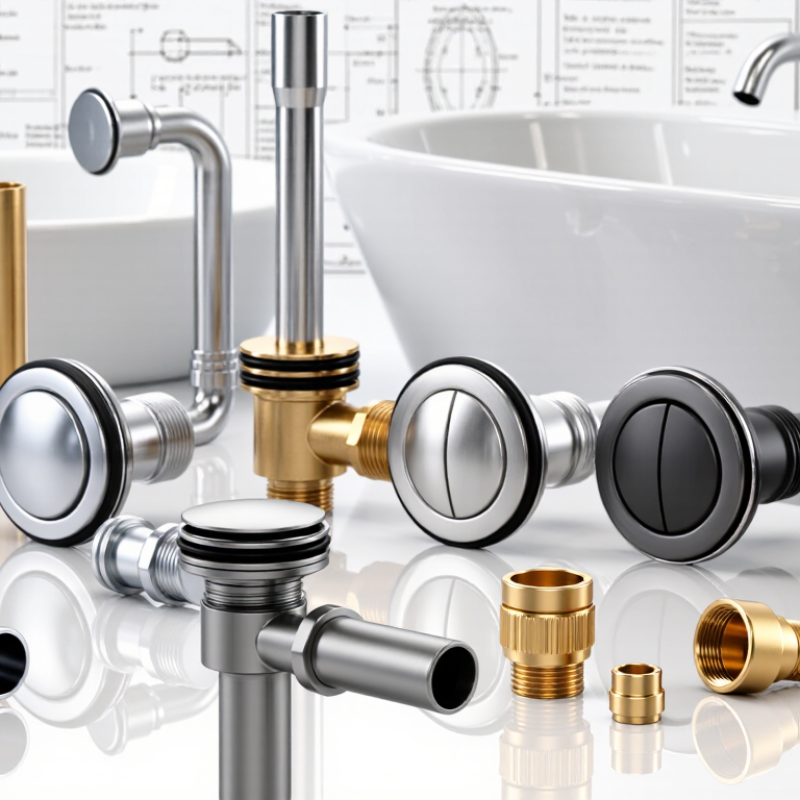
A bath waste push button is only the visible part of a working assembly. Beneath the cap, a spindle or cable transfers movement to the waste plug, while seals help contain water around the drain. Some designs also connect the button to an overflow mechanism. Small parts matter. A cap may be made from stainless steel, brass, zinc alloy, or plated materials; the internal linkage and seals often use different materials. Check that finishes resist bathroom moisture and that moving parts operate smoothly after repeated use. A shiny surface alone proves little.
EN 274-1 sets requirements and test methods for waste fittings used with sanitary appliances. It is relevant to the waste assembly, not simply a button’s appearance. Buyers should review product specifications, applicable test evidence, dimensions, and installation instructions against the standard’s current edition and the intended application. A button that feels firm in a sample may still bind after installation if the cable is misaligned. Fit is not cosmetic. There is no universal “best” material: water conditions, cleaning products, finish quality, and maintenance all affect service life. And even careful testing cannot replace correct installation.
Technical comparison framework: the ten entries below are product and supplier evaluation criteria, not ranked companies or claims about specific manufacturers. Confirm applicable requirements against the current edition of the standard and the product’s intended market.
| No. | Evaluation area | Common components or materials | Practical checks | EN 274-1 relevance |
|---|---|---|---|---|
| 1 | Push-button cap | Chrome-plated brass, stainless steel, or moulded engineering plastic | Check finish consistency, corrosion resistance, fit, and ease of cleaning. | Assess as part of the waste fitting’s materials, construction, and overall performance. |
| 2 | Actuator and spindle | Brass, stainless steel, or suitable polymer components | Check smooth movement, secure engagement, alignment, and repeatable opening and closing. | Verify the assembled fitting meets applicable functional requirements and test methods. |
| 3 | Spring mechanism | Typically stainless steel; exact grade depends on design and service conditions | Check return action, resistance to corrosion, and function over repeated operation. | Performance is assessed for the fitting as a whole; do not assume a particular spring grade is mandated. |
| 4 | Waste body and outlet connection | Brass, stainless steel, or suitable plastics, depending on construction | Check connection dimensions, compatibility with the bath and trap, and installation access. A 1½-inch connection is common but not universal. | Dimensional and functional conformity should be assessed against the applicable requirements and product configuration. |
| 5 | Sealing washers and gaskets | EPDM and other suitable elastomers are commonly used | Check sealing surfaces, compression, material compatibility, and leakage after installation. | Leak-tight performance should be verified using the relevant standard test provisions. |
| 6 | Overflow linkage and connection | Metal or polymer linkage, with seals and connecting fittings as required by the design | Check compatibility with the bath’s overflow position, routing, and available installation space. | Evaluate the complete waste assembly and its intended sanitary-appliance application. |
| 7 | Surface finish and corrosion protection | Chrome plating, polished stainless steel, or other specified finishes | Request finish specifications and inspect for peeling, pitting, visible defects, and cleaning compatibility. | Confirm material and product performance using the applicable requirements; a decorative finish alone does not establish conformity. |
| 8 | Flow and drainage behaviour | Determined by the outlet, plug, passage geometry, and connected plumbing | Check drainage in the assembled installation and ensure the plug opens fully. | Use the applicable EN 274 test provisions and specified conditions rather than relying on an unsupported flow claim. |
| 9 | Product testing and documentation | Test reports, drawings, material information, and installation instructions | Confirm that documents identify the tested model and configuration and are issued by a suitably qualified laboratory or organization. | EN 274-1 sets product requirements; EN 274-2 covers test methods. Check the editions and national adoption applicable to the project. |
| 10 | Quality control and traceability | Batch records, inspection plans, and production identification | Ask how incoming materials, assembly, sealing, and finished-product checks are recorded. | Quality-control evidence supports consistent production; it is distinct from proof that a specific product meets requirements. |
Note: EN 274-1 addresses requirements for waste fittings for sanitary appliances. Material choices listed here are common examples, not a complete or mandatory material specification; verify suitability, dimensions, and conformity for the exact product and market.
China’s bath-waste push-button suppliers vary widely in product range and factory capacity. Some focus on plastic or brass buttons; others supply complete waste assemblies, overflow covers, seals, and replacement parts. Factory scale is best judged through verifiable details: production lines, monthly capacity, inspection records, and lead times. A large showroom is not proof of high output. Details matter.
Export figures need careful reading. China’s General Administration of Customs reported goods exports of RMB 25.45 trillion in 2024, up 7.1% year on year. That is national context, not bath-waste sales. UN Comtrade and customs classifications may group related plumbing components under broader product categories, so public data rarely provides a clean push-button waste total. Ask suppliers for recent shipment records, destination markets, and product-specific documentation. Cross-check dates and quantities where possible. A polished catalog can still leave gaps.
Tips: Request samples from current production, not only display stock. Compare button finish, thread fit, gasket thickness, and drainage performance. Ask for the factory’s monthly output and export share, then confirm whether figures cover this product line or the whole plant. Some records may be incomplete; note that uncertainty before comparing suppliers.
China’s total merchandise exports, 2020–2024 (trillion yuan)
Exports rose from 17.93 trillion yuan in 2020 to 25.45 trillion yuan in 2024. These national merchandise-export figures provide broad trade context; they do not isolate bath wastes, plumbing products, or individual manufacturers. Source: General Administration of Customs of China.
A push-button bath waste uses a linkage to lift or lower a plug. Press once to seal the outlet; press again to release water into the waste pipe. Drainage depends on the outlet opening, pipe slope, and flow rate—not the button alone. A slow drain can point to a restricted pipe or a plug that does not lift fully. The EN 274-1 and EN 274-2 standards specify requirements and test methods for sanitary-appliance waste fittings, including checks relevant to function and leakage.
For manufacturer comparisons, record flow rate, drain-down time, and leakage under stated test conditions. Cycle tests add useful evidence: log button force and sealing performance before and after repeated operation. A buyer-set 10,000-cycle test can serve as a comparison target, but it should not be presented as a universal standard requirement. Small differences in linkage adjustment can change the result. That detail is easy to miss.
Tips: Test with the waste installed in a real bath setup, not only on a bench. Check for leaks beneath the outlet after cycling, and note any change in button feel. A clean pass matters. Still, test conditions should be reported clearly; otherwise, the numbers may look precise without being comparable.
When comparing bath waste push button manufacturers in China, material specifications matter more than polished product photos. Brass bodies feel substantial and tolerate repeated handling, but buyers should confirm alloy grade, wall thickness, and plating process. A bright finish can hide thin plating. Ask for corrosion-test details and samples before approving a large order.
Stainless steel offers a different balance. Grade 304 is common for bathroom fittings, while 316 may suit harsher, chloride-rich conditions; neither grade guarantees performance if welds or surface finishing are poor. Check the button’s return action, drain compatibility, and exposed fasteners. Small parts matter.
Polymer components, often made from ABS or polypropylene, can reduce weight and cost. Their suitability depends on resin quality, temperature exposure, and how securely the button joins the waste mechanism. Request material declarations and dimensional drawings, then compare them with a physical sample. Catalog descriptions can be vague, and I would not treat “stainless” or “brass” alone as proof of quality. Fit can disappoint. Ask manufacturers how they inspect button travel, thread alignment, and finish consistency across production batches.
When evaluating bath waste push button manufacturers in China, request EN 274-2 test reports for the exact waste assembly you plan to buy. Check the report date, tested configuration, and applicable clauses; a document for a similar model may not cover different seals or materials. Ask who performed the testing and whether the sample came from regular production. Not enough. A certificate alone cannot show how consistently each batch is made.
Request flow-rate results with the test conditions clearly stated. The outlet size, trap, pipework, and water head can change the measured result. Compare suppliers only when their setups are comparable, and ask for raw data if the headline figure seems unusually high. A useful supplier will explain the limits, not just quote one number. That detail matters during installation.
For corrosion, confirm the base material, surface finish, test method, and exposure duration. Ask for before-and-after photos, especially around the button, drain opening, and joints. A salt-spray result can help compare finishes, but it does not predict years of bathroom use exactly. Read warranty terms closely: duration, covered parts, labor, exclusions, spare-part availability, and claim steps should be written down. Vague promises are difficult to rely on when a button sticks or the finish begins to peel.
„Thanks to the LUVIR technology, the solder resist process could be switched directly from the previously used mask exposure to direct exposure. As an outstanding digital solution on the market, this technology has been able to demonstrate fast process times and superior quality on our certified conventional ink in production. This allowed us to fully digitize the solder mask process at low cost – without process or ink adjustments. An excellent benefit to our production in Rot am See.“
Ralf Göhringer (Head of Production WE Rot am See)
I would definitely recommend the Limata machine and team for a future company purchase
Michael Greenaway
Compunetics Inc.
“The Limata ldi has been amazing!! Best thing we did was buy this machine”
Richard Brady
GM
Circuitlabs
“Since 2019, we have been running the Limata X1000 LDI system (including LUVIR for solder mask imaging) in daily production as an addition to our current process with film. The machine was capable of properly exposing Taiyo PSR-4000 BN (DI) solder mask types on normal to high-copper boards using a new and unique direct imaging process. The machine operating interface is very user friendly which allowed for a quick technical training curve. The pre-registration processing reduced several seconds of production time at every print. Limata support and service staff is incomparable. They supported our team every step of the way at basically any time of the day or night, with literally, an immediate response time, customizing the software interface to best fit our Operations and needs.
We have exposed more than 8,000 prints since end of October, on various solder mask colors and some resist film panels. Limata, has proven to be very capable and innovative. They are a strong contender in the industry.
We have very much enjoyed this project, and working with the team!
Thank you Limata for the continued support and being a part of our growth.”
Bill Sezate
Vice President, GM
Summit Interconnect
As a replacement to our current contact exposure process with film, the LIMATA X2000 system including LUVIR-Technology was capable of properly exposing non-LDI solder mask types using a direct imaging process. The machine offers cutting edge software with a very intuitive operating interface which allowed for quick technician training curve. The dual drawer system combined with pre-registration processing reduced several seconds of production time at every machine cycle. Limata support and service staff is world class. They added software patches to keep production running at shortest possible response times, customized the software interface to best fit our in-house Operations system, and even wrote a step-by-step machine processing manual. As a result of the project, we have exposed more than 16,000 times on various product types and solder mask brands/colors. Limata, in a very short timeframe as a company, has definitely shown they are truly innovative and will be challenging the industry of direct imaging for the top spot.
Kevin Beattie
Process Engineer
TTM Technologies
Forest Grove Division
