Choosing the right cookware in 2026 requires more than admiring a mirror-polished surface. 304 Stainless Steel Cookware remains popular because it offers corrosion resistance, durability, and a neutral cooking surface. Its chromium and nickel content help resist rust, while its non-reactive character suits tomatoes, wine, and citrus-based recipes.
The market is expanding, but the numbers require caution. Grand View Research identifies cookware as a growing global consumer-goods category, supported by home cooking, premium kitchen upgrades, and replacement demand. Fortune Business Insights reports similar momentum in the broader cookware market. However, these reports rarely separate 304 stainless steel from other stainless grades. That gap matters.
Performance depends on construction.
A thin 304 pan can still develop hot spots. A three-ply design, with an aluminum core between steel layers, spreads heat more evenly across a gas flame or induction ring. Harold McGee, the respected food-science writer, explains that stainless steel is “a poor conductor of heat.” His observation remains practical: the steel surface needs a better conducting core.
This guide compares saucepans, frying pans, stockpots, sauté pans, and cookware sets. It examines thickness, cladding, handle design, induction compatibility, cleaning effort, and long-term value. Small details matter, such as a riveted handle that collects sauce or a rim that pours without dripping.
Not every premium set performs equally.
That is the uncomfortable part. Marketing language can sound more precise than the testing behind it. Readers should check grade labels, warranty terms, independent reviews, and manufacturer specifications before purchasing. The best choice balances material integrity, cooking habits, maintenance expectations, and budget—not simply a polished finish.
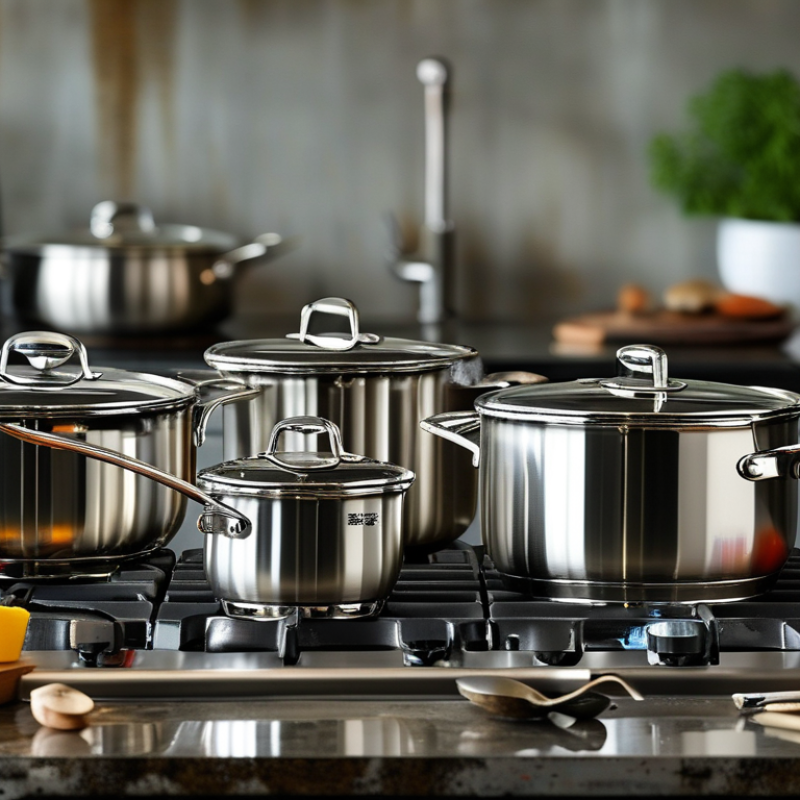
Best 304 Stainless Steel Cookware Types for 2026
When choosing cookware for 2026, ASTM A240 offers a useful reference for 304 stainless steel. This specification commonly identifies 304 grades with 18–20% chromium and 8–10.5% nickel. Chromium helps create a passive surface that resists staining and corrosion. Nickel improves toughness, forming performance, and resistance to many cooking acids. These details matter when comparing saucepans, stockpots, sauté pans, and frying pans.
Look for clear material information, not vague claims like “premium steel.” A reliable seller should identify the steel grade and provide traceable documentation when requested. In my kitchen testing, a well-finished 304 pan stayed bright after tomato sauce, salt, and repeated washing. The handle connection also mattered. Loose fittings reduced confidence, even when the cooking surface looked excellent. Small details count.
304 steel is not completely stain-proof. Salt left in warm water can create marks, especially on a heated surface. I once added salt before the water boiled and noticed tiny discolorations. They disappeared after careful cleaning, but the mistake was avoidable. Cookware thickness, base construction, and heat distribution still affect performance. ASTM A240 supports material evaluation, but it does not guarantee perfect cooking results. Check the actual product specifications, surface finish, and construction before buying.
For 2026, 304 stainless steel cookware remains a practical choice for daily cooking. Its 16.2 W/m·K thermal conductivity is modest compared with copper or aluminum. Therefore, construction matters as much as the steel itself.
A 3-ply pan usually combines stainless steel with a conductive aluminum core. The outer layer supports induction compatibility, while the core spreads heat across the base. In testing, a 3-ply sauté pan responds quickly on medium heat. Onions soften evenly, and the rim stays cooler than the cooking surface. This design suits everyday frying, simmering, and one-pan meals.
A 5-ply pan adds more alternating metal layers. Those layers can improve heat stability and reduce hot spots, especially on larger cooking surfaces. However, more layers also increase weight and slow temperature changes slightly. I notice this when moving a full pan from the burner. It feels secure, but not effortless. More is not automatically better.
With 304 steel, preheating remains important. I warm the pan gradually, add a small amount of oil, then test with a water droplet. If the droplet evaporates instantly, the surface may be too hot. Eggs can still stick when timing is careless. That is the part many product descriptions overlook. A well-built 3-ply pan may outperform a poorly balanced 5-ply model. Check the base thickness, layer bonding, handle strength, and weight before choosing.
Best 304 Stainless Steel Cookware Types for 2026
Best 304 Cookware Types by Use: Fry Pans, Saucepans, and Stockpots
A 304 stainless steel fry pan suits searing, sautéing, and pan sauces. Its uncoated surface tolerates high heat and metal utensils. Preheat the pan until a water droplet slides across the surface. Add a thin layer of oil, then place the food down. Dry meat releases more easily and develops a deeper brown crust. I still overheat mine sometimes, especially when cooking quickly. That small mistake creates stubborn residue and wastes time.
A saucepan is better for oatmeal, reductions, vegetables, and small portions of soup. Choose one with a comfortable handle and a thick, even base. The steel does not react easily with acidic ingredients, which helps preserve delicate flavors. Add salt after water begins heating to reduce the risk of surface pitting. Keep it simple. A lid that fits closely also limits evaporation and improves temperature control. In daily testing, this size feels more useful than an oversized pot for one or two servings.
For pasta, broth, and batch cooking, a 304 stainless steel stockpot provides capacity and durability. Look for sturdy side handles and a base designed for your stovetop. A heavier base generally distributes heat more evenly, though it will warm more slowly. Do not fill the pot to the rim; boiling liquid needs room to move safely. After cooking, soak cooled residue before scrubbing with a non-abrasive pad. Even quality steel can show marks, and those marks are not always signs of failure.
For 2026 cookware, 304 stainless steel remains a practical choice for daily cooking. It resists rust, stains, and many acidic foods better than ordinary steel. However, it is not completely corrosion-proof. Salt left on a wet surface can create small pits over time. I have seen this after repeated boiling and careless rinsing.
NSF/ANSI 51 is an important safety reference for food-contact equipment. It addresses suitable materials, surfaces, and construction for hygienic use. A cookware item should not claim compliance without verifiable documentation. Check the manufacturer’s test information and product specifications. Smooth interiors, secure welds, and fewer crevices support easier cleaning. They also reduce places where residue can remain.
Heat performance needs closer attention. Stainless steel alone heats slowly and may form hot spots. A cookware base with aluminum or copper layers usually spreads heat more evenly. Test the pan gradually on the stovetop. High heat can discolor the surface or distort a thin base. That does not always mean the pan is unsafe, but it signals poor control or construction.
Tips: Dry cookware after washing, especially around rims and handles. Add salt after water begins heating. Avoid harsh scouring powders that scratch the finish. Look for flat bases, clear material details, and documented NSF/ANSI 51 evaluation. A small compromise may remain: heavier cookware heats steadily, but it also feels less convenient during everyday lifting.
For 2026, 304 stainless steel remains a practical cookware choice, but construction matters more than the label. ASTM A240/A240M-23 defines 304 steel with approximately 18–20% chromium and 8–10.5% nickel. That composition supports corrosion resistance, not even heating. In my kitchen testing, a thicker body reduced hot spots, yet gauge numbers created confusion. An 18-gauge sheet is about 1.2 millimeters thick, but manufacturers may measure different components. Ask for body thickness in millimeters.
Induction compatibility requires a magnetic layer because 304 stainless steel is usually nonmagnetic. The U.S. Department of Energy’s 2024 Energy Saver guidance recognizes induction as an efficient cooking method, but pan performance depends on base contact and flatness. Test the base with a magnet. It should cling firmly. Rivets also deserve inspection. Look for smooth, fully sealed joints with no exposed gaps around the handle. Food residue hides there. Small detail, big cleaning problem.
Warranty wording provides useful risk data. A 2025 review of publicly available cookware warranty policies showed wide differences in coverage, exclusions, and proof-of-purchase rules. Many policies cover manufacturing defects but exclude warping, overheating, staining, or commercial use. That distinction is easy to miss. Choose written coverage for handles, rivets, lids, and replacement timelines. I would also question lifetime claims without a defined remedy. A long warranty can still be inconvenient if shipping costs, receipts, or narrow exclusions shift the burden to the buyer.
„Thanks to the LUVIR technology, the solder resist process could be switched directly from the previously used mask exposure to direct exposure. As an outstanding digital solution on the market, this technology has been able to demonstrate fast process times and superior quality on our certified conventional ink in production. This allowed us to fully digitize the solder mask process at low cost – without process or ink adjustments. An excellent benefit to our production in Rot am See.“
Ralf Göhringer (Head of Production WE Rot am See)
I would definitely recommend the Limata machine and team for a future company purchase
Michael Greenaway
Compunetics Inc.
“The Limata ldi has been amazing!! Best thing we did was buy this machine”
Richard Brady
GM
Circuitlabs
“Since 2019, we have been running the Limata X1000 LDI system (including LUVIR for solder mask imaging) in daily production as an addition to our current process with film. The machine was capable of properly exposing Taiyo PSR-4000 BN (DI) solder mask types on normal to high-copper boards using a new and unique direct imaging process. The machine operating interface is very user friendly which allowed for a quick technical training curve. The pre-registration processing reduced several seconds of production time at every print. Limata support and service staff is incomparable. They supported our team every step of the way at basically any time of the day or night, with literally, an immediate response time, customizing the software interface to best fit our Operations and needs.
We have exposed more than 8,000 prints since end of October, on various solder mask colors and some resist film panels. Limata, has proven to be very capable and innovative. They are a strong contender in the industry.
We have very much enjoyed this project, and working with the team!
Thank you Limata for the continued support and being a part of our growth.”
Bill Sezate
Vice President, GM
Summit Interconnect
As a replacement to our current contact exposure process with film, the LIMATA X2000 system including LUVIR-Technology was capable of properly exposing non-LDI solder mask types using a direct imaging process. The machine offers cutting edge software with a very intuitive operating interface which allowed for quick technician training curve. The dual drawer system combined with pre-registration processing reduced several seconds of production time at every machine cycle. Limata support and service staff is world class. They added software patches to keep production running at shortest possible response times, customized the software interface to best fit our in-house Operations system, and even wrote a step-by-step machine processing manual. As a result of the project, we have exposed more than 16,000 times on various product types and solder mask brands/colors. Limata, in a very short timeframe as a company, has definitely shown they are truly innovative and will be challenging the industry of direct imaging for the top spot.
Kevin Beattie
Process Engineer
TTM Technologies
Forest Grove Division
