Choosing the best Car Camera manufacturer in China takes more than comparing prices or counting features. Buyers need to assess image quality, low-light performance, heat resistance, firmware stability, and quality-control procedures. A camera may look impressive in a product photo. Its real test is a rainy night, a dim parking garage, or months of summer heat.
Grand View Research estimated the global dashboard camera market at approximately USD 3.8 billion in 2023 and projected continued growth through 2030. OICA reported 93.5 million motor vehicles produced worldwide in 2023. These figures show a large, active market, but they do not prove that any individual supplier is reliable. Factory audits, sample testing, warranty terms, and traceable component specifications still matter.
For a safety-focused perspective, the Insurance Institute for Highway Safety’s chief research officer, David Zuby, has studied vehicle visibility and crash prevention. A concise paraphrase of the principle behind this work is: “A camera earns its value through useful visibility, not a crowded specification sheet.” This is a paraphrase, not a verbatim quotation. The comparison that follows focuses on practical evidence: sensor and lens choices, recording consistency, manufacturing experience, certifications, and after-sales support. The strongest Chinese manufacturer is not necessarily the largest. It is the supplier that can document performance and deliver it consistently.
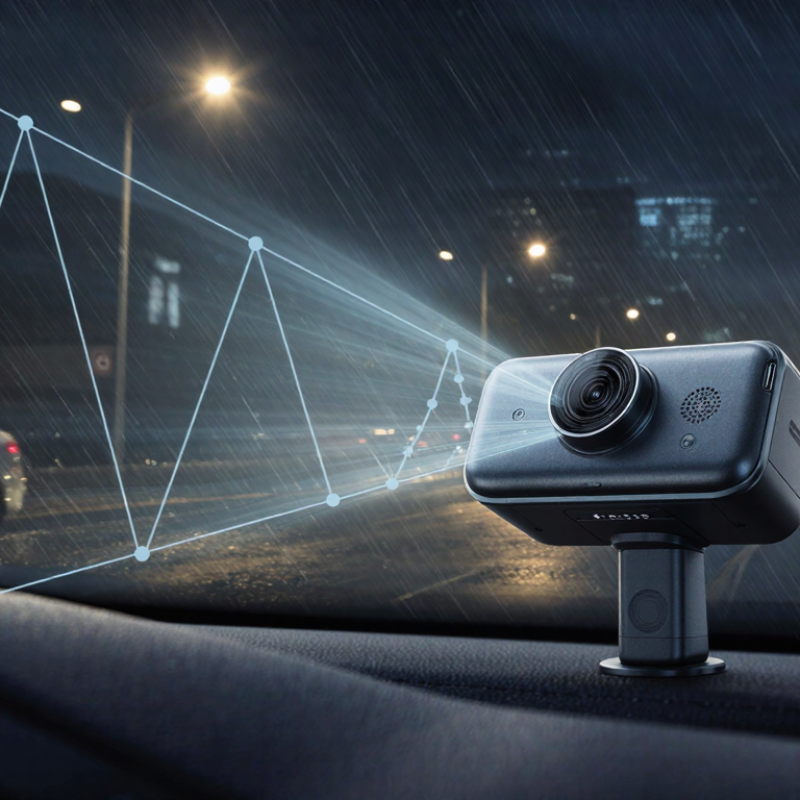
A car camera captures images through a small lens and converts them into digital video. Most systems use a CMOS image sensor and a processor that adjusts exposure, reduces noise, and compresses footage. The screen may show the image live, while a memory card stores recordings. Simple hardware, but the view can still be limited.
Different cameras serve different purposes. A dashboard camera records the road ahead, often in short looping clips. A rearview camera activates when reverse is selected, showing nearby obstacles on the vehicle display. Some dash cameras use a G-sensor to protect footage after a sudden impact. NHTSA’s rear-visibility rule requires covered new vehicles to show an area extending 10 feet behind and 20 feet wide. That helps explain why camera angle and screen placement matter.
The evidence is useful, though not perfect. IIHS’s 2014 analysis found rearview cameras were associated with a 17% reduction in backing-crash rates. Dirt, rain, glare, and darkness can still degrade the image. A camera also cannot show every approaching person or object. Drivers should treat it as an aid, not a replacement for mirrors and direct checks. It’s a small distinction with real consequences.
A quality car camera should capture useful evidence, not merely advertise a high resolution. In practical evaluations, clear footage depends on the sensor, lens, exposure control, and stable processing working together. Readable number plates matter, but only when lighting and distance allow. At night, balanced exposure can preserve details near bright headlights. Details matter.
A wide viewing angle helps cover adjacent lanes, yet an overly wide lens can distort objects at the edges. Look for consistent video, reliable loop recording, and a sensor that protects important clips during sudden movement. These features should work without confusing menus or frequent manual checks. Heat resistance is important in parked vehicles, where cabin temperatures can rise sharply. Storage should be easy to verify, and power connections should feel secure. Bigger numbers are not always better.
A careful buyer should test sample footage in daylight, shade, and low light. Check whether distant signs remain legible and whether motion looks smooth. Also consider mounting stability: a loose camera can produce shaky images on rough roads. Some specifications sound impressive but reveal little about real performance. I would weigh clear evidence and dependable operation more heavily than a long feature list. No camera performs perfectly in every condition.
China’s automotive scale creates a broad supplier base, but volume alone does not prove camera quality. The China Association of Automobile Manufacturers reported 30.16 million vehicles produced in 2023. That figure offers useful industry context, not a supplier ranking. Buyers should compare optical performance, manufacturing controls, and field reliability using consistent test conditions.
A practical evaluation begins with footage: Can the camera preserve readable detail in dim parking garages and handle glare from oncoming headlights? Check image stability, lens distortion, color accuracy, and performance after heat, vibration, and humidity testing. Request documented test results, component traceability, and failure-rate data across production batches. An IATF 16949 quality-management certificate can support an audit, but it does not replace product-level evidence. A clean laboratory score can still flatter a camera. Real roads differ. Sample size and test duration matter, too, and they are easy to overlook.
Tips: Request unedited day and night footage, plus test records for the exact camera model. Compare results under matching conditions, and ask how reported failures led to design changes.
China’s leading car-camera manufacturers are best understood as several groups, not a single ranked list. Automotive electronics suppliers often lead in complete camera systems, while specialist imaging companies contribute compact modules, lenses, and image-processing expertise. Some manufacturers focus on original-equipment programs; others produce aftermarket dash cameras. The right comparison depends on the intended vehicle and application.
Look for evidence of automotive-grade testing, stable image quality, and reliable production control. Ask how cameras perform in low light, glare, and rapid changes between bright sunlight and dark roads. Check temperature and vibration test records, lens alignment procedures, and traceability for critical components. A sharp sample image is useful, but it cannot prove consistent performance across thousands of units. Supplier documentation and customer references matter. They are easy to overlook.
Tips: Request sample footage from dawn, nighttime, and rainy conditions. Confirm the tested temperature range and warranty terms. Ask who handles calibration and software updates. Specifications can sound impressive; real testing sometimes tells a less tidy story.
China’s Car Camera Manufacturing Landscape
Annual vehicle production provides context for the scale of China’s automotive supply chain, but it is not a ranking of camera manufacturers or a measure of camera-module output. Figures are reported by the China Association of Automobile Manufacturers (CAAM).
When comparing Chinese car camera manufacturers, request the same evidence from each supplier. Ask for sample footage recorded in daylight, at night, and during sudden changes in brightness. Check whether road signs and nearby vehicles remain clear, not just whether the image looks sharp on a product page. Small details matter. Confirm the camera’s sensor, lens options, resolution, storage method, and operating temperature range. Then compare test reports and quality-control records, checking that they apply to the exact model you are evaluating. A polished factory presentation is useful, but it does not replace consistent production evidence.
Technical support deserves equal attention. Ask how the manufacturer tracks defects, updates firmware, and handles a camera that fails during a pilot run. A clear corrective-action report tells you more than a quick promise. Compare warranty terms, spare-part availability, sample costs, minimum order quantities, and realistic lead times. If possible, test several units in the same vehicle and note differences in focus, heat, and vibration performance. No comparison sheet is perfect; real installation conditions can still expose weaknesses. I would also pay attention to how openly a supplier discusses limitations, because that conversation is sometimes more revealing than the specification list.
„Thanks to the LUVIR technology, the solder resist process could be switched directly from the previously used mask exposure to direct exposure. As an outstanding digital solution on the market, this technology has been able to demonstrate fast process times and superior quality on our certified conventional ink in production. This allowed us to fully digitize the solder mask process at low cost – without process or ink adjustments. An excellent benefit to our production in Rot am See.“
Ralf Göhringer (Head of Production WE Rot am See)
I would definitely recommend the Limata machine and team for a future company purchase
Michael Greenaway
Compunetics Inc.
“The Limata ldi has been amazing!! Best thing we did was buy this machine”
Richard Brady
GM
Circuitlabs
“Since 2019, we have been running the Limata X1000 LDI system (including LUVIR for solder mask imaging) in daily production as an addition to our current process with film. The machine was capable of properly exposing Taiyo PSR-4000 BN (DI) solder mask types on normal to high-copper boards using a new and unique direct imaging process. The machine operating interface is very user friendly which allowed for a quick technical training curve. The pre-registration processing reduced several seconds of production time at every print. Limata support and service staff is incomparable. They supported our team every step of the way at basically any time of the day or night, with literally, an immediate response time, customizing the software interface to best fit our Operations and needs.
We have exposed more than 8,000 prints since end of October, on various solder mask colors and some resist film panels. Limata, has proven to be very capable and innovative. They are a strong contender in the industry.
We have very much enjoyed this project, and working with the team!
Thank you Limata for the continued support and being a part of our growth.”
Bill Sezate
Vice President, GM
Summit Interconnect
As a replacement to our current contact exposure process with film, the LIMATA X2000 system including LUVIR-Technology was capable of properly exposing non-LDI solder mask types using a direct imaging process. The machine offers cutting edge software with a very intuitive operating interface which allowed for quick technician training curve. The dual drawer system combined with pre-registration processing reduced several seconds of production time at every machine cycle. Limata support and service staff is world class. They added software patches to keep production running at shortest possible response times, customized the software interface to best fit our in-house Operations system, and even wrote a step-by-step machine processing manual. As a result of the project, we have exposed more than 16,000 times on various product types and solder mask brands/colors. Limata, in a very short timeframe as a company, has definitely shown they are truly innovative and will be challenging the industry of direct imaging for the top spot.
Kevin Beattie
Process Engineer
TTM Technologies
Forest Grove Division
