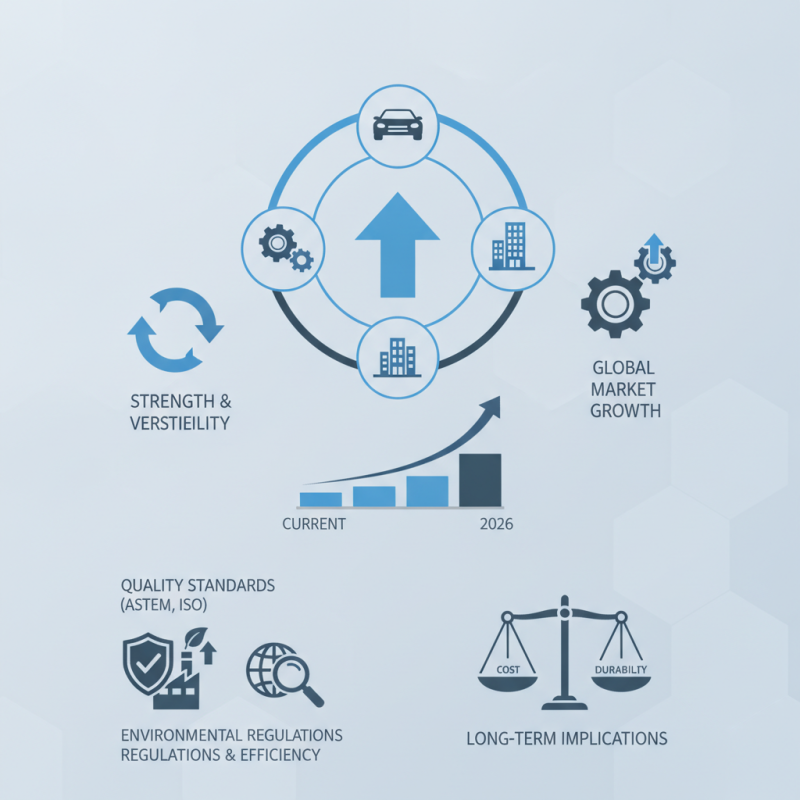
The demand for carbon alloy steel round bars continues to surge in various industries, driven by their strength and versatility. According to a recent market analysis, the global market for carbon alloy steel is projected to reach $250 billion by 2026, with an impressive CAGR of 4.5%. These materials are essential in sectors like construction, automotive, and manufacturing, offering superior mechanical properties and durability.
Key players in the market recognize the need for high-quality carbon alloy steel round bars. Industries increasingly rely on ASTM and ISO standards to ensure the reliability of these products. Notably, the disparity in specifications across regions can lead to inconsistencies in product quality. Also, many manufacturers face challenges in meeting environmental regulations while maintaining production efficiency.
As we look ahead to 2026, understanding the nuances of carbon alloy steel round bars will be crucial for global buyers. Challenges exist in sourcing reliable suppliers and ensuring compliance with standards. Buyers should also reflect on the long-term implications of sourcing decisions. Careful analysis and informed choices will drive success in this competitive market.
Carbon alloy steel is a versatile material used in many industries. It combines carbon with other elements to enhance its properties. This alloy offers strength, hardness, and toughness. These qualities make it suitable for structural and manufacturing applications.
In construction, carbon alloy steel round bars are essential for creating robust frameworks. They withstand heavy loads and are resistant to wear. In automotive industries, they are often used in axle and gear production. Their durability ensures safe and long-lasting vehicle performance.
However, challenges arise in sourcing high-quality steel. Variations in production methods can affect material performance. Buyers must be diligent in identifying reputable suppliers. Testing and certification play crucial roles in ensuring reliability. Some suppliers may fall short, leading to potential issues in application. A careful evaluation is necessary to mitigate risks.
Carbon alloy steel round bars are vital in various industries. Their properties make them suitable for demanding applications. These bars possess high tensile strength, which ensures durability in construction and manufacturing.
One key property is their hardness. Carbon alloy steel typically has a hardness rating between 20 and 60 HRC, depending on the specific alloy composition. This hardness allows the bars to withstand extreme wear, making them ideal for heavy machinery parts. A recent report from the Global Steel Institute suggests that demand for these steel bars will increase by 5% per year. This growth reflects their importance in sectors like automotive and aerospace.
Another important property is weldability. While high carbon content can reduce weldability, many carbon alloy steels are engineered for improved performance. Engineers often seek a balance between hardness and ductility. This balance can be challenging, as alterations to the alloy can impact characteristics. Understanding these intricacies can help buyers make informed decisions when selecting round bars for their projects. Not all options will fit every application perfectly.
The global demand for carbon alloy steel round bars is expected to rise significantly in 2026. Key markets, including construction and automotive, drive this demand. According to a recent report by Research and Markets, the carbon alloy steel market is projected to grow at a CAGR of 5% through 2026. This increase is mainly due to the material's excellent strength-to-weight ratio and durability.
Top manufacturers are focusing on innovative production processes. Many are adopting advanced technologies like electric arc furnaces to enhance production efficiency. Reports indicate that firms with automated quality control systems tend to outperform competitors. They achieve higher quality consistency in their products. However, challenges remain. Supply chain interruptions and fluctuating raw material costs can impact availability and pricing.
**Tip:** Always verify the credibility of suppliers before making bulk purchases. Seek manufacturers with a track record of high standards. Consider requesting certifications and product samples to ensure the quality before committing. Keeping an eye on industry trends can help anticipate market fluctuations.
The global market for carbon alloy steel round bars is evolving rapidly. Increasing demand in various industries drives innovation. Common applications include construction, automotive, and manufacturing. These sectors require durable materials, making carbon alloy steel a preferred choice.
Market trends indicate a rising focus on sustainability. Companies are exploring eco-friendly production methods. This reflects a broader shift towards environmental responsibility. However, challenges persist. Raw material costs can fluctuate, impacting pricing strategies. Additionally, suppliers must navigate regulatory changes affecting production.
Quality assurance remains paramount. Buyers seek reliable sources to ensure performance standards. Emerging technologies, like advanced quality analytics, can help. Yet, some producers might struggle to adopt these innovations. This creates potential gaps in market competitiveness. In a dynamic landscape, staying informed is crucial for all stakeholders.
| Region | Average Price ($/ton) | Market Demand (tons) | Main Applications | Key Insights |
|---|---|---|---|---|
| North America | 1100 | 15000 | Automotive, Aerospace | Stable demand with a focus on high-strength applications. |
| Europe | 1200 | 18000 | Construction, Machinery | Increasing focus on sustainability in production. |
| Asia-Pacific | 1000 | 25000 | Manufacturing, Energy | Strong growth driven by industrial expansion. |
| South America | 1150 | 8000 | Mining, Oil & Gas | Potential for growth depending on resource prices. |
| Middle East & Africa | 1250 | 5000 | Infrastructure, Defense | Investment in infrastructure projects driving demand. |
When considering the purchase of carbon alloy steel round bars, several factors should guide your decision. The grade of steel is crucial, as different alloys offer varied properties. For instance, some grades provide enhanced strength, while others excel in corrosion resistance. Understanding these distinctions is essential for selecting the right material for your project.
Another important consideration is the dimensions of the round bars. Buyers must ensure that the diameter and length meet their specific requirements. Custom sizes may be necessary for certain applications. Additionally, it’s wise to check the manufacturing process used to create the bars. This can affect the overall quality and performance of the steel.
Quality certifications also play a significant role. Validating that your supplier adheres to established standards assures reliability. However, some suppliers may not always provide complete information about their products. Established relationships with trusted manufacturers can help mitigate this risk. Investing time in thorough research can lead to better choices and long-term satisfaction.
„Thanks to the LUVIR technology, the solder resist process could be switched directly from the previously used mask exposure to direct exposure. As an outstanding digital solution on the market, this technology has been able to demonstrate fast process times and superior quality on our certified conventional ink in production. This allowed us to fully digitize the solder mask process at low cost – without process or ink adjustments. An excellent benefit to our production in Rot am See.“
Ralf Göhringer (Head of Production WE Rot am See)
I would definitely recommend the Limata machine and team for a future company purchase
Michael Greenaway
Compunetics Inc.
“The Limata ldi has been amazing!! Best thing we did was buy this machine”
Richard Brady
GM
Circuitlabs
“Since 2019, we have been running the Limata X1000 LDI system (including LUVIR for solder mask imaging) in daily production as an addition to our current process with film. The machine was capable of properly exposing Taiyo PSR-4000 BN (DI) solder mask types on normal to high-copper boards using a new and unique direct imaging process. The machine operating interface is very user friendly which allowed for a quick technical training curve. The pre-registration processing reduced several seconds of production time at every print. Limata support and service staff is incomparable. They supported our team every step of the way at basically any time of the day or night, with literally, an immediate response time, customizing the software interface to best fit our Operations and needs.
We have exposed more than 8,000 prints since end of October, on various solder mask colors and some resist film panels. Limata, has proven to be very capable and innovative. They are a strong contender in the industry.
We have very much enjoyed this project, and working with the team!
Thank you Limata for the continued support and being a part of our growth.”
Bill Sezate
Vice President, GM
Summit Interconnect
As a replacement to our current contact exposure process with film, the LIMATA X2000 system including LUVIR-Technology was capable of properly exposing non-LDI solder mask types using a direct imaging process. The machine offers cutting edge software with a very intuitive operating interface which allowed for quick technician training curve. The dual drawer system combined with pre-registration processing reduced several seconds of production time at every machine cycle. Limata support and service staff is world class. They added software patches to keep production running at shortest possible response times, customized the software interface to best fit our in-house Operations system, and even wrote a step-by-step machine processing manual. As a result of the project, we have exposed more than 16,000 times on various product types and solder mask brands/colors. Limata, in a very short timeframe as a company, has definitely shown they are truly innovative and will be challenging the industry of direct imaging for the top spot.
Kevin Beattie
Process Engineer
TTM Technologies
Forest Grove Division
