Choosing a China Best Combination Sweeper Scrubber Manufacturer takes more than comparing prices or polished product photos. The right machine must sweep grit, recover wash water, and leave a busy floor ready for foot traffic. Picture a warehouse aisle after a delivery: dust gathers near pallet racks, while tire marks streak the concrete. A capable Combination Sweeper Scrubber should handle both without repeated passes or messy water trails.
Manufacturing quality deserves close attention. W. Edwards Deming, an influential expert in quality management, said, “Quality is everyone’s responsibility.” His principle applies to floor-care equipment: durable brushes, predictable water recovery, and accessible service parts depend on more than final inspection. Ask how a manufacturer tests machines, sources key components, and supports customers after delivery. A factory visit or a detailed product demonstration can reveal practical strengths that a brochure may miss.
Specifications still matter, but they need context. Compare cleaning width, tank capacity, battery runtime, turning space, and the floor surfaces you actually maintain. Then ask for a trial under realistic conditions. Small details matter. A machine that looks efficient in a showroom may struggle around tight corners or leave damp patches on textured flooring. No single manufacturer is right for every facility. This guide outlines how to assess China-based suppliers, compare equipment fairly, and spot questions worth asking before making a purchasing decision.
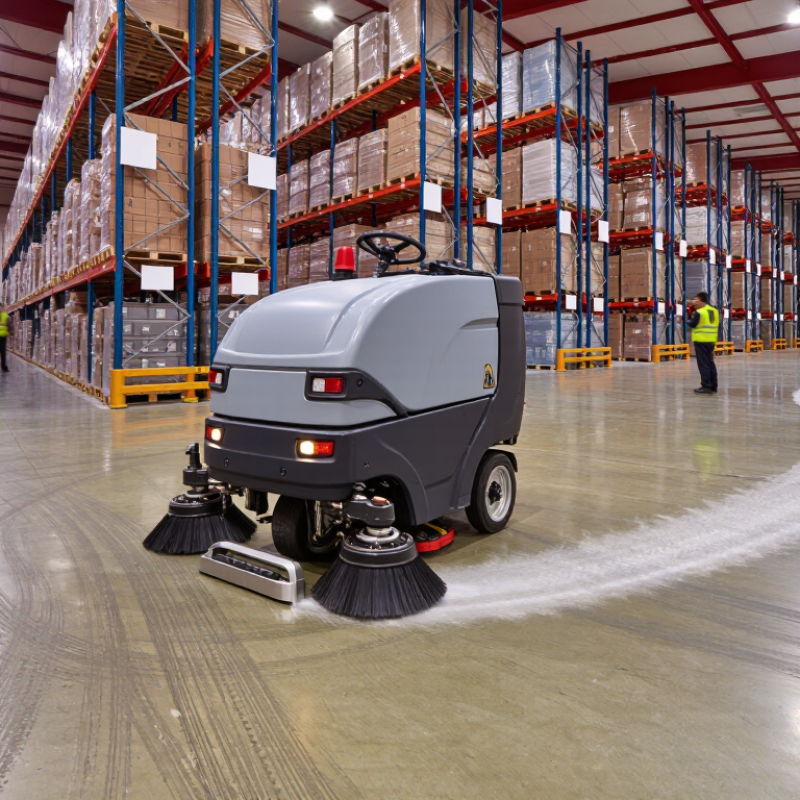
A combination sweeper-scrubber handles loose debris and wet floor cleaning in one machine. It is designed for sites where dust, grit, and tracked-in dirt collect across broad indoor floors. The two cleaning stages work together, but they do different jobs. That distinction matters.
During the first stage, brushes gather dry debris into a hopper before it can spread beneath the scrubbing brushes. Brush pressure and travel speed affect how much grit is collected. In the second stage, water and cleaning solution reach the floor while rotating brushes loosen stuck-on soil. A vacuum system then draws the dirty liquid into a recovery tank. Keep the tank clean.
This process can leave a floor cleaner and drier than sweeping alone, but results depend on the surface and the type of soil. Fine dust, oily marks, and larger scraps may each need different settings or preparation. On a warehouse aisle, for example, operators should check the hopper and recovery tank during a shift, not only at the end. A missed check can reduce pickup or leave streaks. I would not assume one pass solves every problem; heavily soiled patches may need slower travel or another pass. Brush wear, water flow, and squeegee contact also deserve regular inspection.
| Topic | Stage or Feature | How It Works | What to Check |
|---|---|---|---|
| Definition | Combination sweeper-scrubber | A floor-cleaning machine that collects loose debris and performs wet scrubbing in one pass. Depending on its design and settings, these actions may happen together or in sequence. | Confirm whether sweeping and scrubbing can operate independently, simultaneously, or only in a specified sequence. |
| Two-stage cleaning process | Stage 1: Dry debris collection | A side brush may move debris away from edges, while a main brush or pickup system gathers loose dirt into a hopper. The exact arrangement varies by machine. | Check the hopper capacity, brush access, filter arrangement, and suitability for the debris commonly found on site. |
| Stage 2: Wet scrubbing and recovery | A cleaning solution is dispensed onto the floor and worked by rotating brushes or pads. A rear squeegee gathers the resulting liquid, which is drawn into a recovery tank. | Check brush or pad options, solution and recovery tank access, squeegee design, and whether the floor is left suitably dry for the site. | |
| Typical work sequence | Prepare, clean, inspect | Remove oversized objects, select the appropriate brush or pad and cleaning solution, clean the floor, then inspect the result and empty or rinse tanks as required. | Follow the machine instructions and cleaning-chemical label; use a separate pre-sweep where debris levels exceed the machine’s intended capacity. |
| Suitable environments | Large, hard-floor areas | Common applications include warehouses, distribution areas, manufacturing floors, and other sites with compatible hard flooring and enough clearance for the machine. | Assess floor type, aisle width, turning space, slopes, thresholds, traffic, and access to charging or refilling points. |
| Key selection criteria | Cleaning width and maneuverability | A wider cleaning path can cover open areas efficiently, while a more compact machine may be easier to operate in narrow aisles and around obstacles. | Compare the stated cleaning path with the site layout, including turning areas and access through doors. |
| Key selection criteria | Tank and hopper capacity | Solution and recovery tanks support wet cleaning; a debris hopper supports dry collection. Their capacities affect how often the operator needs to stop for refilling or emptying. | Match capacities to the area, soil load, cleaning schedule, and available time for servicing between runs. |
| Key selection criteria | Power and operating time | Battery-powered machines need a suitable charging plan; corded machines require safe cable management and access to power. Run time depends on the machine and operating conditions. | Verify the published operating-time information, charging requirements, and whether the planned shifts allow enough time for charging. |
| Maintenance | Daily care | Routine care commonly includes emptying and rinsing tanks, clearing the hopper and filters, checking brushes, and cleaning the squeegee according to the operating instructions. | Review access to wear parts, cleaning steps, service documentation, and availability of qualified maintenance support. |
| Performance verification | On-site demonstration | A practical trial can show how the machine handles the site’s debris, floor finish, obstacles, and cleaning routine. | Evaluate debris pickup, cleaning consistency, liquid recovery, maneuverability, operator visibility, and ease of routine maintenance. |
When comparing combination sweeper scrubbers, start with cleaning width and the spaces the machine must reach. A wider path can cover open warehouse floors faster. It may also struggle around shelving, doorways, or tight turns. Measure the narrowest aisle before choosing. A few centimeters can matter.
Tank capacity affects how often operators stop to refill or empty the machine. A larger tank can suit long shifts, but it adds weight and may make the unit harder to maneuver when full. Match capacity to the floor area, water access, and soil level. Real floors vary. Brush pressure matters too: too little may leave tracked-in dirt, while excessive pressure can wear brushes and stress delicate surfaces. Test settings on a small area, especially when floor finishes differ.
Runtime should reflect actual work, not just a brochure figure. Battery age, brush pressure, water use, floor texture, and operator pace can all change how long a machine runs. Ask how runtime was measured, and whether it includes scrubbing and sweeping under load. That detail is easy to miss. A practical trial can reveal whether the machine finishes a shift or needs a charging break halfway through. Check charging time and battery access as well; sometimes the advertised runtime looks fine, but the work schedule says otherwise.
For a combination sweeper scrubber, the estimate starts with working width and travel speed. A 1.0 m cleaning path moving at 5 km/h covers 5,000 linear metres in one hour. Multiply by the width: 1.0 m × 5,000 m = 5,000 m²/h. That is theoretical coverage, assuming straight, continuous travel with no overlap or stops. A clean calculation. Not a site result.
Real floors interrupt the formula. Doorways, tight turns, shelving, debris, and refill stops all reduce productive time; a narrow aisle may also prevent the machine from using its full width. ISSA’s 612 Cleaning Times is a professional planning reference for cleaning-task productivity, useful for comparing estimates with practical benchmarks. Still, its figures should not replace a site trial: layouts and soil loads differ. I would record the actual area cleaned during a timed run, including turning and servicing. Then compare that result with 5,000 m²/h. The gap is often the useful number. It may expose an overly optimistic speed assumption, or simply a difficult floor plan.
Choosing a China-based combination sweeper scrubber manufacturer requires more than comparing cleaning width or battery capacity. IEC 60335-2-72:2021 addresses safety requirements for commercial floor-treatment machines, including powered equipment used in wet conditions. Ask for test evidence covering the exact machine configuration, not merely a similar model. Check practical details: emergency stops, electrical protection, tank seals, and stability on a damp ramp. Small details matter.
ISO 9001:2015 helps assess how consistently a manufacturer controls design changes, inspections, supplier inputs, and corrective actions. The ISO Survey of Certifications 2022 reported 1,265,216 valid ISO 9001 certificates worldwide. That figure shows broad adoption, not proof that any individual machine performs well. A certificate is only a starting point. Request the current scope and verify that it covers the manufacturing site and relevant processes. Then compare inspection records, production traceability, and how defects are handled.
For a fair evaluation, ask the supplier to demonstrate sweeping and scrubbing in the same pass on representative debris and floor surfaces. Review water recovery, edge cleaning, noise, and runtime under a stated load. Not enough, though. I would also ask what happens when a brush motor fails mid-shift; the answer may expose service gaps that a polished brochure misses. No checklist replaces an on-site trial, and documentation can be imperfect. Look for evidence that problems are recorded and resolved, rather than hidden behind a certificate.
How IEC 60335-2-72 and ISO 9001:2015 Inform Manufacturer Evaluation
The chart compares the publication years of IEC 60335-2-72:2021, which addresses safety requirements for commercial floor-treatment machines, and ISO 9001:2015, which specifies quality management system requirements. These standards inform different parts of a manufacturer evaluation; publication year alone does not establish product conformity or certification. Ask manufacturers for relevant test reports, certificates, and quality-system evidence.
China Best Combination Sweeper Scrubber Manufacturer?
How to Compare Chinese Manufacturers by Testing, Service, and Lifecycle Cost
A polished brochure is not a performance test. Ask each Chinese manufacturer to clean the same floor area, using comparable soil, water settings, and operator instructions. Record cleaned square meters per hour, water use, battery runtime, and drying results. Include tight turns, doorways, and debris near walls. Small details matter. Repeat the test; one run may not reflect daily conditions.
Service and lifetime costs deserve equal attention. Request written response times, parts availability, warranty terms, and a maintenance schedule. The U.S. Bureau of Labor Statistics reported a 2023 median wage of $17.27 per hour for janitors and building cleaners. At that rate, one labor hour saved per shift across 250 shifts equals $4,317.50 annually, before benefits and downtime. That estimate is imperfect, and it is not a China wage benchmark. Use your own loaded labor cost. Compare purchase price, consumables, energy, maintenance, and expected service life, consistent with federal life-cycle costing guidance from FEMP.
Tips: Ask for a live site trial and a written cost breakdown. Keep the test conditions consistent. A missed service commitment can outweigh a low purchase price.
„Thanks to the LUVIR technology, the solder resist process could be switched directly from the previously used mask exposure to direct exposure. As an outstanding digital solution on the market, this technology has been able to demonstrate fast process times and superior quality on our certified conventional ink in production. This allowed us to fully digitize the solder mask process at low cost – without process or ink adjustments. An excellent benefit to our production in Rot am See.“
Ralf Göhringer (Head of Production WE Rot am See)
I would definitely recommend the Limata machine and team for a future company purchase
Michael Greenaway
Compunetics Inc.
“The Limata ldi has been amazing!! Best thing we did was buy this machine”
Richard Brady
GM
Circuitlabs
“Since 2019, we have been running the Limata X1000 LDI system (including LUVIR for solder mask imaging) in daily production as an addition to our current process with film. The machine was capable of properly exposing Taiyo PSR-4000 BN (DI) solder mask types on normal to high-copper boards using a new and unique direct imaging process. The machine operating interface is very user friendly which allowed for a quick technical training curve. The pre-registration processing reduced several seconds of production time at every print. Limata support and service staff is incomparable. They supported our team every step of the way at basically any time of the day or night, with literally, an immediate response time, customizing the software interface to best fit our Operations and needs.
We have exposed more than 8,000 prints since end of October, on various solder mask colors and some resist film panels. Limata, has proven to be very capable and innovative. They are a strong contender in the industry.
We have very much enjoyed this project, and working with the team!
Thank you Limata for the continued support and being a part of our growth.”
Bill Sezate
Vice President, GM
Summit Interconnect
As a replacement to our current contact exposure process with film, the LIMATA X2000 system including LUVIR-Technology was capable of properly exposing non-LDI solder mask types using a direct imaging process. The machine offers cutting edge software with a very intuitive operating interface which allowed for quick technician training curve. The dual drawer system combined with pre-registration processing reduced several seconds of production time at every machine cycle. Limata support and service staff is world class. They added software patches to keep production running at shortest possible response times, customized the software interface to best fit our in-house Operations system, and even wrote a step-by-step machine processing manual. As a result of the project, we have exposed more than 16,000 times on various product types and solder mask brands/colors. Limata, in a very short timeframe as a company, has definitely shown they are truly innovative and will be challenging the industry of direct imaging for the top spot.
Kevin Beattie
Process Engineer
TTM Technologies
Forest Grove Division
