Choosing the best concert LED screen supplier in China involves more than comparing prices or browsing polished product photos. Concert Led Screens must perform under demanding conditions, from bright outdoor stages to fast-changing indoor productions. A screen that looks impressive in a showroom may behave differently under camera lights, rain, or repeated transport.
A useful supplier review starts with practical specifications. Check pixel pitch, brightness, refresh rate, cabinet weight, and protection ratings against the venue and viewing distance. Ask how the display handles camera refresh, signal processing, and color consistency across large panels. Small test details matter. Request a sample video, inspection records, and clear warranty terms before placing an order. Also confirm whether spare modules, control guidance, and technical support are available when a show is underway. Not always.
This guide looks at Chinese suppliers through these operational questions, rather than treating one brand as universally best. It considers product range, customization, manufacturing transparency, communication, and after-sales service. Supplier claims deserve verification; a specification sheet alone cannot show how quickly a team responds when a panel fails during setup. Buyers should compare evidence, ask precise questions, and match each supplier’s strengths to their production needs. There is no perfect shortlist for every event. The right choice depends on budget, screen scale, touring demands, and the support your crew can realistically access.
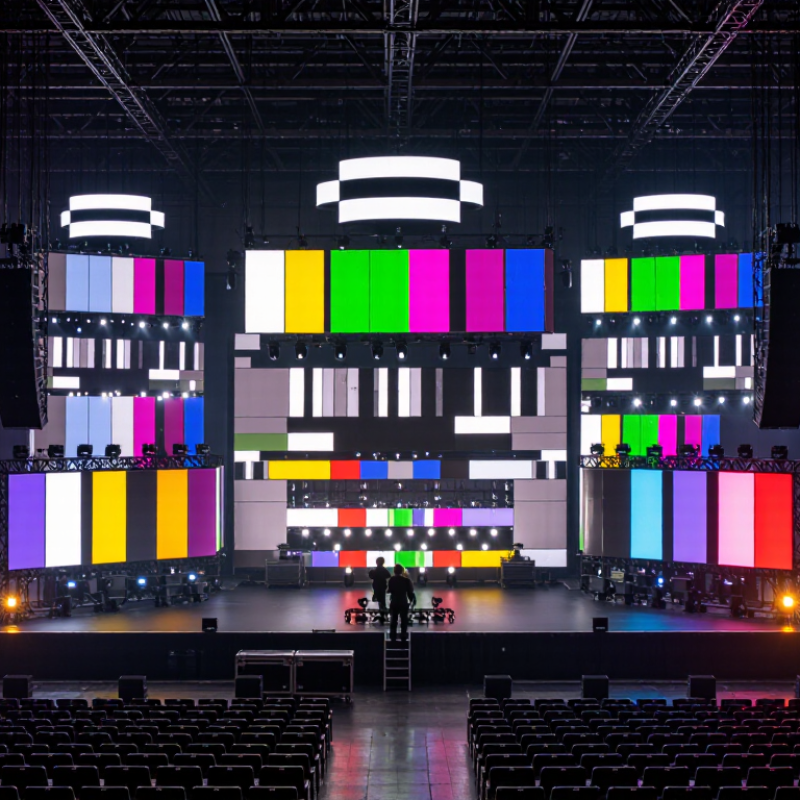
For concert LED screens, pixel pitch describes the distance between neighboring pixels. Smaller pitches usually produce sharper close-up images, but they cost more and may add unnecessary detail for distant audiences. A practical starting rule is one meter of viewing distance per millimeter of pitch; a P3 screen may suit viewers about three meters away. Treat this as a guide, not a specification. Balcony angles and camera framing can change the result.
Brightness should match the venue. Indoor stages often work around 1,000–1,500 nits, while daylight use may call for 5,000 nits or more. Measure under actual lighting conditions; maximum brightness alone does not guarantee readable images. Check refresh performance through a camera test, too. Flicker can spoil close-ups. Small detail, big impact.
Rental design matters as much as the display surface. Compare cabinet weight, quick-lock systems, service access, power draw, and spare-module availability. For outdoor use, confirm the stated ingress protection and test connectors before loading in. A 2023 Grand View Research report valued the global LED display market at about US$7.12 billion and projected 11% annual growth from 2024 to 2030. That market figure signals demand, not quality; request measured brightness, refresh-rate, and reliability data for the exact rental configuration.
Chinese concert LED screen suppliers commonly offer pixel pitches from 2.6 to 4.8 mm, but the right choice depends on viewing distance and stage layout. A 2.6 mm screen can keep faces and text clear for audiences near the stage. It also needs careful content preparation; small text may still look crowded. Pitches around 2.9 or 3.9 mm often balance image detail, panel cost, and practical viewing distances. For large outdoor stages, 4.8 mm panels may suit viewers farther back, where finer pixel density is less noticeable.
Compare more than the pitch number. Ask suppliers for a live demonstration using concert footage, including fast camera movement and dark scenes. Check refresh performance through a camera, color consistency across cabinets, brightness control, and the time needed to replace a panel. Request the cabinet dimensions, power requirements, spare-parts plan, and a written specification sheet. Details matter. A tighter pitch is not automatically better if the screen sits far from the audience or exceeds the production budget. One useful check is to view the proposed panel from the nearest audience position, not just from a showroom desk. Specifications can look perfect on paper, and I would still verify them under the actual stage conditions.
When comparing concert LED screen suppliers in China, treat IP65 and 5,000 nits as testable requirements, not sales phrases. IP65 indicates protection against dust and water jets under defined test conditions; it does not make every connector or cable joint waterproof. Ask for the exact rating of the front and rear cabinets, plus reports tied to the quoted model. Check how seams, power connections, and ventilation are protected. Details matter in outdoor setups.
Tips: Request a brightness test at full white and typical show settings. Confirm whether the figure is measured before or after calibration. View the screen in daylight from several angles, not only in a dark showroom. Also ask how brightness and color consistency are checked across cabinets.
On a sunlit stage, 5,000 nits can help keep content readable, but higher brightness is not automatically better. It may increase power demand and make close-up viewing uncomfortable. Ask suppliers for power-consumption data, refresh-rate specifications, and sample footage of moving content. Inspect a few cabinets together for visible color shifts or uneven seams. A document can look reassuring; a practical demonstration may still reveal gaps. The final choice depends on viewing distance, weather exposure, and show schedule.
Reference brightness threshold for evaluating outdoor concert LED panels
Use 5,000 nits as the brightness screening benchmark, and check for an IP65 rating: the first digit 6 indicates dust-tight protection, while the second digit 5 indicates protection against water jets. These are evaluation criteria, not verified measurements for any supplier.
For concert LED screens, a 3,840 Hz refresh rate can reduce visible scan lines and rolling bands on camera. At 60 frames per second, that equals 64 refresh cycles per frame. But the number alone cannot guarantee clean footage. Scan mode, grayscale processing, and pulse-width modulation also matter. A screen may look smooth to the eye yet show dark bars in a close-up.
IEEE Std 1789-2015 gives frequency-dependent recommendations for LED-light modulation, including a low-risk limit of 0.08 times the modulation frequency above 90 Hz. This guidance concerns lighting flicker, not LED-wall camera certification, so treat it as context rather than a pass mark. Test the actual rig. Ask suppliers to run your camera at intended shutter settings, such as 1/50, 1/100, and 1/250 second, then review slow-motion footage. Check every brightness level, especially dim scenes, where artifacts can become more noticeable. Request test results at the proposed scan configuration, not just a specification sheet. I would also compare panels side by side; honestly, that step is easy to skip when schedules tighten.
A useful ranking of concert LED screen suppliers starts with evidence, not polished sales claims. Check whether certifications are current, issued to the supplier or factory, and relevant to the actual products offered. A certificate alone proves little if its scope excludes the display cabinets or power systems in your quotation. Request test reports and verify certificate numbers with the issuing body where possible. Details matter.
Warranty terms deserve equal scrutiny. Compare coverage length, excluded components, replacement-part availability, and who pays shipping. Ask how dead pixels, receiving cards, and damaged modules are handled during a live event. Get response times in writing, not just a promise of “full support.” Small print matters. A longer warranty may still be weak if repairs take weeks or spare parts are unavailable.
For rental projects, rank suppliers by the fleet they can actually dispatch, not by warehouse photos. Ask for recent inventory records, cabinet counts, flight-case condition, and a demonstration using your intended signal chain. Support should include named technical contacts, setup guidance, and practical troubleshooting during show hours. Score each category separately, then compare the evidence behind the scores. A scorecard is useful, but not magic. A factory visit or sample test can reveal issues a document review misses, and even a careful ranking cannot predict every show-day problem.
„Thanks to the LUVIR technology, the solder resist process could be switched directly from the previously used mask exposure to direct exposure. As an outstanding digital solution on the market, this technology has been able to demonstrate fast process times and superior quality on our certified conventional ink in production. This allowed us to fully digitize the solder mask process at low cost – without process or ink adjustments. An excellent benefit to our production in Rot am See.“
Ralf Göhringer (Head of Production WE Rot am See)
I would definitely recommend the Limata machine and team for a future company purchase
Michael Greenaway
Compunetics Inc.
“The Limata ldi has been amazing!! Best thing we did was buy this machine”
Richard Brady
GM
Circuitlabs
“Since 2019, we have been running the Limata X1000 LDI system (including LUVIR for solder mask imaging) in daily production as an addition to our current process with film. The machine was capable of properly exposing Taiyo PSR-4000 BN (DI) solder mask types on normal to high-copper boards using a new and unique direct imaging process. The machine operating interface is very user friendly which allowed for a quick technical training curve. The pre-registration processing reduced several seconds of production time at every print. Limata support and service staff is incomparable. They supported our team every step of the way at basically any time of the day or night, with literally, an immediate response time, customizing the software interface to best fit our Operations and needs.
We have exposed more than 8,000 prints since end of October, on various solder mask colors and some resist film panels. Limata, has proven to be very capable and innovative. They are a strong contender in the industry.
We have very much enjoyed this project, and working with the team!
Thank you Limata for the continued support and being a part of our growth.”
Bill Sezate
Vice President, GM
Summit Interconnect
As a replacement to our current contact exposure process with film, the LIMATA X2000 system including LUVIR-Technology was capable of properly exposing non-LDI solder mask types using a direct imaging process. The machine offers cutting edge software with a very intuitive operating interface which allowed for quick technician training curve. The dual drawer system combined with pre-registration processing reduced several seconds of production time at every machine cycle. Limata support and service staff is world class. They added software patches to keep production running at shortest possible response times, customized the software interface to best fit our in-house Operations system, and even wrote a step-by-step machine processing manual. As a result of the project, we have exposed more than 16,000 times on various product types and solder mask brands/colors. Limata, in a very short timeframe as a company, has definitely shown they are truly innovative and will be challenging the industry of direct imaging for the top spot.
Kevin Beattie
Process Engineer
TTM Technologies
Forest Grove Division
