Choosing the right Construction piling machine is crucial for any project. According to a 2021 report by the National Association of Home Builders, proper foundation investment can reduce costly repairs by up to 30%. Different projects have unique requirements, which makes selecting the right equipment feel overwhelming.
Various factors come into play. Site conditions, soil composition, and project scale are critical. For example, a heavy-duty hydraulic piling machine may suit larger commercial sites, while lighter options may be better for residential builds. Some companies report challenges in balancing cost with efficiency. This raises questions about long-term investments in machinery versus immediate budget constraints.
Emerging technologies in piling machines offer efficiency but come with learning curves. Not all operators are trained to manage advanced equipment. The construction industry needs continuous training and skills updates. Effective selection ensures safety and efficiency. Gaps in expertise can lead to project delays. It's beneficial to weigh all options before making a decision, focusing not just on immediate needs but also on future-proofing your approach.
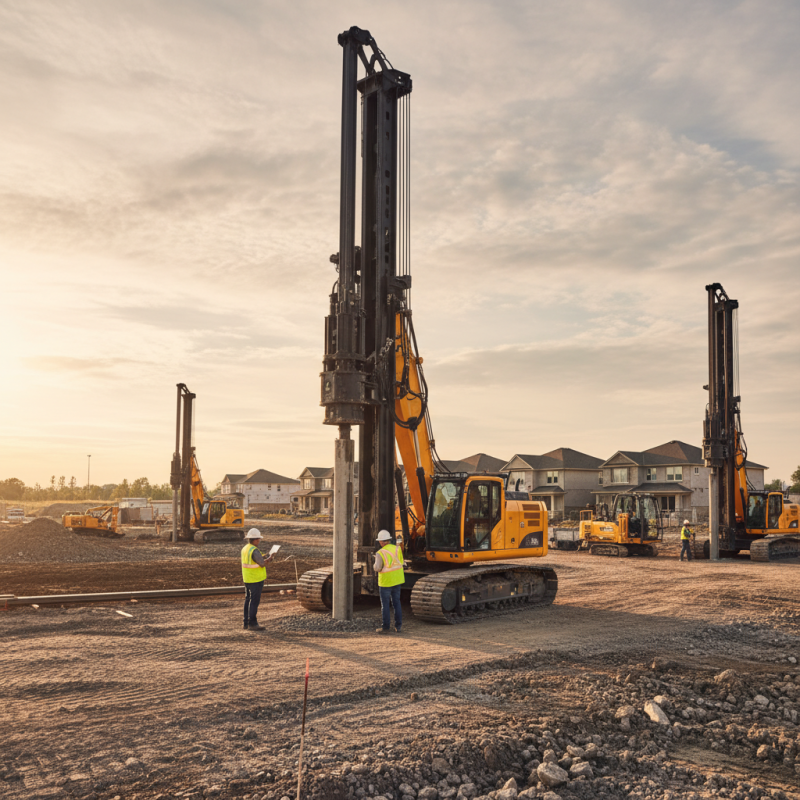
When it comes to construction projects, selecting the right piling machine is crucial. Different types exist, each suited for specific applications. For instance, rotary piling machines are favored in urban areas. They create less noise and vibration, making them ideal for dense environments. An important factor is the machine's operational depth. Some projects may require deeper foundations, demanding equipment capable of reaching significant depths.
Another popular choice is hammer piling machines. These machines drive piles into the ground using repeated impact. They are effective in solid, compact soil conditions. However, they may not be suitable for sensitive locations. The vibrations can disrupt nearby structures. It’s essential to evaluate soil conditions and project requirements before deciding.
Additionally, some may consider silent piling methods. These techniques involve hydraulic presses to install piles with minimal disturbance. While they are quieter, they can be slower. Ultimately, each type of piling machine has its pros and cons. It’s vital to reflect on the site’s unique challenges and requirements before making a selection.
When selecting a piling machine, several key factors must be examined closely. The project type largely influences the choice. For instance, a heavy-duty piling machine is essential for deep foundations in urban areas. According to industry reports, about 22% of construction delays occur from poor equipment selection, highlighting the importance of informed choices.
The soil condition is another critical consideration. Different piling machines operate efficiently in various soil types. For instance, clay soil requires machines that can penetrate and stabilize effectively. Understanding geotechnical data is vital. Reports indicate that projects using appropriate machinery reduce costs by up to 15%.
Finally, the project scale also dictates the suitable piling machine. Custom-sized machines may be necessary for confined spaces. Current industry data shows that 30% of construction projects exceed their timeline due to unsuitable machinery. Thus, evaluating these factors ensures efficient project execution and mitigates risks.
When selecting a piling machine for construction, it’s crucial to analyze the features and capabilities of each option. Many machines on the market vary significantly. Some excel in maneuverability, while others offer greater power for deep foundations. A compact machine may be ideal for urban sites with limited space. However, larger machines might be necessary for heavy-duty projects.
Power source is a significant factor. Hydraulic systems are highly efficient, providing consistent performance. Electric machines are quieter, making them suitable for residential areas. But they often lack the same strength as their hydraulic counterparts. Assessing the soil type and project depth is important. Each machine has its own limits when it comes to these aspects.
User reviews can offer valuable insights. Many professionals highlight the importance of reliability over flashy features. A piling machine may promise high-tech functionality, yet can falter under heavy use. Prioritizing durability and ease of maintenance is critical. Ultimately, there is no one-size-fits-all solution. Identify the specific needs of your project before choosing a machine.
| Piling Machine Type | Max Depth (meters) | Load Capacity (tons) | Weight (tons) | Unique Features |
|---|---|---|---|---|
| Hydraulic Piling Rig | 30 | 70 | 35 | High precision and durability |
| Vibratory Pile Driver | 25 | 60 | 20 | Fast installation and low noise |
| Bored Pile Rig | 40 | 80 | 50 | Flexible for various soil conditions |
| Auger Piling Machine | 20 | 50 | 15 | Efficient in difficult terrain |
| Static Pile Driver | 35 | 75 | 45 | Reduced vibration impact |
When selecting a construction piling machine, balancing cost and performance is crucial. The most effective equipment can significantly impact your project’s timeline and overall budget. Cost-effective machines may seem appealing, but you might face issues later on that can lead to higher expenses.
Consider the soil conditions at your site. Not all machines perform well in every environment. A device that works excellently in one type may falter in another. Analyze the machine’s specifications closely. Look for features that provide the best performance for your specific needs. Sometimes, investing a little more upfront can save you from expensive repairs down the line.
Tip: Always consult with experienced professionals before making a decision. They can offer insights on what has worked best in similar scenarios. Make sure to factor in long-term maintenance costs. Cheaper options may require frequent repairs, which can nullify initial savings.
Tip: Check user reviews and expert evaluations. Real-world feedback may reveal performance strengths and weaknesses you hadn’t considered. Aim for equipment that offers a good balance of durability and efficiency. This way, you avoid pitfalls related to poor performance.
Choosing the right piling machine can be a challenging task. Each project has unique requirements. Case studies provide valuable insights into successful applications of specific piling machinery. For instance, a large-scale urban development project needed a robust solution for deep foundations. The team opted for a machine that could efficiently penetrate dense soil layers. The result was a solid base for the high-rise structure.
In another instance, a waterfront construction project faced challenging soil conditions. A specialized piling machine was employed, allowing for quick installation. Despite some initial setbacks, the flexibility of the equipment proved beneficial. It adapted to the varying soil textures with ease. The contractor appreciated the enhanced efficiency and reduced downtime.
These examples illustrate the importance of selecting the right machinery. Each project variable plays a role in the decision-making process. Learning from past experiences can guide future choices. Piling machine performance directly affects project outcomes. Identifying and reflecting on these details is crucial for success.
„Thanks to the LUVIR technology, the solder resist process could be switched directly from the previously used mask exposure to direct exposure. As an outstanding digital solution on the market, this technology has been able to demonstrate fast process times and superior quality on our certified conventional ink in production. This allowed us to fully digitize the solder mask process at low cost – without process or ink adjustments. An excellent benefit to our production in Rot am See.“
Ralf Göhringer (Head of Production WE Rot am See)
I would definitely recommend the Limata machine and team for a future company purchase
Michael Greenaway
Compunetics Inc.
“The Limata ldi has been amazing!! Best thing we did was buy this machine”
Richard Brady
GM
Circuitlabs
“Since 2019, we have been running the Limata X1000 LDI system (including LUVIR for solder mask imaging) in daily production as an addition to our current process with film. The machine was capable of properly exposing Taiyo PSR-4000 BN (DI) solder mask types on normal to high-copper boards using a new and unique direct imaging process. The machine operating interface is very user friendly which allowed for a quick technical training curve. The pre-registration processing reduced several seconds of production time at every print. Limata support and service staff is incomparable. They supported our team every step of the way at basically any time of the day or night, with literally, an immediate response time, customizing the software interface to best fit our Operations and needs.
We have exposed more than 8,000 prints since end of October, on various solder mask colors and some resist film panels. Limata, has proven to be very capable and innovative. They are a strong contender in the industry.
We have very much enjoyed this project, and working with the team!
Thank you Limata for the continued support and being a part of our growth.”
Bill Sezate
Vice President, GM
Summit Interconnect
As a replacement to our current contact exposure process with film, the LIMATA X2000 system including LUVIR-Technology was capable of properly exposing non-LDI solder mask types using a direct imaging process. The machine offers cutting edge software with a very intuitive operating interface which allowed for quick technician training curve. The dual drawer system combined with pre-registration processing reduced several seconds of production time at every machine cycle. Limata support and service staff is world class. They added software patches to keep production running at shortest possible response times, customized the software interface to best fit our in-house Operations system, and even wrote a step-by-step machine processing manual. As a result of the project, we have exposed more than 16,000 times on various product types and solder mask brands/colors. Limata, in a very short timeframe as a company, has definitely shown they are truly innovative and will be challenging the industry of direct imaging for the top spot.
Kevin Beattie
Process Engineer
TTM Technologies
Forest Grove Division
