Choosing the best battery management system for an agricultural drone is not a simple brand comparison. A sprayer may fly early, carry a full tank, and return with battery capacity already reduced by repeated pump use. Heat, vibration, current peaks, and frequent charging all shape how a BMS performs in the field. Small details matter.
This guide explores what to look for in a Drone Bms For Uav Sprayer, including cell monitoring, overcurrent and temperature protection, balancing, communication options, and fit with the battery pack. It also considers how suppliers in China can be assessed through clear specifications, test records, product support, and practical answers to technical questions. A polished datasheet helps, but it cannot replace verified compatibility.
There is no universal winner. The right system depends on pack chemistry, series configuration, operating current, enclosure, and the drone’s control electronics. A unit that works well on a compact sprayer may not suit a larger aircraft or a different duty cycle. Check the details.
Readers should compare measurable limits against their own operating conditions, rather than relying on broad claims such as “high performance.” Ask how protection thresholds are set, what happens after a fault, and whether logs can help diagnose repeated voltage drops. Some answers may remain unclear until a representative pack is tested. That is worth admitting. The goal is a safer, more dependable battery system—not a confident guess based on a product title.
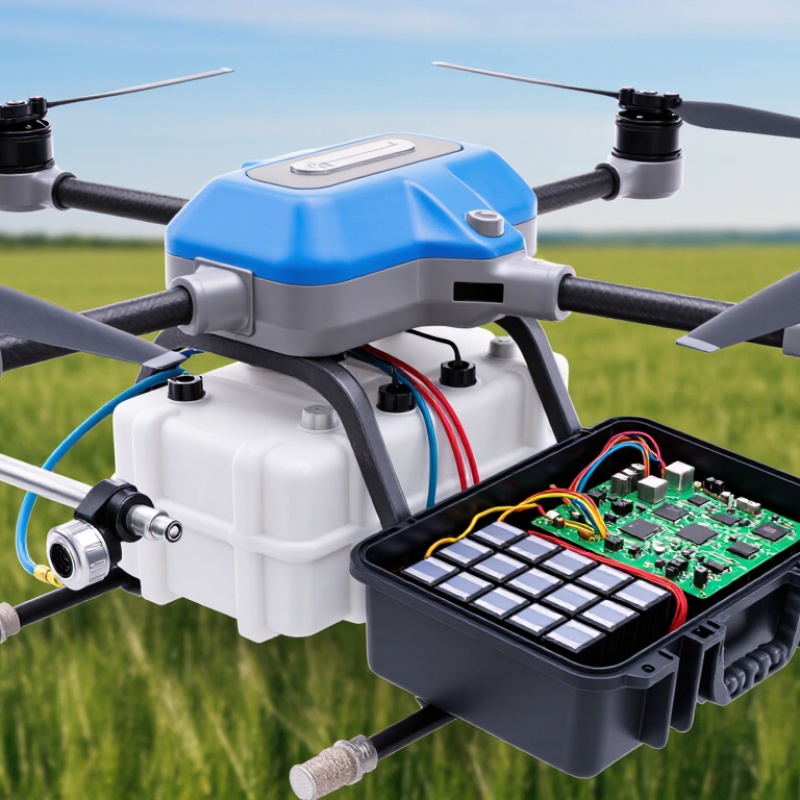
A drone battery management system (BMS) monitors cell voltage, pack current, and temperature while the sprayer is operating. It can estimate state of charge, flag abnormal readings, and limit charging or discharging when preset safety thresholds are reached. Cell balancing helps keep individual cells closer in voltage, which matters when a pack is repeatedly charged between field runs. A BMS is not a substitute for sound pack design or regular inspection.
Spraying creates changing loads: the motors lift the aircraft while pumps and control equipment draw power. A useful BMS should report battery status clearly to the flight controller, so operators can respond before voltage drops too far. Logs can also help identify a cell that heats faster during repeated flights. Small details matter. Connectors, vibration protection, and moisture-resistant housing deserve attention, though housing alone cannot prevent every failure.
For cost context, the International Energy Agency’s Global EV Outlook 2024 reported an average lithium-ion battery pack price of US$139 per kilowatt-hour in 2023, down 14% from 2022. That is a broad market benchmark, not a price estimate for UAV packs.
Specifications and field conditions vary. A BMS can support safer operation, but its displayed remaining-charge estimate may still be imperfect under heavy, changing loads. Operators should compare its readings with actual flight records.
Agricultural spraying drones need a battery management system built for repeated, high-current work. A pump may start while the aircraft is climbing, creating a brief load spike. The BMS should measure cell voltage and pack current quickly enough to detect abnormal sag without triggering nuisance shutdowns. Stable monitoring matters.
Temperature sensing is just as important. Sensors should sit near cells that heat unevenly, not only beside the control board. Spraying often happens in warm weather, and a dusty landing area can slow cooling. The enclosure and connectors should resist moisture, vibration, and residue, while remaining serviceable for inspection. Field conditions are rarely tidy.
A useful BMS should estimate remaining capacity under changing loads, rather than relying on voltage alone. It should also record faults, support cell balancing, and communicate clear warnings to the flight controller or operator. Protection settings need careful tuning: an abrupt cutoff during flight may be more hazardous than an early, visible warning. Charging limits must match the selected cell chemistry and pack design. No single threshold fits every aircraft. Even a well-designed system can misread a worn or poorly matched pack, so periodic checks remain necessary.
Comparing Chinese drone BMS options for UAV sprayers starts with the battery’s actual workload, not a headline current rating. Spraying involves repeated takeoffs, hovering, vibration, and changing pump demand. Ask suppliers for continuous and peak discharge limits, balancing methods, temperature-sensor locations, and documented responses to cell undervoltage. Small details matter.
Check whether the BMS reports cell voltage, pack current, temperature, and fault codes in a format your flight controller supports. Confirm the connector pinout and communication protocol in writing; similar-looking plugs may carry different signals. Request traceable test reports and clear warranty terms. A polished specification sheet may still leave one practical question unanswered: will the system warn early enough when a full tank increases the load?
For a field comparison, record pack voltage before takeoff, during a loaded hover, and after landing. Repeat this over several cycles, including a warm operating day. Compare the logs with the BMS alarms and battery temperature, not just flight time. If a supplier cannot explain a fault code or provide test conditions, note that gap. It may be minor, or it may matter later.
For a UAV sprayer, BMS compatibility starts with the battery pack, not the product label. Match cell chemistry, series count, operating voltage, and continuous discharge current to the aircraft’s documented requirements. Check that the BMS can handle pump-start current and brief load changes without nuisance cutoffs. Small details matter. Confirm connector polarity, wiring, and communication protocols before installation; a familiar plug does not guarantee compatible signals.
Safety checks should cover cell-level overvoltage and undervoltage protection, temperature monitoring, short-circuit response, and clear fault reporting. Ask for evidence. Request test reports, wiring diagrams, operating limits, and instructions for interpreting alarms. For spraying work, inspect enclosure sealing and vibration resistance, too. Moisture or loose wiring can turn a sound design into an unreliable system.
Certification scope matters. Verify that certificates apply to the specific BMS model and battery configuration, and check whether recognized testing covers the intended environment. A certificate for a component does not automatically certify the whole aircraft. Keep records of revisions and supplier test data. Even a careful checklist can miss an integration issue; bench checks under representative loads may reveal problems, but they cannot replace qualified engineering review.
A useful BMS for a UAV sprayer fleet starts with the aircraft’s actual electrical demands, not a generic capacity target. List each battery’s nominal voltage, chemistry, capacity, and permitted charge and discharge rates. Record the pump, flight motors, and other loads during takeoff, spraying, and return. Peak current can differ sharply from the average shown during steady flight.
Then check whether the BMS can handle those measured peaks with a sensible margin. Confirm cell-voltage monitoring, temperature sensing, balancing, and clear fault reporting. If crews rely on battery data between flights, make sure the system can report charge level and warnings in a format they can read. Small details matter. Connector fit, enclosure space, vibration, and access for inspection can complicate installation across different aircraft.
Choose a configuration that matches the fleet’s battery packs and charging routine, rather than forcing one setting onto incompatible packs. In hot weather or after repeated sorties, review temperature and voltage logs for patterns. Ask the supplier for test conditions and protection limits; a specification sheet alone cannot prove performance in your field setup. A controlled trial with a full sprayer load is useful, though it may not reproduce every operating day. Measure under load. Compare readings with a trusted meter, and document any mismatch before standardizing the pack.
„Thanks to the LUVIR technology, the solder resist process could be switched directly from the previously used mask exposure to direct exposure. As an outstanding digital solution on the market, this technology has been able to demonstrate fast process times and superior quality on our certified conventional ink in production. This allowed us to fully digitize the solder mask process at low cost – without process or ink adjustments. An excellent benefit to our production in Rot am See.“
Ralf Göhringer (Head of Production WE Rot am See)
I would definitely recommend the Limata machine and team for a future company purchase
Michael Greenaway
Compunetics Inc.
“The Limata ldi has been amazing!! Best thing we did was buy this machine”
Richard Brady
GM
Circuitlabs
“Since 2019, we have been running the Limata X1000 LDI system (including LUVIR for solder mask imaging) in daily production as an addition to our current process with film. The machine was capable of properly exposing Taiyo PSR-4000 BN (DI) solder mask types on normal to high-copper boards using a new and unique direct imaging process. The machine operating interface is very user friendly which allowed for a quick technical training curve. The pre-registration processing reduced several seconds of production time at every print. Limata support and service staff is incomparable. They supported our team every step of the way at basically any time of the day or night, with literally, an immediate response time, customizing the software interface to best fit our Operations and needs.
We have exposed more than 8,000 prints since end of October, on various solder mask colors and some resist film panels. Limata, has proven to be very capable and innovative. They are a strong contender in the industry.
We have very much enjoyed this project, and working with the team!
Thank you Limata for the continued support and being a part of our growth.”
Bill Sezate
Vice President, GM
Summit Interconnect
As a replacement to our current contact exposure process with film, the LIMATA X2000 system including LUVIR-Technology was capable of properly exposing non-LDI solder mask types using a direct imaging process. The machine offers cutting edge software with a very intuitive operating interface which allowed for quick technician training curve. The dual drawer system combined with pre-registration processing reduced several seconds of production time at every machine cycle. Limata support and service staff is world class. They added software patches to keep production running at shortest possible response times, customized the software interface to best fit our in-house Operations system, and even wrote a step-by-step machine processing manual. As a result of the project, we have exposed more than 16,000 times on various product types and solder mask brands/colors. Limata, in a very short timeframe as a company, has definitely shown they are truly innovative and will be challenging the industry of direct imaging for the top spot.
Kevin Beattie
Process Engineer
TTM Technologies
Forest Grove Division
