A Manual Ceramic Coffee Grinder can look simple on a kitchen shelf: a small handle, ceramic burrs, and a glass jar. But “best” depends on more than materials. Grind consistency, adjustment range, comfort, capacity, and cleaning all shape the cup—and the daily routine behind it.
Coffee’s popularity makes that choice worth examining. The National Coffee Association’s 2024 National Coffee Data Trends report found that 67% of U.S. adults had coffee in the past day. That figure does not prove every drinker needs a hand grinder. It does show why practical brewing equipment matters to many households. The Specialty Coffee Association’s brewing guidance also treats grind size as an important variable in extraction. A grinder’s burr material alone, however, cannot guarantee better flavor.
This guide compares ceramic models by criteria readers can check: adjustment clarity, grind consistency, build quality, portability, and value. It also considers common brewing methods, from pour-over to French press, because a setting that suits one may frustrate another. There is no universal winner. Some grinders feel sturdy but take longer to adjust; others travel well yet offer limited capacity. Small differences matter. And product claims deserve a closer look. Our aim is a useful, evidence-aware shortlist—not a promise that one grinder will transform every cup.
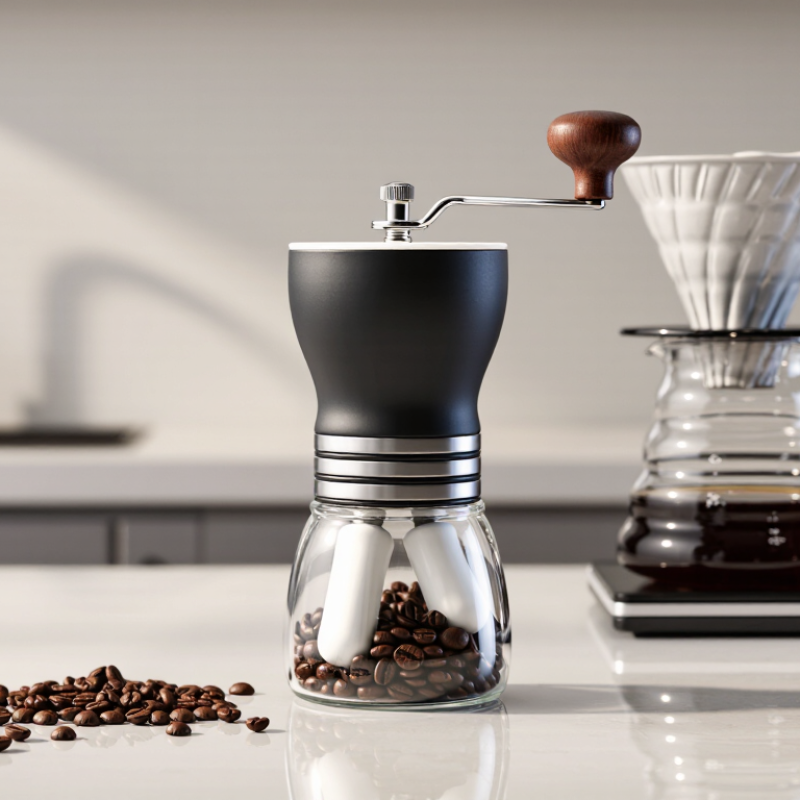
A manual ceramic coffee grinder is a hand-operated tool that crushes coffee beans between two ceramic burrs. Beans sit in a small hopper, while a crank turns one burr against the other. The distance between the burrs controls grind size, from coarse particles for a French press to finer grounds for espresso-style brewing. That matters.
Ceramic burrs resist rust and usually stay cool during grinding, though grind consistency depends on the burr design and how evenly you turn the handle. They can also chip if the grinder is dropped, so ceramic does not automatically mean tougher or better. After grinding, grounds collect in a cup beneath the burr chamber; a few may cling to the walls, especially in dry air. A quick brush helps, but cleaning every nook can be fiddly.
For daily use, check whether the adjustment clicks into repeatable settings and whether the handle feels steady under load. A compact grinder is convenient for travel, yet its small capacity may require several rounds for a large pot. The “best” choice in 2026 depends on your brew method, hand comfort, and patience for manual grinding. I would not judge one by its burr material alone.
A manual ceramic coffee grinder uses a hand-operated crank to turn ceramic burrs, which crush coffee beans into grounds. The gap between the burrs controls grind size. The chart shows approximate particle-size ranges commonly used for different brewing methods; targets vary by grinder and recipe.
Inside a manual ceramic grinder, two ridged burrs break beans into smaller particles. Turning the handle draws beans between the burrs, where their surfaces crush and shear them. That matters. Burr spacing helps determine particle size, but it cannot make every particle identical. A little variation is normal. Too many fine particles can make a cup taste harsh, while oversized pieces may taste thin or sour.
The Specialty Coffee Association’s Brewing Control Chart places a commonly cited extraction range at 18–22%. Grind size helps shape extraction, alongside water temperature, brew time, and pouring technique. The National Coffee Association’s 2024 National Coffee Data Trends report found that 67% of U.S. adults drank coffee daily, making repeatable preparation useful for many routines.
For a practical check, grind the same dose twice and compare how evenly the particles look. Adjust the burr setting if the brew runs too quickly or tastes sharp. Ceramic burrs can chip if dropped, and a hand grinder may take longer than expected. Not perfect, but useful.
A good grinder should produce repeatable grounds, not just look sturdy on a kitchen shelf. Check whether its adjustment mechanism makes small, clear changes. This matters when switching from a coarse French press to a finer pour-over. Feel the click. If settings drift during grinding, repeatability suffers.
Particle consistency is harder to judge by eye. The Specialty Coffee Association’s brewing guidance uses a target extraction range of 18–22 percent, with a Golden Cup strength range of 1.15–1.35 percent total dissolved solids. These are brewing targets, not grinder certifications, but they offer a useful test: brew the same recipe several times and note whether the cup swings from thin to bitter. A basic kitchen scale helps control dose and water.
Ceramic burrs may appeal for their hardness, but material alone does not guarantee even particles or long life. Inspect burr alignment, handle wobble, adjustment range, and how much coffee remains inside after grinding. The National Coffee Association’s Spring 2024 National Coffee Data Trends report found that 67 percent of American adults drank coffee in the past day, a reminder that daily ease matters. A grinder that is awkward to hold may stay unused. I would still treat hand-testing as imperfect: beans, roast, and pouring technique can distort the comparison.
Manual ceramic coffee grinders differ most in burr shape, adjustment range, build quality, and how much effort they need. Ceramic burrs resist corrosion and can stay sharp through regular home use. They may suit travelers who want a compact tool with no power cord. But “ceramic” alone does not guarantee an even grind. Alignment and burr geometry matter too.
A useful comparison starts with the coffee you make. For pour-over, a grinder with small, repeatable adjustment steps can help you tune flow and taste. Espresso usually demands finer control, and some manual models make those tiny changes awkward. French press is more forgiving, though uneven particles can leave both dusty bitterness and large, weak-tasting pieces. Check whether the handle turns smoothly; a stiff crank becomes noticeable during a full dose. Small detail. Big difference.
Ceramic burrs can produce less frictional heat than some metal setups, but hand grinding is still slow, and heat is rarely the only flavor factor. Ceramic can chip if dropped or knocked against a hard sink. Cleaning also varies: removable parts are easier to brush out, while narrow chambers trap old grounds. I would compare adjustment clarity, capacity, grip, and replacement-part availability before paying extra for a material claim. Reviews can help, but brewing needs differ. A grinder that feels steady at home may be tiring on a camping trip.
| Grinder format | Typical grounds capacity | Adjustment style | Portability | Best suited to | Main trade-off |
|---|---|---|---|---|---|
| Compact travel grinder | About 15–25 g per load | Usually stepped; settings may be adjusted at the burr | High; small body and removable handle are common | Single cups, travel, and limited storage space | Smaller capacity can mean grinding in multiple batches |
| Standard everyday grinder | About 25–40 g per load | Often stepped, with a range for common brew methods | Medium; generally portable but larger than travel formats | Daily pour-over, drip, and French press brewing | May require more effort for very fine settings |
| Large-capacity hand grinder | About 40–60 g per load | Typically stepped; check that the range suits the intended brew method | Low to medium; larger chamber and body take more space | Multiple cups or brewing for more than one person | Bulkier to pack and store |
| Fine-adjustment hand grinder | Often about 20–40 g per load | Finer stepped or stepless adjustment, depending on design | Medium; adjustment mechanism may add complexity | Brewers who regularly switch grind settings | More settings can take time to learn and reproduce |
How to choose: For most daily users, a standard-capacity grinder with stable burr alignment and repeatable adjustment is a balanced choice. Choose a compact format for travel or a larger chamber for multiple servings. Ceramic burrs resist corrosion, but burr material alone does not determine grind consistency; construction, alignment, adjustment, and the coffee beans also matter. Capacity figures above are broad category ranges, not specifications for a particular product.
Choosing a manual ceramic coffee grinder starts with the brew you make most often. For pour-over, look for clear grind adjustments and a stable handle; espresso needs much finer, repeatable settings. Ceramic burrs resist rust, but material alone does not guarantee even grounds. Check that the burrs sit securely and the adjustment mechanism does not drift. A useful home test: grind the same dose twice and compare the grounds. Noticeable clumps or many powder-fine particles may point to uneven grinding, though beans and technique also affect the result.
Maintenance matters more than many buyers expect. The National Coffee Association’s 2024 National Coffee Data Trends report found that 67% of U.S. adults had coffee in the past day. For frequent brewing, small routines add up. Brush dry grounds from the burrs after use, and clean the chamber when stale aromas linger. Keep the grinder dry; do not rinse ceramic burrs unless its instructions specifically allow it. The Specialty Coffee Association’s Golden Cup guidance uses about 55 grams of coffee per liter of water, a useful baseline for testing grind changes. Adjust one step at a time, then taste. A little mess is normal. I would not chase perfect uniformity: hand grinding varies, and that variation is worth noticing rather than hiding.
„Thanks to the LUVIR technology, the solder resist process could be switched directly from the previously used mask exposure to direct exposure. As an outstanding digital solution on the market, this technology has been able to demonstrate fast process times and superior quality on our certified conventional ink in production. This allowed us to fully digitize the solder mask process at low cost – without process or ink adjustments. An excellent benefit to our production in Rot am See.“
Ralf Göhringer (Head of Production WE Rot am See)
I would definitely recommend the Limata machine and team for a future company purchase
Michael Greenaway
Compunetics Inc.
“The Limata ldi has been amazing!! Best thing we did was buy this machine”
Richard Brady
GM
Circuitlabs
“Since 2019, we have been running the Limata X1000 LDI system (including LUVIR for solder mask imaging) in daily production as an addition to our current process with film. The machine was capable of properly exposing Taiyo PSR-4000 BN (DI) solder mask types on normal to high-copper boards using a new and unique direct imaging process. The machine operating interface is very user friendly which allowed for a quick technical training curve. The pre-registration processing reduced several seconds of production time at every print. Limata support and service staff is incomparable. They supported our team every step of the way at basically any time of the day or night, with literally, an immediate response time, customizing the software interface to best fit our Operations and needs.
We have exposed more than 8,000 prints since end of October, on various solder mask colors and some resist film panels. Limata, has proven to be very capable and innovative. They are a strong contender in the industry.
We have very much enjoyed this project, and working with the team!
Thank you Limata for the continued support and being a part of our growth.”
Bill Sezate
Vice President, GM
Summit Interconnect
As a replacement to our current contact exposure process with film, the LIMATA X2000 system including LUVIR-Technology was capable of properly exposing non-LDI solder mask types using a direct imaging process. The machine offers cutting edge software with a very intuitive operating interface which allowed for quick technician training curve. The dual drawer system combined with pre-registration processing reduced several seconds of production time at every machine cycle. Limata support and service staff is world class. They added software patches to keep production running at shortest possible response times, customized the software interface to best fit our in-house Operations system, and even wrote a step-by-step machine processing manual. As a result of the project, we have exposed more than 16,000 times on various product types and solder mask brands/colors. Limata, in a very short timeframe as a company, has definitely shown they are truly innovative and will be challenging the industry of direct imaging for the top spot.
Kevin Beattie
Process Engineer
TTM Technologies
Forest Grove Division
