Choosing the Best Marine Steel Castings Manufacturer in China takes more than comparing prices. These components may sit inside a propeller hub, rudder assembly, or shipboard pump, where saltwater, vibration, and repeated loading test every surface. A casting can look sound on arrival and still hide problems beneath its skin. Details matter.
Foundry metallurgist John Campbell, author of The Complete Casting Handbook, emphasizes sound metal flow and careful casting design. His practical message for buyers can be put simply: “Control the metal flow, and you improve the chance of sound castings.” This is a paraphrase of his foundry principles, not a verified verbatim quotation. For Marine Steel Castings, those principles connect directly to mold design, alloy selection, pouring practice, and inspection. Buyers should ask how a supplier controls each stage, rather than relying on a polished brochure.
A capable Chinese manufacturer should explain its material traceability, heat treatment, and nondestructive testing procedures in clear terms. Ask for sample inspection records, drawings, and evidence that the proposed steel grade suits the component’s service conditions. Look closely at critical areas: a thick propeller boss, a narrow rudder section, or a machined flange face. These are not small details. They can shape a part’s performance and repair needs over time. No supplier is flawless, and no checklist removes every risk. Still, careful questions help distinguish manufacturing evidence from sales language—and support a more confident choice.
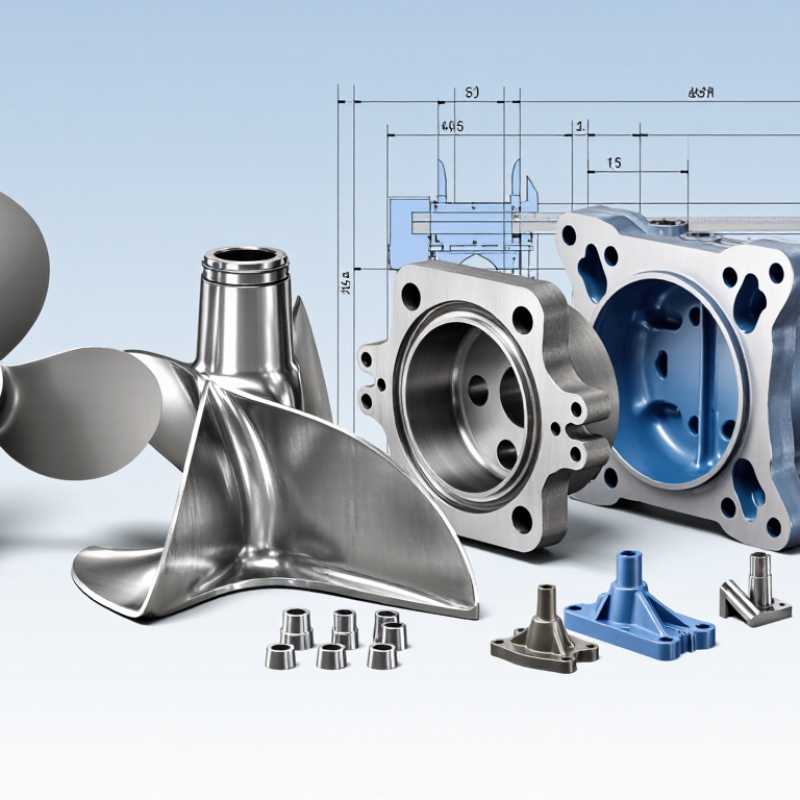
Marine steel castings are components formed by pouring molten steel into shaped molds. They can provide complex, load-bearing parts for rudders, stern structures, valves, and propulsion systems. Their role is practical: transfer forces, maintain alignment, and withstand vibration, impact, and seawater exposure. Details matter. A rough surface or hidden shrinkage defect can become a fatigue problem after repeated service. Material selection, heat treatment, and inspection should match the component’s load and operating environment.
UNCTAD’s Review of Maritime Transport 2024 reports that more than 80% of world trade by volume moves by sea. That scale helps explain why dependable ship structures matter. The IMO’s Fourth Greenhouse Gas Study reports that shipping produced 2.89% of global anthropogenic CO2 emissions in 2018, making efficient operation an ongoing industry concern.
Castings alone do not deliver fuel savings, but accurate, durable parts can support reliable propulsion and steering. That matters at sea.
Buyers should check material certificates, dimensional records, and nondestructive testing results, such as ultrasonic inspection where appropriate. A casting is not automatically reliable; that assumption deserves scrutiny. Strength depends on design, process control, and evidence from inspection.
Marine steel castings must match the vessel’s operating conditions, not just a strength target. Carbon and low-alloy steels are common where load capacity and toughness matter. Stainless grades may suit components exposed to seawater, but alloy choice alone does not prevent corrosion. Design, surface condition, and maintenance all influence service life. Small details matter. A casting near a propeller or rudder may face vibration, impact, and changing loads, so material specifications should reflect its actual duty.
The manufacturing process starts with a pattern and a mold designed to control metal flow and shrinkage. Foundries select melting and pouring conditions to maintain consistent chemistry and reduce defects. Risers feed the casting as it cools. After solidification, heat treatment can refine properties or relieve residual stress, depending on the alloy and specification. Inspection may include visual checks, dimensional measurement, and suitable non-destructive testing. No single test reveals every problem. Careful records of material certificates, heat-treatment cycles, and inspection results help buyers assess traceability. It is worth admitting that complex shapes can still cool unevenly; process controls reduce that risk, but they do not make casting design irrelevant.
Marine steel castings work in salt spray, vibration, and changing loads. Their reliability depends on more than a clean surface. A sound quality plan starts with approved drawings, material specifications, and clear acceptance criteria. Chemical analysis confirms the melt composition, while tensile and impact tests check strength and toughness. Impact testing should reflect the service temperature stated in the project requirements.
Inspection continues after casting and heat treatment. Visual checks can reveal cracks, laps, and rough repairs. Dimensional inspection verifies critical features, such as flange faces and bolt-hole spacing. Ultrasonic or radiographic testing can detect internal discontinuities, but each method has limits. The inspection plan should define coverage, locations, and acceptance levels before production. Test results should be traceable to the casting heat and inspection record. A missed detail here can create costly fit-up problems later.
Tips: Ask for material certificates, heat-treatment records, and test reports. Check that non-destructive testing matches the casting’s shape and risk areas. Keep the requirements practical and documented. No single test proves every casting defect-free; even a careful plan may need review after field feedback.
| Quality Dimension | Standard or Method | What It Covers | Typical Verification Record |
|---|---|---|---|
| Material selection | ASTM A216/A216M | Carbon-steel castings for pressure-containing parts intended for high-temperature service; includes grades such as WCA, WCB and WCC. | Material grade, heat number and material test report checked against the purchase specification. |
| Low-temperature service materials | ASTM A352/A352M | Ferritic and martensitic steel castings for pressure-containing parts designed for low-temperature service; LCB and LCC are commonly specified grades. | Grade confirmation and impact-test results where required by the grade and order specification. |
| Alloy-steel castings | ASTM A217/A217M | Alloy and martensitic stainless-steel castings for pressure-containing parts intended for high-temperature service. | Chemical composition and mechanical-property results assessed against the ordered grade requirements. |
| General delivery requirements | ASTM A703/A703M | General requirements for steel castings used in pressure-containing parts, when invoked by the applicable product specification. | Inspection and documentation requirements reviewed alongside the material specification and purchase order. |
| Visual and dimensional inspection | Approved drawings and purchase specification | Checks visible surface condition, casting features, critical dimensions and machining allowances against the agreed requirements. | Visual inspection report and dimensional inspection record. |
| Chemical analysis | Applicable material specification; analysis method agreed for the order | Verifies the heat’s reported chemical composition against the limits for the specified steel grade. | Heat analysis report linked to the casting’s heat identification. |
| Tensile and impact testing | Applicable material specification and ordered test requirements | Measures specified mechanical properties; impact testing is required where applicable to the grade, service temperature or purchase order. | Test results and specimen traceability recorded in the material test report. |
| Radiographic examination | ASTM E94/E94M, when specified | Radiographic examination can reveal internal discontinuities in castings; coverage and acceptance criteria depend on the governing specification and order. | Radiographic report identifying inspected areas, results and applicable acceptance criteria. |
| Ultrasonic examination | ASTM A609/A609M, when applicable | Provides ultrasonic examination procedures for carbon and low-alloy steel castings covered by the standard. | Ultrasonic examination report stating the examination scope and results. |
| Surface crack detection | ASTM E709 (magnetic particle) or ASTM E165/E165M (liquid penetrant), when specified | Magnetic particle testing is used on suitable ferromagnetic materials; liquid penetrant testing detects surface-opening discontinuities on nonporous materials. | NDT report documenting method, examined surfaces and results against the agreed acceptance criteria. |
| Pressure or leak testing | Applicable component code, drawing and purchase specification | Hydrostatic or other pressure testing is performed when required for the finished component; test pressure and acceptance criteria are not universal for all castings. | Test record showing the specified procedure, pressure, duration and outcome. |
| Traceability and final release | Purchase order, inspection plan and applicable standards | Connects the casting to its material heat, inspection results and required documentation before acceptance. | Compiled inspection dossier, with identification and records required by the order. |
Note: Applicable standards, editions, examination extent and acceptance criteria should be confirmed in the contract and component design requirements.
Choosing a marine steel castings manufacturer in China starts with the part’s service conditions, not a polished brochure. Ask how the foundry controls steel chemistry, pouring temperature, and heat treatment for your specified grade. Request material certificates linked to each heat and casting number. Check that records follow the component through machining and inspection. Details matter. A reliable answer should describe real process controls, not just offer assurances.
Review inspection capability against your drawings and purchase requirements. For a large propeller hub or valve body, ask for dimensional reports, pressure-test records where applicable, and non-destructive examination results. Clarify test methods, acceptance criteria, and who reviews indications. If practical, visit the production floor. Observe mold preparation, furnace records, and calibration labels on measuring tools. Photos help, but they cannot replace current documents or a live technical discussion. Ask for evidence.
Past marine orders can show experience, but similar geometry and alloy are more useful than a long client list. Request anonymized examples, lead-time assumptions, and details about how defects or delays were handled. Compare quotations for tooling, machining allowance, testing, packaging, and export preparation. One detail may be missed. Speak with engineering and quality staff, not only sales. A supplier may look strong on paper, yet reveal gaps when asked to trace one casting from melt to final release.
Marine steel castings are used in rudder stocks, propeller hubs, stern frames, deck machinery, and pump housings. These components face saltwater, vibration, impact, and changing loads. A rudder part may experience repeated bending around joints and sharp transitions. Small casting defects can become serious after years of service.
Selection starts with the component’s loads, geometry, and operating environment. For a propeller hub, engineers consider torque, fatigue, corrosion exposure, and machining allowance. For pump bodies, pressure, fluid chemistry, and wall thickness matter. Material grades should match relevant marine specifications and inspection requirements. Toughness matters. So does traceability. Casting methods also affect soundness: thick sections cool slowly, while narrow passages can trap gas or complicate feeding. Request documented chemical analysis, mechanical test results, and suitable nondestructive examination. A smooth surface does not prove internal quality. Choosing a casting involves trade-offs; extra alloying or inspection may add cost without improving every application. Verify critical dimensions early, since machining rework can be frustrating—and not always avoidable.
Yield strength is one factor to consider when selecting castings for marine pumps, valves, and structural components.
Values are representative minimum specified yield strengths, rounded to MPa: WCB 250 MPa, CF8M 205 MPa, and CA6NM 550 MPa. Figures depend on the applicable specification and casting condition. Strength alone does not determine marine suitability; also assess seawater corrosion, pitting and crevice-corrosion risks, operating temperature, toughness, and maintenance requirements. Reference specifications: ASTM A216 and ASTM A743.
„Thanks to the LUVIR technology, the solder resist process could be switched directly from the previously used mask exposure to direct exposure. As an outstanding digital solution on the market, this technology has been able to demonstrate fast process times and superior quality on our certified conventional ink in production. This allowed us to fully digitize the solder mask process at low cost – without process or ink adjustments. An excellent benefit to our production in Rot am See.“
Ralf Göhringer (Head of Production WE Rot am See)
I would definitely recommend the Limata machine and team for a future company purchase
Michael Greenaway
Compunetics Inc.
“The Limata ldi has been amazing!! Best thing we did was buy this machine”
Richard Brady
GM
Circuitlabs
“Since 2019, we have been running the Limata X1000 LDI system (including LUVIR for solder mask imaging) in daily production as an addition to our current process with film. The machine was capable of properly exposing Taiyo PSR-4000 BN (DI) solder mask types on normal to high-copper boards using a new and unique direct imaging process. The machine operating interface is very user friendly which allowed for a quick technical training curve. The pre-registration processing reduced several seconds of production time at every print. Limata support and service staff is incomparable. They supported our team every step of the way at basically any time of the day or night, with literally, an immediate response time, customizing the software interface to best fit our Operations and needs.
We have exposed more than 8,000 prints since end of October, on various solder mask colors and some resist film panels. Limata, has proven to be very capable and innovative. They are a strong contender in the industry.
We have very much enjoyed this project, and working with the team!
Thank you Limata for the continued support and being a part of our growth.”
Bill Sezate
Vice President, GM
Summit Interconnect
As a replacement to our current contact exposure process with film, the LIMATA X2000 system including LUVIR-Technology was capable of properly exposing non-LDI solder mask types using a direct imaging process. The machine offers cutting edge software with a very intuitive operating interface which allowed for quick technician training curve. The dual drawer system combined with pre-registration processing reduced several seconds of production time at every machine cycle. Limata support and service staff is world class. They added software patches to keep production running at shortest possible response times, customized the software interface to best fit our in-house Operations system, and even wrote a step-by-step machine processing manual. As a result of the project, we have exposed more than 16,000 times on various product types and solder mask brands/colors. Limata, in a very short timeframe as a company, has definitely shown they are truly innovative and will be challenging the industry of direct imaging for the top spot.
Kevin Beattie
Process Engineer
TTM Technologies
Forest Grove Division