Choosing the best Powder Coating Spray Booth in 2026 starts with the work it must handle, not a glossy feature list. A booth sized for small brackets may struggle with long panels, frequent color changes, or a busy production schedule. Look closely at usable dimensions, airflow design, powder recovery, access for cleaning, and how easily operators can load parts. Small details matter.
Market growth helps explain why equipment decisions deserve care. Grand View Research’s Powder Coatings Market Size, Share & Trends Analysis Report estimated the global market at about $13.1 billion in 2023 and projected a 5.4% compound annual growth rate from 2024 to 2030. That figure describes the powder coatings market, not booth sales. Still, it points to sustained demand across applications such as appliances, automotive components, and metal furniture.
This guide compares booth types and practical selection factors, including production volume, part geometry, color-change frequency, and available floor space. It also considers maintenance needs and the information manufacturers should provide about airflow and powder collection. A larger booth is not automatically better; it may consume valuable space without solving a real production bottleneck. And a feature can look impressive on paper yet prove awkward beside a real production line. No single model suits every shop. Buyers should verify performance claims with technical documentation, reference installations, and a site-specific assessment before choosing.
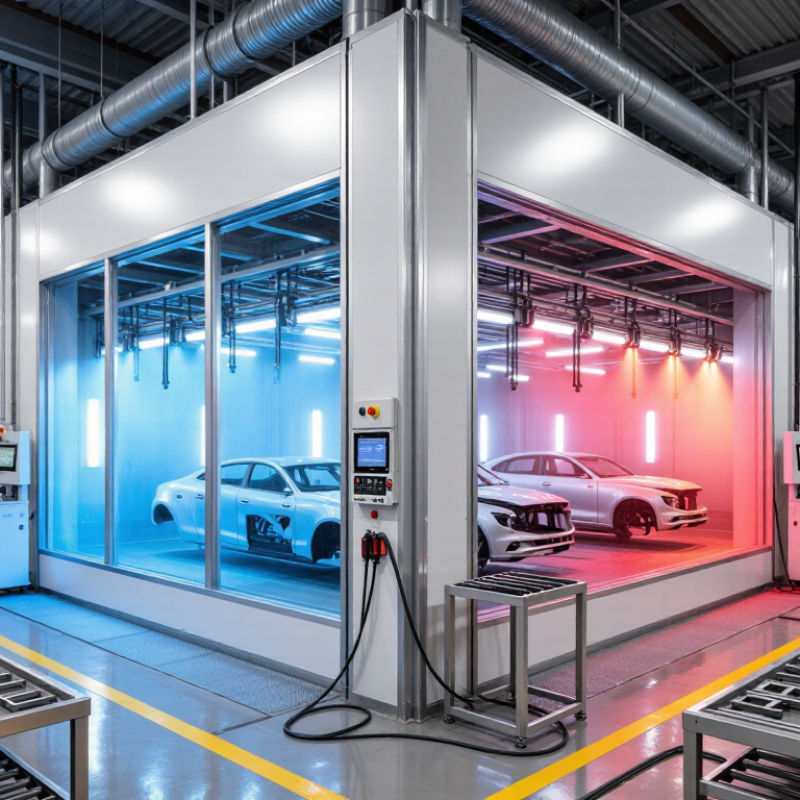
A powder coating spray booth is a controlled space for applying charged powder to grounded parts. Its airflow draws airborne overspray away from the operator and workpiece, while filters or a recovery system collect powder for reuse. The booth also helps limit dust settling on wet-looking, freshly coated surfaces. It does not cure the coating; that happens later in an oven. Small details matter: a clogged filter or uneven airflow can leave powder buildup near corners and thin coverage on recessed edges.
The U.S. Environmental Protection Agency’s Control Techniques Guidelines for Miscellaneous Metal and Plastic Parts Coatings (2008) reports powder-coating transfer efficiency of up to 95% when overspray is recovered. That figure is a potential, not a guarantee: part shape, grounding, operator technique, and booth balance all affect results. A booth that seems powerful can still create turbulent airflow and waste powder. Quiet, even flow is usually more useful than sheer fan speed. In practice, operators should check filters, airflow indicators, and powder buildup regularly. One overlooked gap. That is where defects often begin.
Choosing the best powder coating spray booth in 2026 depends on part size, production pace, and how often colors change. An open-face booth offers quick access for large or irregular parts, but relies on carefully balanced airflow to contain overspray. Enclosed, conveyorized booths suit repeatable production and can reduce dust escaping into nearby work areas. The trade-off is space, maintenance, and less flexibility for unusual jobs. Small details matter: a door opening, a hanging hook, or a loaded filter can alter how powder moves.
Recovery design changes both material handling and changeover work. Cartridge systems capture powder through filters and are often practical for single-color production. Cyclone systems separate reusable powder before final filtration, which can help in longer runs; cleaning between colors takes more attention. Grand View Research estimated the global powder coatings market at about USD 13.1 billion in 2023 and projected 5.3% annual growth from 2024 to 2030. That market figure signals activity, not a guaranteed return on a booth. A buyer should compare actual powder loss, filter pressure readings, and color-change time on the intended parts. I still hesitate to treat “higher recovery” as automatically better. A few minutes spent cleaning a cyclone can outweigh reclaimed powder during frequent color shifts.
In 2026, the best powder coating spray booth is not simply the largest or newest. It is the booth that maintains steady airflow, captures overspray, and suits the parts moving through your shop. Start with the work. A narrow cabinet door and a long steel frame need different access, hanging space, and clearance. Measure your largest routine part, then allow room for operators and carts. Tight layouts look efficient on paper. They can feel awkward in daily use.
Airflow deserves close attention. Even extraction across the work area helps limit powder drift and supports consistent application. Ask for airflow readings at several points, not just a fan rating. Check filter loading, pressure gauges, and how easily filters can be changed. Small details matter. A clogged filter can turn a clean shift into cleanup time. Recovery design matters, too: reclaim systems may suit repeat colors, while frequent color changes can make simpler cleaning more valuable.
Evaluate safety and controls alongside production performance. Look for accessible emergency stops, clear grounding provisions, and suitable interlocks. Have qualified professionals review the electrical and fire-protection design for your site; a sales sheet cannot replace that assessment. Lighting, noise, and service access affect daily work. Bright, even lighting can reveal thin spots and missed edges. I would test the booth with real parts, not a flawless demo sample. The setup may still need adjustments after installation, so useful commissioning data matters more than a glossy promise.
Booth capacity should reflect the parts you coat, not just the available floor space. Measure each part’s length, width, and height, then include hooks, racks, and turning clearance. A long cabinet door may need more usable depth than its dimensions suggest. Measure twice. Also check how operators load parts and reach corners without crowding the work area.
Estimate your busiest production hour, rather than relying only on a daily average. Record typical batch size, color changes, coating time, and the minutes needed to load and unload. A booth that handles one large batch may suit scheduled work; a conveyor setup may better serve steady, repeatable output. Include airflow and filter capacity in the assessment, since both affect consistent powder containment as production rises. More space alone does not guarantee higher throughput.
Leave room for future product changes, but avoid buying capacity you cannot use. Extra volume can increase installation and operating demands. Compare your largest routine parts with the booth’s usable opening, and confirm that racks can move safely through it. Check proposed airflow, filtration, and maintenance access with a qualified equipment professional. The estimate may still miss a bottleneck. Track actual cycle times for a few weeks, then revise your capacity plan using real production data.
Before choosing a powder coating spray booth, ask how it controls airborne powder. Check that the design provides suitable airflow, accessible filters, and a clear way to monitor pressure or airflow loss. A warning light helps, but operators also need instructions for responding when it activates. Ask for commissioning records and maintenance intervals, not just a sales brochure.
Grounding matters. Confirm that the booth, workpieces, and application equipment can be properly bonded, and ask how continuity is checked. Review electrical components for suitability in the intended work area. Door interlocks and emergency stops should be easy to reach and tested regularly. Fire detection and suppression must match the booth design and be reviewed by qualified safety professionals. Local requirements vary, so have the installation checked against applicable codes before purchase.
Look closely at housekeeping details. Smooth surfaces, removable filters, and convenient access can make powder buildup easier to spot and clean. Ask how collected powder should be handled, and whether filter changes require specific protective equipment. Small details count. I would not assume a booth is safe because its paperwork looks complete; actual airflow, grounding, and operator habits can differ after installation. Leave time for training and a site-specific inspection.
„Thanks to the LUVIR technology, the solder resist process could be switched directly from the previously used mask exposure to direct exposure. As an outstanding digital solution on the market, this technology has been able to demonstrate fast process times and superior quality on our certified conventional ink in production. This allowed us to fully digitize the solder mask process at low cost – without process or ink adjustments. An excellent benefit to our production in Rot am See.“
Ralf Göhringer (Head of Production WE Rot am See)
I would definitely recommend the Limata machine and team for a future company purchase
Michael Greenaway
Compunetics Inc.
“The Limata ldi has been amazing!! Best thing we did was buy this machine”
Richard Brady
GM
Circuitlabs
“Since 2019, we have been running the Limata X1000 LDI system (including LUVIR for solder mask imaging) in daily production as an addition to our current process with film. The machine was capable of properly exposing Taiyo PSR-4000 BN (DI) solder mask types on normal to high-copper boards using a new and unique direct imaging process. The machine operating interface is very user friendly which allowed for a quick technical training curve. The pre-registration processing reduced several seconds of production time at every print. Limata support and service staff is incomparable. They supported our team every step of the way at basically any time of the day or night, with literally, an immediate response time, customizing the software interface to best fit our Operations and needs.
We have exposed more than 8,000 prints since end of October, on various solder mask colors and some resist film panels. Limata, has proven to be very capable and innovative. They are a strong contender in the industry.
We have very much enjoyed this project, and working with the team!
Thank you Limata for the continued support and being a part of our growth.”
Bill Sezate
Vice President, GM
Summit Interconnect
As a replacement to our current contact exposure process with film, the LIMATA X2000 system including LUVIR-Technology was capable of properly exposing non-LDI solder mask types using a direct imaging process. The machine offers cutting edge software with a very intuitive operating interface which allowed for quick technician training curve. The dual drawer system combined with pre-registration processing reduced several seconds of production time at every machine cycle. Limata support and service staff is world class. They added software patches to keep production running at shortest possible response times, customized the software interface to best fit our in-house Operations system, and even wrote a step-by-step machine processing manual. As a result of the project, we have exposed more than 16,000 times on various product types and solder mask brands/colors. Limata, in a very short timeframe as a company, has definitely shown they are truly innovative and will be challenging the industry of direct imaging for the top spot.
Kevin Beattie
Process Engineer
TTM Technologies
Forest Grove Division
