In the ever-evolving field of renewable energy, the importance of a Solar Charge Controller cannot be overstated. Experts like Dr. Sarah Thompson, a leading authority on solar technology, emphasize that "a reliable solar charge controller is vital for optimizing energy storage." This statement underlines the critical role these devices play in managing power efficiently.
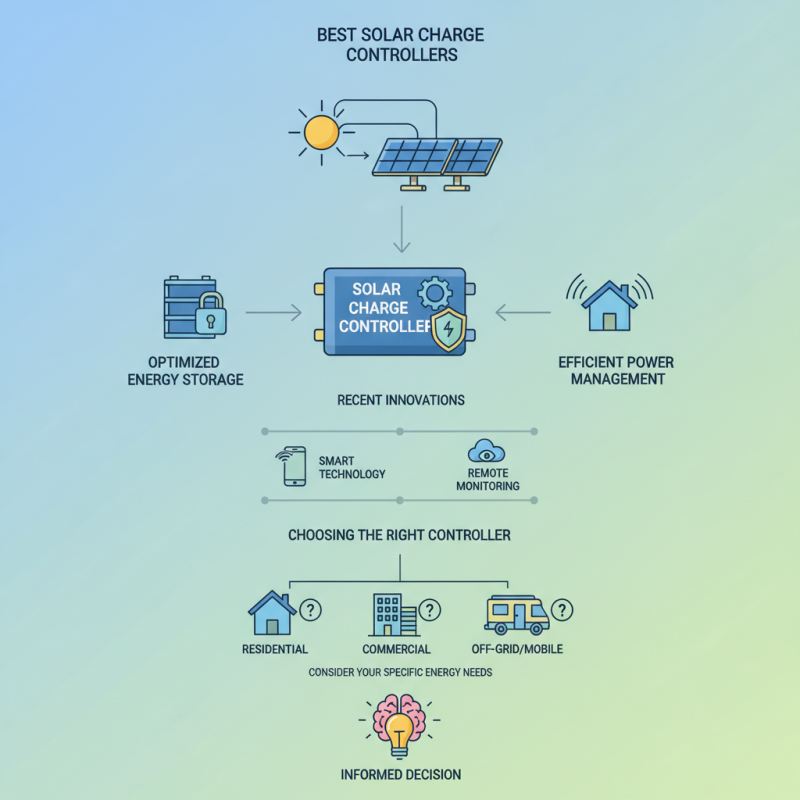
Solar charge controllers regulate the voltage and current coming from solar panels to batteries. They prevent overcharging and ensure batteries operate at peak efficiency. Without these controllers, the entire energy management system may falter. Recent innovations in this industry have brought forth controllers with enhanced features, including smart technology and remote monitoring.
However, the choice of the right solar charge controller can be daunting. The market is flooded with options, each boasting unique features. It’s essential to recognize that not all controllers suit every application. Users must consider their specific energy needs carefully to make an informed decision. As we explore the best solar charge controllers, understanding these nuances will enhance our ability to manage solar power effectively.
Solar charge controllers play a vital role in managing power from solar panels. They regulate the voltage and current coming from the panels to the batteries, preventing overcharging and ensuring battery longevity. According to a report by the National Renewable Energy Laboratory, improper charging can reduce battery lifespan by 50%. Proper management is essential for off-grid systems, where maximizing energy efficiency is crucial.
The importance of these devices extends beyond just battery health. A study by the Solar Energy Industries Association highlights that using an efficient charge controller can improve overall system performance by up to 30%. This optimization not only provides reliable energy but also enhances safety, mitigating risks of overheating or electrical fires.
However, one can’t overlook the complexities in choosing the right controller. There are various types, such as PWM and MPPT, each suited for different applications. Many users struggle with understanding their unique requirements. This can lead to suboptimal selections, resulting in wasted energy and increased costs. Understanding different scenarios is critical to achieving the most from solar investments.
This chart illustrates the efficiency of various types of solar charge controllers. The efficiency is an important metric for power management in solar energy systems, indicating how effectively the controller converts solar energy into usable power.
When selecting solar charge controllers, several key features should be prioritized. One crucial aspect is the controller type. MPPT (Maximum Power Point Tracking) controllers can significantly increase the efficiency of solar energy conversion, especially in cloudy conditions. They adapt to changing sunlight conditions, maximizing energy harvest. PWM (Pulse Width Modulation) controllers are simpler and cheaper, suitable for smaller systems. Understanding your energy needs will help guide this choice.
Another important feature is compatibility with battery types. Different batteries—like lithium-ion, AGM, or gel—require specific charging profiles. Ensuring your controller supports the right battery type ensures optimal performance. Additionally, look for an LCD or LED display; having real-time data readily available can aid in monitoring system performance.
Finally, consider the safety features. Overcharge protection and temperature compensation can prevent damage and extend battery life. It’s essential to choose a unit that offers these safeguards. While many products boast high efficiency, not all deliver the same reliability. Research user reviews and expert recommendations to ensure your choice aligns with your specific energy management needs.
Solar charge controllers play a critical role in managing power for solar energy systems. There are several types, each suited for different applications. PWM (Pulse Width Modulation) controllers regulate voltage by adjusting the duty cycle. This method is cost-effective for small systems. They are simple and reliable but less efficient than MPPT controllers.
MPPT (Maximum Power Point Tracking) controllers are more advanced. They maximize energy extraction from solar panels, making them ideal for larger installations. These systems can adjust to varying weather conditions, ensuring optimal performance. However, they tend to be pricier and more complex. Choosing the right type depends largely on your energy needs and budget.
When selecting a solar charge controller, consider these tips. Ensure compatibility with your solar panel and battery type. Understand the voltage and current ratings to avoid damage. Also, assess your energy usage patterns. This will help you choose a controller that matches your needs. Regular maintenance can enhance efficiency and prolong the life of the system.
| Type | Voltage (V) | Rated Current (A) | Efficiency (%) | Features | Applications |
|---|---|---|---|---|---|
| PWM | 12/24 | 20 | 75 | Low cost, simple | Small solar panels, RVs |
| MPPT | 12/24/48 | 40 | 95 | Higher efficiency, smart tracking | Larger solar systems, off-grid applications |
| Smart Controllers | 12/24 | 30 | 80 | Wi-Fi/Bluetooth connectivity, remote monitoring | Residential setups, smart homes |
| Hybrid Controllers | 12/24 | 50 | 85 | Combines multiple power sources | Commercial buildings, complex energy needs |
Solar charge controllers are vital for efficient power management in solar energy systems. They regulate the voltage and current from solar panels to batteries. Choosing the right controller can significantly impact energy efficiency and battery life. Focus on top brands to ensure quality and reliability. Their advanced features can optimize charging cycles and protect batteries.
When selecting a solar charge controller, consider your system's capacity and the type of batteries you use. Make sure the controller matches the voltage of your solar panels and batteries. It's essential to check the efficiency ratings and compatibility with your solar inverter. Different models offer unique features, such as LCD displays for easy monitoring and MPPT technology for improved energy harvest.
Tips: Always read reviews from other users for insights on performance. This helps gauge real-world efficiency and potential issues. Monitor your system regularly to adjust settings if needed. Small tweaks can lead to better performance over time. Investing a little effort can yield significant benefits for your solar setup.
Maintaining and optimizing solar charge controllers is essential for maximizing solar system efficiency. Regular checks on the controller's performance can prevent issues before they arise. Ensure connections are clean and tight. Dust or corrosion can disrupt power flow. Keeping the device in a shaded area also helps. Excessive heat can affect efficiency.
Using the right settings is crucial. Every system is unique, and choosing appropriate charge profiles significantly impacts battery lifespan. Monitor the state of charge to avoid overcharging or deep discharging. Both scenarios can lead to diminished efficiency. A digital display on some controllers can help visualize these metrics.
Routine firmware updates may enhance your controller's performance. Many models allow for upgrades that improve functionality. Ignoring this can leave your system outdated. Although it may seem tedious, keeping a maintenance log can reveal patterns over time. This will help identify chronic issues and track improvements effectively.
„Thanks to the LUVIR technology, the solder resist process could be switched directly from the previously used mask exposure to direct exposure. As an outstanding digital solution on the market, this technology has been able to demonstrate fast process times and superior quality on our certified conventional ink in production. This allowed us to fully digitize the solder mask process at low cost – without process or ink adjustments. An excellent benefit to our production in Rot am See.“
Ralf Göhringer (Head of Production WE Rot am See)
I would definitely recommend the Limata machine and team for a future company purchase
Michael Greenaway
Compunetics Inc.
“The Limata ldi has been amazing!! Best thing we did was buy this machine”
Richard Brady
GM
Circuitlabs
“Since 2019, we have been running the Limata X1000 LDI system (including LUVIR for solder mask imaging) in daily production as an addition to our current process with film. The machine was capable of properly exposing Taiyo PSR-4000 BN (DI) solder mask types on normal to high-copper boards using a new and unique direct imaging process. The machine operating interface is very user friendly which allowed for a quick technical training curve. The pre-registration processing reduced several seconds of production time at every print. Limata support and service staff is incomparable. They supported our team every step of the way at basically any time of the day or night, with literally, an immediate response time, customizing the software interface to best fit our Operations and needs.
We have exposed more than 8,000 prints since end of October, on various solder mask colors and some resist film panels. Limata, has proven to be very capable and innovative. They are a strong contender in the industry.
We have very much enjoyed this project, and working with the team!
Thank you Limata for the continued support and being a part of our growth.”
Bill Sezate
Vice President, GM
Summit Interconnect
As a replacement to our current contact exposure process with film, the LIMATA X2000 system including LUVIR-Technology was capable of properly exposing non-LDI solder mask types using a direct imaging process. The machine offers cutting edge software with a very intuitive operating interface which allowed for quick technician training curve. The dual drawer system combined with pre-registration processing reduced several seconds of production time at every machine cycle. Limata support and service staff is world class. They added software patches to keep production running at shortest possible response times, customized the software interface to best fit our in-house Operations system, and even wrote a step-by-step machine processing manual. As a result of the project, we have exposed more than 16,000 times on various product types and solder mask brands/colors. Limata, in a very short timeframe as a company, has definitely shown they are truly innovative and will be challenging the industry of direct imaging for the top spot.
Kevin Beattie
Process Engineer
TTM Technologies
Forest Grove Division
