Choosing a Stone Frying Pan can feel simple until you compare coatings, handles, and care instructions. The name may suggest natural rock, but many stone-style pans use a metal base with a mineral-look nonstick coating. That distinction matters. Construction, heat limits, and cleaning guidance vary by model, so the label alone is not a quality guarantee. Small details matter. A flat, stable base can help distribute heat, while a comfortable handle makes lifting and turning food easier. Still, even a well-designed pan has limits. High heat or metal utensils may shorten the life of some coatings, so check the manufacturer’s instructions before cooking.
This guide looks at seven options for different kitchens, budgets, and cooking habits. It considers practical features such as pan size, weight, stovetop compatibility, ease of cleaning, and the foods each pan may suit. A compact pan can work well for a quick breakfast; a wider one gives vegetables more room to brown. Not every pan fits. The right choice depends on your stove, storage space, and how often you cook. I would not call any single model perfect for everyone, and product details can change over time. Use the comparisons as a starting point, then verify current specifications and care advice before buying.
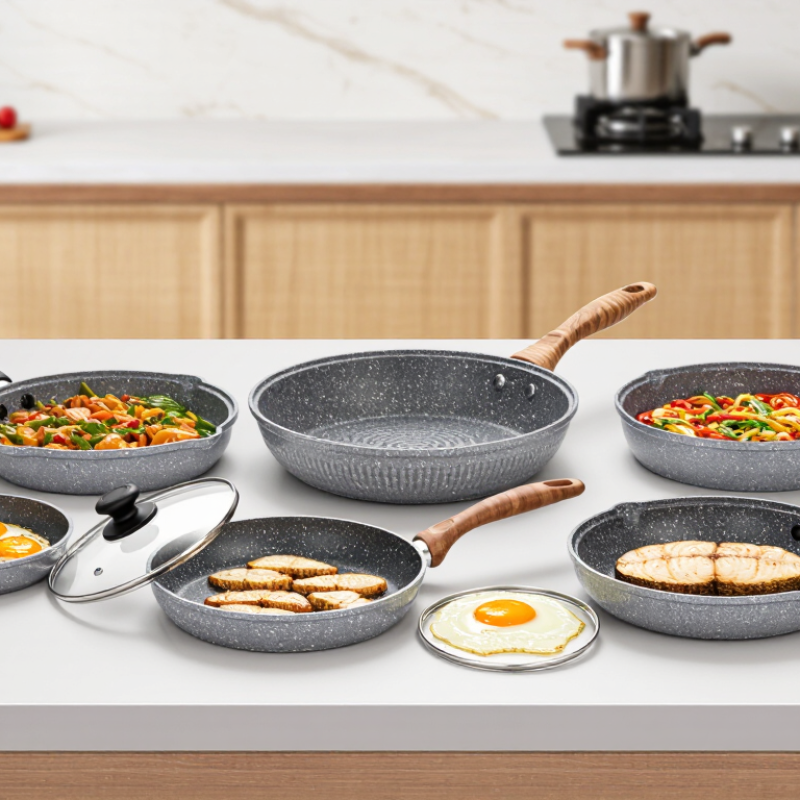
Stone frying pans are usually named for their speckled finish, not carved from rock. Most have an aluminum body and a nonstick coating blended with mineral particles. The coating may be PTFE-based or ceramic-style; “stone” alone does not identify its chemistry. Check the care label and product specifications. A textured gray surface can look rugged, but it is still a thin layer that can wear.
The pan’s core affects how evenly it heats, while the coating affects food release and care. For eggs or delicate fish, an intact surface usually needs only a little oil and moderate heat. Keep flames within the pan’s base, and avoid heating an empty coated pan for long. Use silicone or wooden utensils, and let the pan cool before washing; sudden temperature changes can stress some materials. No coating is indestructible. Even careful cooks sometimes overheat a pan or scrape it with a fork. If the surface starts flaking, or food sticks despite normal care, replace it rather than guessing what has changed. Check whether the handle and oven-use limits suit your routine. That part is easy to overlook.
A “stone” frying pan is usually metal with a textured or mineral-infused coating, not a solid slab of stone. Check the manufacturer’s material and care details before comparing appearance. A thick, flat base can sit steadily on the hob and help spread heat, while a very heavy pan may feel awkward when tossing vegetables. Lift it if you can. Handle balance matters.
Match the base to your cooktop, especially if you use induction; the pan must contain a magnetic layer. The U.S. Department of Energy’s Energy Saver guide estimates induction transfers about 85% of its energy to food, compared with roughly 32% for gas cooking. That figure describes the cooking method, not a guarantee of better results from any particular pan. Check the listed hob compatibility. Also compare usable diameter, oven-safe temperature, handle material, and cleaning instructions. Small details matter.
Coating care deserves close attention. Germany’s Federal Institute for Risk Assessment warns that empty PTFE-coated pans can release hazardous gases if heated to around 360°C. Not every stone-style coating contains PTFE, so verify the coating type and follow its stated heat limits. I would not choose a pan by its scratch-resistant claim alone; coating wear depends on use, utensils, and cleaning. Honestly, that part is hard to judge from a product photo.
“Stone” often describes a textured or mineral-reinforced coating, not a pan carved from rock. Check the care instructions before buying; coatings vary. A compact 20-centimeter pan suits one egg or a quick portion of vegetables. A 24-centimeter model handles everyday lunches, while a 28-centimeter pan gives family portions more room. Crowding food can still cause steaming.
A deep-sided stone pan is useful for saucy dishes and gently simmered vegetables. A low-sided crepe pan makes flipping easier, though its shallow shape limits what else it can cook. Ridged grill pans create browned lines on zucchini or chicken, but grooves take extra cleaning. An induction-ready pan needs a compatible magnetic base. Small details matter.
Choose by cooking habits, not appearance alone. A heavier pan may feel steady on the hob, yet tire your wrist during frequent tossing. Nonstick performance also depends on gentle heat and suitable utensils; a stone-style surface is not indestructible. I would avoid assuming every “stone” pan behaves alike. Even a useful pan can disappoint when its size, weight, or care needs do not fit your kitchen.
| Pan Style | Typical Diameter | Best Suited For | What to Look For | Cooktop and Care Notes |
|---|---|---|---|---|
| Compact frying pan | About 8 inches (20 cm) | One egg, a small omelet, or a single portion | A lightweight body and gently sloped sides make small servings easy to turn. | Check the pan’s base diameter against small burners. Use low to medium heat and non-metal utensils if the coating instructions recommend them. |
| Everyday frying pan | About 10 inches (25 cm) | Cooking for one or two people; everyday eggs and vegetables | A flat cooking surface and comfortable handle offer a useful balance of capacity and storage space. | Cooktop compatibility depends on the base. For induction, the pan must have a magnetic base and be listed as induction-compatible. |
| Large family pan | About 12 inches (30 cm) | Larger portions, several servings, or cooking multiple ingredients together | A broad base provides more room, while a helper handle can make lifting a full pan easier. | Confirm that the pan fits your burner and storage space. A larger pan may heat unevenly on a burner that is much smaller than its base. |
| Deep-sided frying pan | About 10–11 inches (25–28 cm) | Sautéing vegetables, shallow frying, and dishes with sauces | Taller sides help contain splashes and hold more food than a standard shallow skillet. | Check the usable depth and whether a lid is included. Follow the manufacturer’s instructions for heat limits and cleaning. |
| Induction-ready stone-look pan | Commonly 10–12 inches (25–30 cm) | Kitchens with an induction cooktop | Look for an induction-compatible label and a flat magnetic base; the “stone” appearance alone does not indicate induction compatibility. | Verify compatibility for your specific cooktop. Keep the pan base clean and lift it rather than sliding it across a glass surface. |
| Ceramic-coated stone-look pan | Commonly 8–12 inches (20–30 cm) | Those who prefer a ceramic-based nonstick coating | Check the product description to confirm the coating type. “Stone” or “granite” styling is not a standardized coating specification. | Use moderate heat and follow the care instructions. Avoid overheating an empty pan and check whether dishwasher use is permitted. |
| Lightweight aluminum-body pan | Commonly 10–12 inches (25–30 cm) | Easy handling and frequent everyday use | An aluminum body is generally lighter than a comparable cast-iron pan; a bonded base may be needed for induction use. | Check the listed cooktop compatibility and any oven-safe temperature limit. Hand-washing can help preserve many nonstick coatings. |
Buying note: “Stone,” “granite,” and “stone-effect” are often marketing descriptions for a pan’s finish or nonstick coating, not proof that the cooking surface is made from solid stone. Check the listed coating, cooktop compatibility, and care instructions before buying.
Choosing a stone frying pan starts with the cooktop, not just the advertised diameter. Pan sizes usually describe the top rim, while the flat base may be noticeably smaller. Measure the cooking zone and compare it with the base. A close match helps distribute heat evenly and avoids wasting energy.
For induction, the pan needs a magnetic base; a small magnet can help check, but follow the maker’s compatibility label. Stone-style coatings alone do not indicate whether a pan will work on induction.
On gas, choose a base that sits securely over the grate, and keep flames beneath the pan rather than licking up its sides. For electric coils or glass-ceramic surfaces, a flat base matters. A warped pan may wobble or heat unevenly. That detail is easy to miss.
Think about the meals you actually cook. A 20-centimeter pan suits eggs or a quick lunch, while a 28-centimeter pan gives vegetables more room to brown. But bigger is not always better: an oversized pan can heat slowly on a small burner. Handle clearance matters, too, especially when neighboring burners are in use.
Check the care instructions before choosing; some coatings need gentler utensils or lower heat. I would not assume every “stone” pan behaves the same. The coating and base construction vary.
A stone-finish frying pan is not necessarily made from solid stone. Its surface may use different coating materials, so check the care label instead of judging safety by its speckled appearance. The German Federal Institute for Risk Assessment warns that PTFE-coated cookware can release hazardous gases when heated to around 360°C or higher. That warning applies to PTFE coatings, not automatically to every pan sold as “stone.” The distinction matters.
Use low or medium heat for everyday cooking, and avoid leaving an empty pan on a hot burner. Add a little oil when the pan is cool, then heat it gently; shimmering oil is a cue to lower the flame. Small habits matter. Don’t use metal utensils if the care instructions advise against them, and let the pan cool before washing. A sudden splash of cold water can stress a hot surface. If the coating is visibly peeling, stop using the pan for cooking and check the manufacturer’s guidance.
Tips: Use a soft sponge and mild dish soap. Dry the pan before storing it, and place a cloth between stacked pans to reduce scratches. Ventilate the kitchen when cooking. It is easy to assume “stone” means tougher, but the coating and its condition are what count.
Smoke points are approximate and vary with processing and refinement. Avoid overheating oil or heating an empty pan, and follow the pan manufacturer’s care and temperature guidance.
„Thanks to the LUVIR technology, the solder resist process could be switched directly from the previously used mask exposure to direct exposure. As an outstanding digital solution on the market, this technology has been able to demonstrate fast process times and superior quality on our certified conventional ink in production. This allowed us to fully digitize the solder mask process at low cost – without process or ink adjustments. An excellent benefit to our production in Rot am See.“
Ralf Göhringer (Head of Production WE Rot am See)
I would definitely recommend the Limata machine and team for a future company purchase
Michael Greenaway
Compunetics Inc.
“The Limata ldi has been amazing!! Best thing we did was buy this machine”
Richard Brady
GM
Circuitlabs
“Since 2019, we have been running the Limata X1000 LDI system (including LUVIR for solder mask imaging) in daily production as an addition to our current process with film. The machine was capable of properly exposing Taiyo PSR-4000 BN (DI) solder mask types on normal to high-copper boards using a new and unique direct imaging process. The machine operating interface is very user friendly which allowed for a quick technical training curve. The pre-registration processing reduced several seconds of production time at every print. Limata support and service staff is incomparable. They supported our team every step of the way at basically any time of the day or night, with literally, an immediate response time, customizing the software interface to best fit our Operations and needs.
We have exposed more than 8,000 prints since end of October, on various solder mask colors and some resist film panels. Limata, has proven to be very capable and innovative. They are a strong contender in the industry.
We have very much enjoyed this project, and working with the team!
Thank you Limata for the continued support and being a part of our growth.”
Bill Sezate
Vice President, GM
Summit Interconnect
As a replacement to our current contact exposure process with film, the LIMATA X2000 system including LUVIR-Technology was capable of properly exposing non-LDI solder mask types using a direct imaging process. The machine offers cutting edge software with a very intuitive operating interface which allowed for quick technician training curve. The dual drawer system combined with pre-registration processing reduced several seconds of production time at every machine cycle. Limata support and service staff is world class. They added software patches to keep production running at shortest possible response times, customized the software interface to best fit our in-house Operations system, and even wrote a step-by-step machine processing manual. As a result of the project, we have exposed more than 16,000 times on various product types and solder mask brands/colors. Limata, in a very short timeframe as a company, has definitely shown they are truly innovative and will be challenging the industry of direct imaging for the top spot.
Kevin Beattie
Process Engineer
TTM Technologies
Forest Grove Division
