Choosing a Storage Rack Upright supplier in China can affect warehouse safety, operating costs, and delivery schedules. A low quotation may look attractive, but price alone tells little about product consistency. The upright must suit the rack design, expected loads, and daily handling conditions. Small differences matter.
Look closely at the steel grade, material thickness, hole spacing, and upright dimensions. Ask how the supplier checks roll forming, welding, and surface coating. Request test records that identify the tested product and its load conditions. Clear documentation is more useful than a broad claim of “high quality.” If possible, review samples and compare their measurements with approved drawings. Check whether the supplier can explain production steps plainly, rather than relying only on polished brochures.
Communication deserves attention. Can the team answer technical questions, confirm drawing changes, and provide realistic lead times? Ask about packaging, shipping protection, and traceability before placing a large order. Factory visits or independent inspections may provide useful evidence, though neither guarantees every future batch will match. Be cautious of unusually low prices, vague specifications, or pressure to approve production quickly. Those signs do not prove poor performance, but they deserve follow-up. I have seen buyers focus heavily on a sample and overlook how repeat orders will be controlled. That is an easy mistake. A dependable supplier should make verification practical, share relevant records, and discuss limits honestly. Use this guide to compare candidates with evidence, not promises, and choose a partner whose products fit your actual storage system.
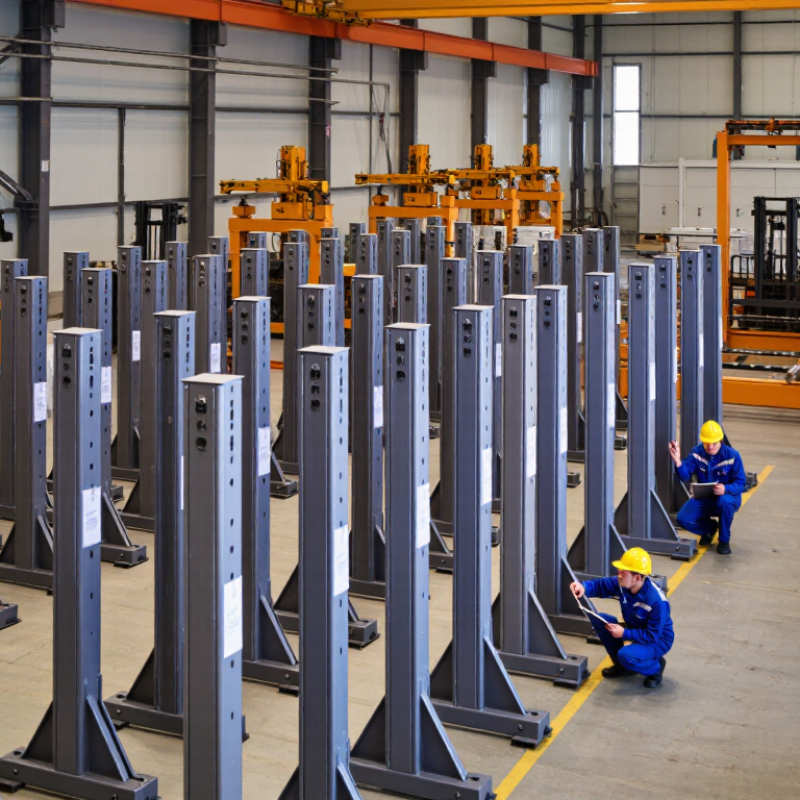
Define Your Storage Rack Upright Requirements
Before contacting suppliers, record the loads and dimensions your rack must handle. Note each pallet’s weight, size, and overhang, plus the number of beam levels. Specify upright height and depth, aisle width, and the forklift’s turning clearance. Small details matter. A few centimeters can affect safe access.
Describe the warehouse conditions, too. Is the floor uneven, or does the space experience moisture, temperature changes, or frequent impacts? These details can influence the upright finish, baseplate, and anchoring needs. Ask suppliers to confirm compatibility with your beams, bracing, and pallet dimensions. Request drawings that show the proposed layout and connection points.
Be precise about load ratings. State the required load per beam level and per bay, and explain how goods will be distributed. Do not rely on a single “maximum capacity” figure without its conditions. Ask what testing or technical documents support the rating, and clarify whether installation assumptions are included. I still find one point easy to overlook: future changes. If pallet sizes or loads may vary, tell the supplier now. It is tempting to specify only today’s needs, but that can leave little room for adjustment.
Build a shortlist from industrial clusters that produce warehouse storage systems, then compare suppliers by product focus, engineering depth, and export experience. Search trade directories and exhibition lists, but treat listings as leads, not endorsements. China ranked 19th among 139 economies in the World Bank’s 2023 Logistics Performance Index. That reflects national logistics performance, not any factory’s reliability. Check each supplier directly.
Request a company profile, production-flow video, and drawings for the upright profile, hole pitch, and beam-connection details. Ask for steel grade certificates, coating specifications, load-test records, and inspection procedures. MHI’s 2024 Annual Industry Report found that 55% of surveyed supply-chain professionals planned to increase technology and innovation investment. Use that shift as a reason to ask whether suppliers can provide traceable quality records, not as proof that they meet your requirements. Ask for proof.
Shortlist three to five factories, then compare like-for-like samples and quotations. Confirm whether quoted capacity refers to one upright or a complete rack bay. Request references from customers in similar markets, and verify them independently. A polished catalogue can hide gaps in testing or after-sales support. I would not rank a supplier on price alone; that is easy to do, and sometimes costly to correct. Ask who handles design changes, spare parts, and damage claims before placing a trial order.
When choosing a storage rack upright supplier in China, inspect the product and the process behind it. Check steel thickness at several points with a caliper, and compare actual measurements with the drawings. Look closely. Welds should be even, without visible gaps or sharp spatter. Check that punched holes align and that the coating covers edges and corners, where rust can start. A polished sample is reassuring, but it may not represent every production batch.
Ask how the supplier verifies load capacity and controls production changes. Request test reports, material records, inspection procedures, and clear identification for each batch. Confirm that reports match the upright profile you plan to buy, not just a similar model. Compliance requirements depend on the destination market and intended use, so verify applicable standards with a qualified local professional. Paperwork matters, but it cannot replace checking samples or production controls. This part is easy to overlook.
Tips: Ask to see a recent inspection record and a marked production sample. Request photos of measuring tools in use, not just finished racks. If answers are vague, pause and ask again; a small mismatch in hole spacing can complicate installation.
A low price per upright can look attractive, but compare the full cost before choosing a supplier. Ask whether the quote includes tooling, samples, protective packaging, inspection, and freight. Check that each supplier prices the same steel thickness, dimensions, finish, and load capacity. Otherwise, the numbers are not truly comparable. Details matter.
Customization affects both cost and production time. Send a clear drawing with hole spacing, base-plate size, and connection details, then ask the supplier to confirm the specifications in writing. If the rack must fit a narrow aisle or existing beams, request a sample or first-piece inspection before full production. A small change can matter. I would not assume that a standard-looking upright matches your system; that is an easy, costly mistake.
Delivery terms deserve equal attention. Confirm the production lead time, packing method, shipment term, and who arranges freight and insurance. Ask how delays or damaged packaging are reported, and request milestone updates with dates. Compare the promised schedule with your installation plan, not just the factory’s dispatch date. A spreadsheet helps, but it can miss awkward details. Suppliers may answer quickly before an order and slowly afterward, so test communication with specific questions. No quotation is perfect; leave room for clarification before you commit.
A supplier’s website can show neat racks and bright factory photos. It cannot prove that each upright matches its drawings. Ask for material certificates, thickness tolerances, welding procedures, and inspection records tied to the production batch. Check whether the supplier can explain upright profiles, connector fit, and load-rating assumptions in plain language. Small details matter. A hole pattern that is slightly off can slow installation and weaken confidence in the finished bay.
MHI’s 2024 Annual Industry Report surveyed more than 2,000 supply-chain professionals; 55% planned to increase investment in supply-chain technology. That figure is not a rack-quality measure, but it highlights the value of traceable records. Ask for dated inspection reports, clear revision control, and photos of the actual production line, not only a showroom. Request a sample upright and compare its dimensions with the approved drawing. Then ask how defects are recorded and corrected. A fast answer is useful. A specific answer is better.
Before ordering, review a recent export shipment reference and speak with a past buyer about delivery accuracy, packaging, and after-sales response. Request a third-party factory audit if the order is large or technically complex. Also verify that the quoted load data matches your beam type and intended configuration. I would not rely on a single certificate; paperwork can be incomplete, and I have seen checks missed when schedules get tight. Put agreed tolerances, inspection points, and replacement terms in writing before production starts.
„Thanks to the LUVIR technology, the solder resist process could be switched directly from the previously used mask exposure to direct exposure. As an outstanding digital solution on the market, this technology has been able to demonstrate fast process times and superior quality on our certified conventional ink in production. This allowed us to fully digitize the solder mask process at low cost – without process or ink adjustments. An excellent benefit to our production in Rot am See.“
Ralf Göhringer (Head of Production WE Rot am See)
I would definitely recommend the Limata machine and team for a future company purchase
Michael Greenaway
Compunetics Inc.
“The Limata ldi has been amazing!! Best thing we did was buy this machine”
Richard Brady
GM
Circuitlabs
“Since 2019, we have been running the Limata X1000 LDI system (including LUVIR for solder mask imaging) in daily production as an addition to our current process with film. The machine was capable of properly exposing Taiyo PSR-4000 BN (DI) solder mask types on normal to high-copper boards using a new and unique direct imaging process. The machine operating interface is very user friendly which allowed for a quick technical training curve. The pre-registration processing reduced several seconds of production time at every print. Limata support and service staff is incomparable. They supported our team every step of the way at basically any time of the day or night, with literally, an immediate response time, customizing the software interface to best fit our Operations and needs.
We have exposed more than 8,000 prints since end of October, on various solder mask colors and some resist film panels. Limata, has proven to be very capable and innovative. They are a strong contender in the industry.
We have very much enjoyed this project, and working with the team!
Thank you Limata for the continued support and being a part of our growth.”
Bill Sezate
Vice President, GM
Summit Interconnect
As a replacement to our current contact exposure process with film, the LIMATA X2000 system including LUVIR-Technology was capable of properly exposing non-LDI solder mask types using a direct imaging process. The machine offers cutting edge software with a very intuitive operating interface which allowed for quick technician training curve. The dual drawer system combined with pre-registration processing reduced several seconds of production time at every machine cycle. Limata support and service staff is world class. They added software patches to keep production running at shortest possible response times, customized the software interface to best fit our in-house Operations system, and even wrote a step-by-step machine processing manual. As a result of the project, we have exposed more than 16,000 times on various product types and solder mask brands/colors. Limata, in a very short timeframe as a company, has definitely shown they are truly innovative and will be challenging the industry of direct imaging for the top spot.
Kevin Beattie
Process Engineer
TTM Technologies
Forest Grove Division
