Choosing the right Wire Fuse Holder supplier in China requires more than comparing quotations. The lowest price may hide thin terminals, weak plastic, or inconsistent spring pressure. A reliable supplier should prove performance through drawings, samples, test reports, and production records.
Dr. David A. Dini, a recognized electrical safety engineer, has emphasized, “Electrical protection must be selected for the real application, not only for its nameplate rating.” This principle matters when reviewing Wire Fuse Holder manufacturers. Buyers should check current rating, voltage rating, fuse size, insulation material, contact resistance, temperature rise, and environmental protection. Ask whether the supplier controls these details during incoming inspection and final testing.
Look closely.
A professional factory should explain its process clearly. Request photographs of crimping, assembly, aging tests, and packaging. A small sample can reveal loose contacts, rough molding edges, or poor wire retention. Confirm whether copper, brass, or plated terminals are used. Material descriptions should not remain vague.
Experience also matters. Suppliers serving automotive, industrial, marine, or renewable-energy customers may understand different vibration and temperature demands. However, a long customer list is not enough. Verify references when possible. Review certificates carefully, because a certificate may cover only one model or production site.
Some decisions remain imperfect. A supplier may offer excellent samples but uneven mass production. Another may communicate well but lack advanced testing equipment. Therefore, assess technical evidence, quality consistency, response speed, and after-sales responsibility together. The best Wire Fuse Holder supplier is not simply the cheapest option. It is the partner that can repeatedly protect your circuit under real operating conditions.
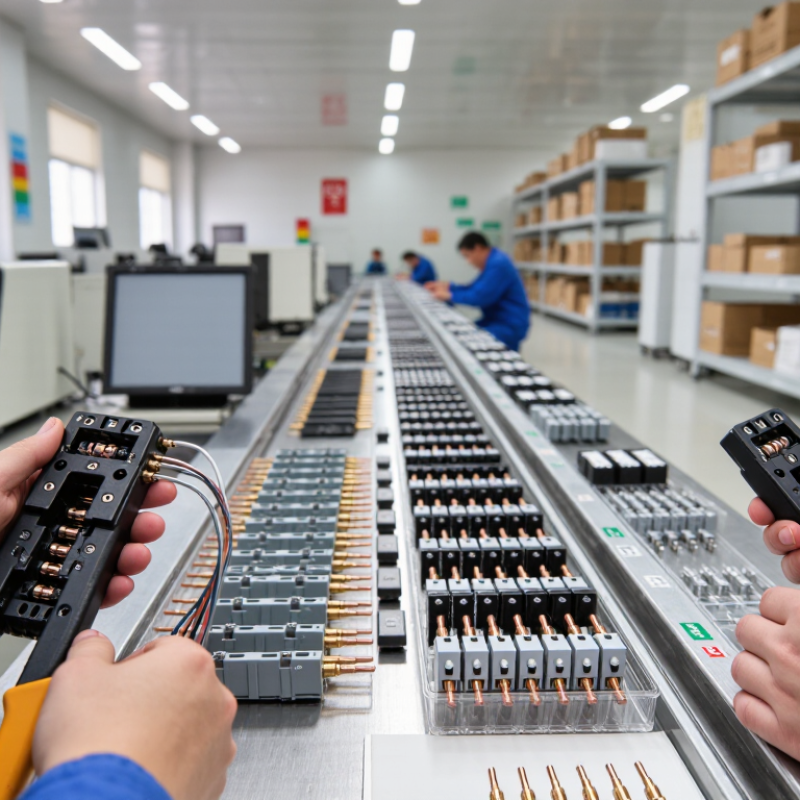
Define Your Wire Fuse Holder Requirements and Application Conditions
Before contacting a supplier in China, describe the electrical conditions clearly. Record the system voltage, normal current, maximum fault current, and fuse specification. Confirm the wire gauge and terminal style. A holder rated for 15 amperes may fail in a warmer enclosure. That detail is easy to miss.
Application conditions matter just as much. Note the installation location, operating temperature, humidity, vibration, dust, and possible chemical exposure. For outdoor equipment, request suitable sealing and corrosion resistance. For vehicles or machinery, check locking strength and strain relief. The holder should remain secure when wires move repeatedly. It must also allow safe fuse replacement.
Ask suppliers for test reports, dimensional drawings, material details, and traceable quality records. Check whether ratings were tested with the intended wire size and fuse type. During sample evaluation, inspect crimp quality, contact pressure, housing fit, and heat rise under load. Do not judge only by appearance. It can mislead.
A practical mistake is choosing the lowest quotation before defining these conditions. I have seen technically similar holders perform differently after extended heating. Request samples from qualified manufacturers, then compare them under realistic loads. Include photographs, temperature readings, and test duration in your evaluation record. If a supplier gives vague answers, pause the order and review the requirement sheet.
Choosing a wire fuse holder supplier in China requires more than comparing unit prices. In practical sourcing, small defects often appear at the crimp, spring, or plastic housing. Ask for production samples from current lots, not only polished showroom pieces. Test fuse fit, terminal grip, insulation, and temperature rise under the intended current. Keep records.
Request certificates for the exact product model and factory. Confirm each certificate’s scope, rating, issuing body, and validity. Relevant documents may include ISO 9001, IEC or UL test reports, and RoHS material declarations. Verify them directly where possible. Ask for reports covering dielectric strength, flame resistance, contact resistance, and mechanical endurance. Check whether testing used the same materials and tooling. A certificate can be genuine yet irrelevant. This is easy to miss.
Review the supplier’s incoming inspection, lot traceability, calibration, and change-control process. Ask how rejected parts are isolated. A useful audit follows one batch from resin receipt to final packing. Third-party pre-shipment inspection adds evidence, but it cannot replace your own application test. Requirements differ by market, so a qualified engineer should compare applicable standards and local rules. Test samples after vibration, heat cycling, and repeated fuse replacement. Early samples may pass. Production can drift. Leave acceptance criteria in writing, including dimensions, conductor range, torque, and defect limits.
A capable supplier should control stamping, molding, plating, and final assembly in-house. This reduces handoff delays and improves consistency between production batches. Ask about equipment, inspection points, and daily capacity before reviewing price. Details matter. Request sample reports for contact resistance, temperature rise, pull force, and dielectric strength. A reliable factory should explain test methods clearly, not only provide attractive certificates.
Customization is more than changing a logo or wire length. Discuss terminal materials, fuse size, insulation type, mounting style, and operating temperature. The supplier should offer drawings, tolerance reviews, and prototype samples before mass production. Confirm whether tooling belongs to you and how design changes are recorded.
Small differences can affect installation. I once underestimated wire routing space, and the finished assembly became difficult to service. That mistake taught me to review real installation conditions early.
Technical support often separates a useful partner from a simple component seller. Look for engineers who can answer questions about derating, vibration, moisture, and heat near terminals. They should provide clear specifications, traceable batch information, and corrective-action reports when failures occur.
Ask how quickly they respond to engineering changes. Also examine packaging and shipment controls, because damaged terminals can create hidden field problems.
A low quotation may hide limited testing or weak documentation. I still question every assumption, especially when a supplier promises unusually fast delivery.
Choosing a wire fuse holder supplier in China requires more than comparing unit prices. Request a full quotation with tooling, packaging, inspection, freight, and payment fees listed separately. A low price may hide costly adjustments later. Compare at least three offers using the same specifications, such as rated current, voltage, terminal material, and temperature range. Ask whether the quoted price applies to samples, pilot orders, or mass production.
Minimum order quantity deserves practical attention. A smaller MOQ can reduce inventory risk, but it may increase setup costs and packaging variation. Ask for price breaks at 500, 1,000, and 5,000 pieces. Confirm sample charges and whether they are refundable. Do not assume the cheapest trial order predicts the final cost. That assumption can fail.
Lead time should be divided into production, quality inspection, and transport. Require a written schedule for tooling approval and pre-shipment inspection. The World Bank’s Logistics Performance Index 2023 evaluates 139 economies through customs, infrastructure, tracking, and timeliness. Use these areas when reviewing a supplier’s export record. UNCTAD’s Review of Maritime Transport 2023 states that over 80% of global merchandise trade moves by sea, making port planning important. Check commercial invoices, packing lists, certificates of origin, and export packaging before payment. Ask for shipment tracking and a clear response process for delays. Good documentation is not glamorous. It prevents expensive confusion.
Typical sourcing benchmarks for comparing pricing, minimum orders, lead times, and export services
The benchmark uses a 100-point evaluation scale, where a higher score indicates a more favorable sourcing condition. Competitive wire fuse holder offers commonly target approximately US$0.08–0.35 per piece, minimum orders of around 1,000–10,000 pieces, standard production lead times of 15–30 days, and export support covering commercial invoices, packing lists, certificates, and shipping coordination. Actual results depend on specifications, order volume, customization, certification requirements, and destination market.
A reliable supplier should prove performance before discussing price. Request samples from a normal production lot, not only polished prototypes. Check terminal grip, contact resistance, fuse fit, and heat rise under rated current. For automotive applications, inspect crimp quality and pull-test records. A small detail matters: loose terminals can create heat inside a crowded harness. Ask for material certificates, flame ratings, and lot traceability. I have seen attractive samples fail when production tooling changed. That is why repeat sampling is worth the time.
Audit the factory beyond its showroom. Review ISO 9001 certification scope, inspection plans, calibration records, nonconformance reports, and corrective actions. Verify whether operators record torque, dimensions, and electrical test results. The 2024 MHI Annual Industry Report found that 83% of supply-chain leaders view innovation as a competitive advantage. This supports a practical question: can the supplier improve processes, or only quote quickly? Audit evidence should answer it. Do not accept certificates without checking issuing details.
Tips: Send the same technical checklist to three suppliers. Ask for two customer references using similar fuse ratings. Compare delivery consistency, complaint response time, and replacement handling. Customer feedback is useful, but not perfect; references may be carefully selected. Request evidence from recent shipments, such as inspection photos and packing records. Keep one sample for independent testing. A low price can still be expensive.
„Thanks to the LUVIR technology, the solder resist process could be switched directly from the previously used mask exposure to direct exposure. As an outstanding digital solution on the market, this technology has been able to demonstrate fast process times and superior quality on our certified conventional ink in production. This allowed us to fully digitize the solder mask process at low cost – without process or ink adjustments. An excellent benefit to our production in Rot am See.“
Ralf Göhringer (Head of Production WE Rot am See)
I would definitely recommend the Limata machine and team for a future company purchase
Michael Greenaway
Compunetics Inc.
“The Limata ldi has been amazing!! Best thing we did was buy this machine”
Richard Brady
GM
Circuitlabs
“Since 2019, we have been running the Limata X1000 LDI system (including LUVIR for solder mask imaging) in daily production as an addition to our current process with film. The machine was capable of properly exposing Taiyo PSR-4000 BN (DI) solder mask types on normal to high-copper boards using a new and unique direct imaging process. The machine operating interface is very user friendly which allowed for a quick technical training curve. The pre-registration processing reduced several seconds of production time at every print. Limata support and service staff is incomparable. They supported our team every step of the way at basically any time of the day or night, with literally, an immediate response time, customizing the software interface to best fit our Operations and needs.
We have exposed more than 8,000 prints since end of October, on various solder mask colors and some resist film panels. Limata, has proven to be very capable and innovative. They are a strong contender in the industry.
We have very much enjoyed this project, and working with the team!
Thank you Limata for the continued support and being a part of our growth.”
Bill Sezate
Vice President, GM
Summit Interconnect
As a replacement to our current contact exposure process with film, the LIMATA X2000 system including LUVIR-Technology was capable of properly exposing non-LDI solder mask types using a direct imaging process. The machine offers cutting edge software with a very intuitive operating interface which allowed for quick technician training curve. The dual drawer system combined with pre-registration processing reduced several seconds of production time at every machine cycle. Limata support and service staff is world class. They added software patches to keep production running at shortest possible response times, customized the software interface to best fit our in-house Operations system, and even wrote a step-by-step machine processing manual. As a result of the project, we have exposed more than 16,000 times on various product types and solder mask brands/colors. Limata, in a very short timeframe as a company, has definitely shown they are truly innovative and will be challenging the industry of direct imaging for the top spot.
Kevin Beattie
Process Engineer
TTM Technologies
Forest Grove Division
