Buying 201 304 430 Stainless Steel Plate by grade name alone can lead to costly mistakes. The right choice depends on the plate’s environment, fabrication needs, and expected service life. A sheet near a kitchen sink faces different conditions from one used in a dry indoor enclosure.
J.R. Davis, editor of ASM Specialty Handbook: Stainless Steels, offers a useful selection principle. In paraphrase: “Match the grade to the service environment, not just the price.” This is a paraphrase, not a verified verbatim quotation. The distinction matters. Grade 201 uses less nickel than 304 and relies more on manganese. Grade 304 suits many general-purpose applications. Grade 430 is ferritic, often magnetic, and may fit less demanding environments.
Price is only one detail. Check the mill test certificate, thickness tolerance, surface finish, and plate dimensions before ordering. Ask how the material will be formed, welded, cleaned, or exposed to moisture and salts. Small oversights can matter. A polished surface, for example, does not by itself guarantee suitable corrosion resistance.
These seven tips will help buyers compare grades with practical requirements in view. They also encourage a second look at assumptions: the cheapest plate may not be the best value, and a familiar grade may not fit every job. Verify the specification with the supplier. Then assess the material against the conditions it will actually face.
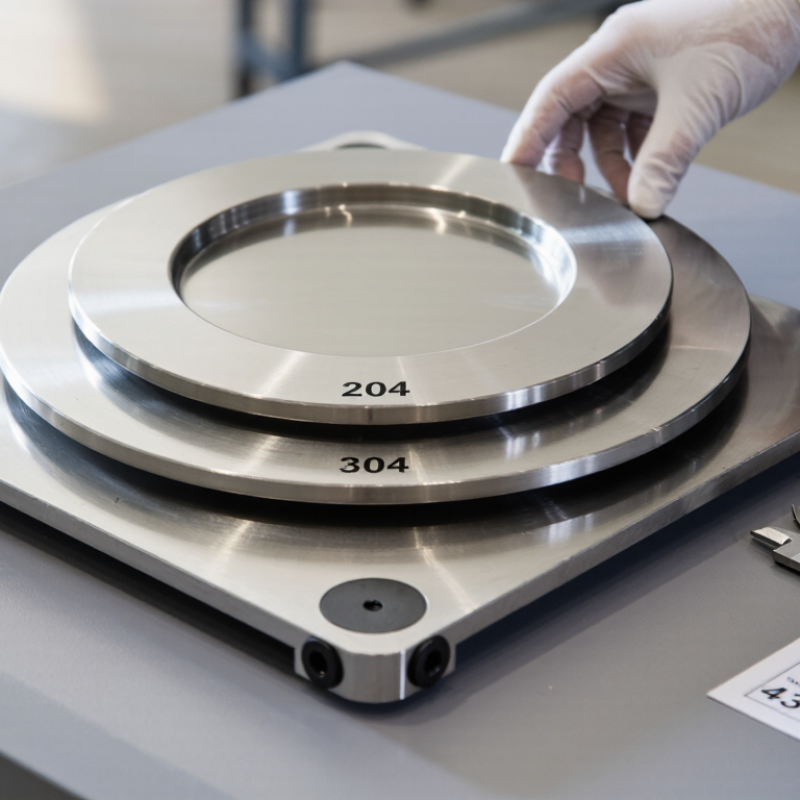
Choosing stainless steel plate starts with understanding what the grade can handle. Grade 201 uses less nickel and more manganese than 304, which can make it a cost-conscious option for indoor equipment and decorative panels. It may be less resistant to corrosion in damp or salty conditions. Check the actual environment, not just the price tag. Details matter.
Grade 304 contains chromium and nickel and is widely used for food-processing equipment, sinks, and general fabrication. It offers good corrosion resistance in many everyday settings, but harsh chemicals or coastal exposure can still cause damage. Grade 430 is a ferritic stainless steel with chromium and little or no nickel. It is magnetic and often suits indoor trim, appliance panels, and other mildly corrosive environments. A magnet test alone cannot confirm a grade; some 304 plate may become slightly magnetic after forming. Ask for material documentation and verify thickness, finish, and flatness against your needs. One point is easy to overlook: a cheaper plate can cost more later if it needs frequent cleaning or replacement. No grade is best for every job. When conditions are uncertain, compare samples in the setting where the plate will actually be used.
Understand the differences between the three grades before choosing a plate.
Approximate composition limits are shown in weight percent, based on common ASTM A240 grade requirements. The 430 nickel bar represents a maximum limit, not a guaranteed content range. Check the applicable specification and material test certificate when buying. In general, 304 offers broad corrosion resistance, 201 uses less nickel, and ferritic 430 is magnetic; confirm suitability for your environment, forming needs, and finish.
Tip 1: Match the grade to exposure, not price alone. Grade 201 can suit indoor equipment and general fabrication where corrosion demands are modest. Its lower nickel content can make it less suitable for damp, salty, or chemically aggressive conditions. Check the actual service environment. A dry kitchen panel and an outdoor coastal panel are not equivalent.
Tip 2: Choose 304 when moisture, regular cleaning, or food contact calls for stronger corrosion resistance. It is widely used for sinks, work surfaces, tanks, and processing equipment. Still, 304 is not immune to every chemical or chloride exposure. Review the operating conditions and cleaning agents before ordering. Ask for a material certificate when traceability matters.
Tip 3: Consider 430 for indoor appliance panels, trim, and other applications needing moderate corrosion resistance and magnetic response. It may be a practical option where severe exposure is unlikely. Details matter. Specify plate thickness, finish, forming, and welding needs alongside the grade. A common purchasing mistake is treating grades as interchangeable. That shortcut can lead to early staining or unnecessary cost. These guidelines are useful, but the final choice depends on the exact environment and fabrication process.
Tip 1: Choose thickness from the part’s job, not a habit. A tank wall, kitchen panel, and laser-cut bracket face different loads. Consider forming, welding, support spacing, and corrosion allowance before requesting a quote. Thicker is not always safer. It can add weight and complicate fabrication. I would still check the design calculations with a qualified engineer.
Tip 2: Specify the finish in measurable terms. “Smooth” means little on its own. State the finish designation and, when appearance or cleanability matters, the required roughness value (Ra). ASTM A480/A480M covers finish and dimensional tolerances for flat-rolled stainless steel. Its requirements help make supplier quotes comparable. A polished sample can look convincing, yet differ under bright inspection lighting.
Tip 3: Give exact dimensions and tolerances, including length, width, and thickness. Allow for cutting, forming, and edge preparation. World Stainless’s Stainless Steel in Figures 2024 reports 58.4 million tonnes of stainless crude steel production in 2023. That broad supply figure does not guarantee a specific size is readily available. Confirm stock dimensions and tolerances before finalizing drawings; this detail is easy to leave until too late.
| Tip | What to Check | 201, 304, and 430 Guide | Practical Buying Check |
|---|---|---|---|
| 1 | Match the grade to the environment. Consider moisture, cleaning chemicals, salt, and outdoor exposure. | 304 is commonly selected for general corrosion resistance. 201 is often used in less demanding environments. 430 is a magnetic ferritic grade commonly used for indoor applications with moderate corrosion requirements. | For coastal, chloride-rich, or frequently wet service, confirm that the grade is suitable for the specific exposure rather than choosing on price alone. |
| 2 | Verify the grade and material certificate. Do not rely on appearance or a magnet test alone. | Typical ASTM A240 composition ranges include 201: 16–18% chromium and 3.5–5.5% nickel; 304: 18–20% chromium and 8–10.5% nickel; 430: 16–18% chromium and no more than 0.75% nickel. | Request documentation identifying the grade, applicable specification, heat or batch number, and supplied dimensions. Composition limits should be checked against the specified standard and product form. |
| 3 | Choose thickness for the job. Account for loads, forming, welding, support spacing, and fabrication tolerances. | Thin sheet is easier to form but can dent or distort more readily; thicker plate is stiffer and heavier. Common commercial offerings span roughly 0.3 mm to 6 mm, but availability and the sheet-versus-plate cutoff vary by supplier and standard. | Specify thickness in millimetres or inches and state whether the required value is nominal or minimum. Confirm permitted thickness tolerances before ordering. |
| 4 | Specify the surface finish. Finish affects appearance, cleaning, reflectivity, and fabrication. | 2B is a common smooth, moderately reflective mill finish; BA is bright annealed and more reflective; No. 4 has a brushed appearance; No. 1 is a rougher hot-rolled, annealed, and pickled finish. | State the finish code and, for brushed finishes, the desired direction or sample standard. Protective film may be available for some finishes and should be specified if needed. |
| 5 | Confirm width and length. The right cut size can reduce scrap and extra processing. | Common stock widths include approximately 1,000, 1,219, 1,250, and 1,500 mm. Common sheet lengths include approximately 2,000, 2,438, 2,500, and 3,000 mm; actual stock sizes vary by grade, thickness, finish, and market. | Provide the required width and length, quantity, and whether pieces should be supplied as standard sheets or cut to size. Confirm dimensional tolerances and squareness requirements. |
| 6 | Consider magnetism and forming. Magnetic response can affect design or fabrication expectations. | Annealed 304 and 201 are generally austenitic and usually weakly magnetic or nonmagnetic, but cold working can induce some magnetism. 430 is ferritic and magnetic. | If magnetism matters, specify the requirement and discuss testing with the supplier. For deep drawing or tight bends, confirm the grade, temper, thickness, and minimum bend guidance for the intended process. |
| 7 | Check flatness, edges, and delivery protection. Handling condition affects cutting, assembly, and visible surfaces. | Surface condition, flatness, edge condition, and protective packaging can vary between mill-finished and cut-to-size material. Cut edges may require deburring or further finishing. | Record flatness and edge requirements, allowable surface marks, packaging, and inspection criteria in the purchase specification. Inspect dimensions and finish on receipt. |
Note: Stock dimensions and availability are illustrative, not universal standards. Confirm current sizes, tolerances, grade certification, and suitability for the intended service before purchasing.
When buying 201, 304, or 430 stainless steel plate, ask for a material test certificate linked to the specific heat or coil. The grade name alone is not enough. Check that the certificate lists chemical composition, mechanical properties, and the production standard agreed in your order. Compare the listed values with that standard, not just with a supplier’s product page. Check the details.
Traceability matters. The heat number on the certificate should match the plate tag or packing list. If plates arrive without clear identification, pause before cutting them; mixed stock can be difficult to spot by eye. For higher-risk applications, consider independent material testing. A handheld analyzer can help distinguish some alloys, but it may not verify every element or replace laboratory analysis.
Supplier quality also shows in routine controls. Ask how incoming material is checked, how measuring equipment is calibrated, and how nonconforming plates are handled. Request clear photos of markings and plate condition before shipment. Look for consistent records, not polished claims alone. Paperwork can look convincing and still contain gaps, so verify a sample order before committing to a larger volume. Keep records. Even careful buyers can miss a detail when specifications are rushed.
A low quote for 201, 304, or 430 stainless steel plate may not mean a lower final bill. Compare the full landed cost: plate price, cutting, packaging, freight, duties, and handling. Ask suppliers to quote the same dimensions, thickness tolerance, surface finish, and quantity. Otherwise, you may be comparing unlike products. Small differences add up.
Tip: Request a line-by-line quote. Include expected yield after cutting and the cost of offcuts or scrap. The 2024 Stainless Steel in Figures report from worldstainless records 58.4 million tonnes of global stainless-steel production in 2023. That figure describes market scale, not the price of a specific grade. Still, it is a useful reminder that supply and pricing can shift; verify current offers rather than relying on an old estimate.
For total cost, match the grade to the service conditions. Compare corrosion resistance, forming needs, and expected maintenance, not just price per kilogram. Ask for mill test certificates and confirm that the quoted material meets your specification. Also check lead time: a cheaper plate that delays production can cost more in overtime or idle equipment. Perhaps your first estimate will miss something. Recheck it against actual cutting plans and delivery terms.
„Thanks to the LUVIR technology, the solder resist process could be switched directly from the previously used mask exposure to direct exposure. As an outstanding digital solution on the market, this technology has been able to demonstrate fast process times and superior quality on our certified conventional ink in production. This allowed us to fully digitize the solder mask process at low cost – without process or ink adjustments. An excellent benefit to our production in Rot am See.“
Ralf Göhringer (Head of Production WE Rot am See)
I would definitely recommend the Limata machine and team for a future company purchase
Michael Greenaway
Compunetics Inc.
“The Limata ldi has been amazing!! Best thing we did was buy this machine”
Richard Brady
GM
Circuitlabs
“Since 2019, we have been running the Limata X1000 LDI system (including LUVIR for solder mask imaging) in daily production as an addition to our current process with film. The machine was capable of properly exposing Taiyo PSR-4000 BN (DI) solder mask types on normal to high-copper boards using a new and unique direct imaging process. The machine operating interface is very user friendly which allowed for a quick technical training curve. The pre-registration processing reduced several seconds of production time at every print. Limata support and service staff is incomparable. They supported our team every step of the way at basically any time of the day or night, with literally, an immediate response time, customizing the software interface to best fit our Operations and needs.
We have exposed more than 8,000 prints since end of October, on various solder mask colors and some resist film panels. Limata, has proven to be very capable and innovative. They are a strong contender in the industry.
We have very much enjoyed this project, and working with the team!
Thank you Limata for the continued support and being a part of our growth.”
Bill Sezate
Vice President, GM
Summit Interconnect
As a replacement to our current contact exposure process with film, the LIMATA X2000 system including LUVIR-Technology was capable of properly exposing non-LDI solder mask types using a direct imaging process. The machine offers cutting edge software with a very intuitive operating interface which allowed for quick technician training curve. The dual drawer system combined with pre-registration processing reduced several seconds of production time at every machine cycle. Limata support and service staff is world class. They added software patches to keep production running at shortest possible response times, customized the software interface to best fit our in-house Operations system, and even wrote a step-by-step machine processing manual. As a result of the project, we have exposed more than 16,000 times on various product types and solder mask brands/colors. Limata, in a very short timeframe as a company, has definitely shown they are truly innovative and will be challenging the industry of direct imaging for the top spot.
Kevin Beattie
Process Engineer
TTM Technologies
Forest Grove Division
