China’s SMC press industry is expanding with automotive electrification, lightweight transport, and demand for corrosion-resistant components. A Smc Slice Material Press converts pre-cut sheet molding compound into consistent panels, housings, and structural parts. Its value depends on more than rated tonnage.
Grand View Research estimated the global composites market at approximately USD 112.7 billion in 2023. Its report also projected strong growth through 2030, supported by transportation and construction applications. MarketsandMarkets has similarly identified compression molding as a key process for high-volume composite production. These figures describe broader markets, not China’s exact press rankings. That distinction matters.
As composites specialist Dr. Sanjay K. Mazumdar has stated, “A press is only as good as its process control.” This practical observation explains why buyers should examine platen parallelism, heating uniformity, hydraulic response, mold protection, and data logging. A machine may show impressive pressure on paper. It can still produce uneven thickness or resin-rich edges.
The strongest Chinese manufacturer is therefore not automatically the largest supplier. Buyers should request sample parts, cycle-time records, energy data, and references from comparable SMC applications. Factory audits remain useful. So does skepticism.
A reliable comparison should also examine after-sales engineering, spare-part availability, controller stability, and operator training. Small details become visible on the shop floor: temperature drift, slow mold opening, or inconsistent slice placement. The market is promising, but published claims can be incomplete. This guide evaluates China’s leading Smc Slice Material Press manufacturers through measurable performance, application experience, and documented customer support.
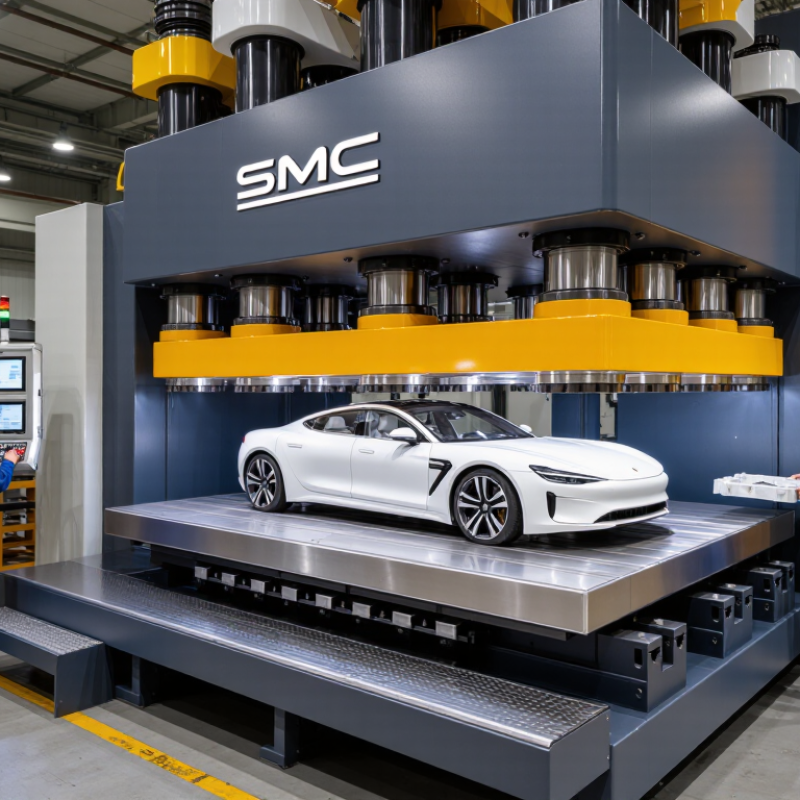
An SMC slice material press is industrial equipment used to shape measured pieces of Sheet Molding Compound into finished components. SMC combines resin, chopped glass fibers, mineral fillers, pigments, and curing agents. The press places this prepared charge inside a heated mold. Pressure then spreads the material through the cavity and forms the required geometry.
A reliable machine needs more than high closing force. Its hydraulic system should control pressure smoothly, while the heating plates should maintain even temperatures across the mold surface. Uneven heat can create weak areas, surface marks, or incomplete curing. Operators also check charge weight, placement, mold temperature, pressing time, and cooling conditions. Small changes matter. A few misplaced slices may cause flow lines or resin-rich edges.
For buyers comparing a China top SMC slice material press manufacturer, practical verification is essential. Ask for mold trials, pressure records, temperature uniformity data, and samples from comparable parts. Safety guarding, emergency stops, controlled access, and clear maintenance procedures should be visible during inspection. A large press is not automatically a better press. The correct capacity depends on part size, material volume, mold design, and production rhythm. In real factories, setup errors remain a frequent problem. Even advanced equipment can produce inconsistent parts when operators lack training or the process window is too narrow. Performance should be judged through repeatable results, not impressive specifications alone.
An SMC slice material press converts measured compound pieces into dense, shaped parts through controlled compression. The process begins with weighing and cutting the sheet into calculated charges. Operators place each charge inside a heated mold, often overlapping pieces for even coverage. This placement matters. Uneven loading can create thin corners, trapped air, or visible flow marks. A reliable press uses guided platens, calibrated heaters, and a hydraulic system that applies steady force. Pressure should not be treated as a magic number.
As the mold closes, heat softens the resin and reduces the compound’s resistance to flow. Hydraulic pressure drives the charge across ribs, corners, and inserts. Mold temperature activates curing, while pressure maintains contact with the cavity surface. Sensors track platen position, temperature, and pressure during each cycle. Venting channels release gases before they become voids. The timing is delicate. Too little heat can leave under-cured material. Excessive heat may shorten flow time and increase defects. Technicians adjust charge weight, closing speed, and dwell time after inspecting actual parts.
A practical manufacturer also checks frame stiffness, platen parallelism, guarding, and emergency controls. These details influence repeatability and operator safety. After curing, the press opens, and ejectors remove the component without damaging edges. Production trials often reveal that small temperature differences affect surface quality more than expected. That finding needs verification with every new mold. Process records, sample testing, and regular calibration make results easier to trust. Even a powerful press cannot correct poor material storage or careless charge preparation.
This chart shows a representative compression-molding cycle for sheet molding compound (SMC). SMC slices are placed into a heated mold, compressed to make the material flow and fill the cavity, held for curing, and then removed after the part has developed sufficient rigidity. Actual cycle times vary with part thickness, mold temperature, material formulation, and press capacity.
Leading manufacturers of SMC slice material presses combine practical engineering with consistent production control. Their machines often use rigid steel frames, balanced hydraulic cylinders, and accurately machined platens. These features help maintain even pressure across the mold surface. Stable heating systems also matter. They support uniform curing and reduce surface defects during repeated production cycles.
Experienced manufacturers usually provide adjustable pressure, temperature, closing speed, and dwell time. A clear control interface helps operators record each batch and identify process changes. Safety guards, emergency stops, and overload protection should be standard features. Reliable suppliers also test platen parallelism, hydraulic stability, and temperature accuracy before delivery. Factory experience is useful here, but it does not guarantee perfection. Some impressive specifications may hide weak after-sales support or limited customization.
Tips: Ask for sample testing with your actual SMC material. Check heating uniformity at several platen points. Request maintenance instructions, spare-part details, and training support. Inspect weld quality and hydraulic connections carefully. A slightly slower press may deliver better consistency than a faster machine with unstable control. Small gaps in communication can become expensive production problems.
China’s Top SMC Slice Material Press Manufacturer? How to Evaluate a Chinese SMC Press Supplier
Demand is rising. MarketsandMarkets’ 2024 report projects the global composites market to grow from about USD 95.6 billion in 2024 to USD 145.6 billion by 2029. This expansion makes supplier screening more important, not less. A reliable Chinese SMC press supplier should provide measurable evidence, not impressive photographs.
Check the press structure, hydraulic response, heating uniformity, and pressure stability. Request factory acceptance test records using your actual mold and compound. Ask for platen temperature mapping, pressure deviation, cycle-time data, and emergency-stop verification. A 1,000-ton press may sound sufficient, but mold area and projected charge pressure decide the real requirement. That detail is often missed.
Review ISO 9001 procedures, material traceability, welding inspections, and calibration certificates. Suppliers should explain steel grades, cylinder sealing, controller protection, and spare-parts availability. The machine should support documented risk assessment under ISO 12100 principles. Ask for customer references with similar part thickness and production volume. Visit the assembly floor if possible. Look closely at cable routing and oil leakage. Small signs matter.
A supplier promising zero maintenance deserves skepticism. No machine is perfect. Independent inspection before shipment can verify alignment, safety circuits, and performance against contract values. Compare total ownership cost, not only the quotation. Grand claims are cheap; repeatable test data is harder to fake.
SMC slice material presses shape sheet molding compound into strong, lightweight components. Their applications include automotive panels, electrical enclosures, utility boxes, and construction covers. Each product needs controlled heat, pressure, and holding time. A small temperature difference across the platen can create uneven curing or visible surface defects.
A reliable press should offer stable platen parallelism, repeatable pressure control, and accurate temperature monitoring. Typical production checks include mold alignment, hydraulic leakage, cycle repeatability, and emergency-stop performance. Electrical systems should follow applicable machinery safety requirements, such as IEC 60204-1. Quality management should also include documented procedures and traceability, often supported by ISO 9001 practices.
Material testing matters too. Tensile, flexural, impact, and dimensional tests can verify whether molded parts meet the customer’s specification. Records should connect each result with the material batch, mold, operator, and press cycle. This detail sounds basic. It prevents difficult disputes later.
Experienced engineers also inspect the first molded pieces under real production conditions. Laboratory results alone may not reveal fiber marks, edge cracks, or warpage after cooling. In practice, perfect uniformity is difficult. Press suppliers should admit process limits and help adjust temperature zones, pressure curves, and mold ventilation. A low purchase price may look attractive, but unstable cycles can increase scrap, maintenance time, and delivery risk.
| Application Area | Typical SMC Material Characteristics | Recommended Press Configuration | Typical Molding Conditions | Key Quality Requirements | Relevant Test or Reference Standard |
|---|---|---|---|---|---|
| Automotive body panels and structural covers | Glass-fiber-reinforced thermoset sheet molding compound with controlled shrinkage and good surface appearance. | Four-column hydraulic press with rigid platens, parallelism control, mold-temperature monitoring, and automatic pressure holding. | Mold temperature commonly about 140–170 °C; molding pressure commonly about 5–15 MPa; cycle time depends on part thickness, resin system, and mold design. | Uniform wall thickness, low warpage, controlled fiber distribution, acceptable surface class, accurate trimming, and repeatable dimensional results. | ISO 527 for tensile properties; ISO 178 for flexural properties; ISO 75 for temperature of deflection under load; drawing-specific dimensional inspection. |
| Electrical enclosures and distribution components | Electrically insulating SMC, often formulated for dielectric strength, tracking resistance, flame behavior, and dimensional stability. | Hydraulic press with insulated tooling, programmable pressure stages, reliable platen parallelism, and safety interlocks. | Mold temperature commonly about 140–170 °C; pressure and cure time must be validated against the compound datasheet and component geometry. | Dielectric performance, insulation resistance, tracking resistance, flame classification where required, burr control, and stable hole locations. | IEC 60112 for comparative tracking index testing; IEC 60695-11-10 for horizontal and vertical flame testing; ISO 527 and ISO 178 for mechanical verification. |
| Electrical meter boxes and utility cabinets | Weather-resistant SMC with low water absorption, corrosion resistance, and suitable outdoor aging performance. | Large daylight hydraulic press with high mold-opening clearance, balanced filling support, and controlled ejection. | Temperature and pressure are selected according to the resin formulation; process records should include mold temperature, pressure, closing time, and cure time. | Weathering resistance, impact strength, water absorption, sealing-surface flatness, enclosure dimensions, and consistent color or surface texture. | ISO 62 for water absorption; ISO 179 or ISO 180 for impact testing; ISO 4892-2 for laboratory accelerated weathering when specified. |
| Construction panels, access covers, and drainage components | High-strength glass-fiber SMC designed for stiffness, corrosion resistance, slip-resistant surfaces, or load-bearing performance. | High-tonnage press with a reinforced frame, robust mold guidance, synchronized hydraulic control, and sufficient daylight for textured tools. | Pressure is determined by projected area, part geometry, and material flow; the required press capacity should be calculated rather than selected by part weight alone. | Load capacity, stiffness, impact resistance, slip resistance, surface uniformity, edge integrity, and resistance to moisture and chemicals. | ISO 178 for flexural properties; ISO 179 or ISO 180 for impact properties; project-specific load, slip, and environmental tests. |
| HVAC housings, fan covers, and equipment panels | SMC selected for dimensional stability, vibration resistance, corrosion resistance, and a controlled cosmetic finish. | Programmable hydraulic press with pressure ramp control, mold-temperature zones, quick mold change features, and automated part removal where appropriate. | Typical mold temperatures are approximately 140–170 °C; cure time varies with thickness, formulation, and insert arrangement. | Low distortion, secure inserts, controlled noise and vibration interfaces, clean trimming, corrosion resistance, and repeatable fit-up. | ISO 527, ISO 178, and ISO 75 for material performance; ISO 4892-2 or equivalent environmental testing when outdoor exposure is required. |
| Industrial machine guards and protective covers | Impact-resistant SMC with adequate stiffness, chemical resistance, and stable performance over the intended operating temperature range. | Press with accurate mold alignment, controlled closing speed, programmable holding pressure, and an ejection system that protects thin sections. | Use validated temperature, pressure, and cure profiles; avoid excessive closing speed that can cause material displacement or trapped air. | Impact resistance, edge safety, hole accuracy, consistent thickness, absence of voids or delamination, and reliable fastening points. | ISO 179 or ISO 180 for impact testing; ISO 178 for flexural properties; visual and dimensional inspection based on the approved drawing. |
| General SMC production and quality control | Thermoset composite sheet containing resin, chopped glass fiber, mineral fillers, additives, and curing components; formulation must be matched to the application. | Press selection should consider required closing force, platen size, daylight, stroke, mold weight, automation needs, energy efficiency, and service access. | Monitor platen parallelism, mold temperature, hydraulic pressure, closing speed, cure time, and ejection sequence; establish a documented process window. | Incoming material checks, first-article approval, process capability monitoring, traceability, preventive maintenance, calibration, and final inspection records. | ISO 9001 quality-management principles; ISO 527, ISO 178, ISO 75, ISO 179, ISO 180, and application-specific customer or regulatory requirements. |
Note: The listed molding temperatures and pressures are general engineering ranges for thermoset SMC compression molding. Final settings must be confirmed through material supplier data, mold trials, part geometry, and validated production testing.
„Thanks to the LUVIR technology, the solder resist process could be switched directly from the previously used mask exposure to direct exposure. As an outstanding digital solution on the market, this technology has been able to demonstrate fast process times and superior quality on our certified conventional ink in production. This allowed us to fully digitize the solder mask process at low cost – without process or ink adjustments. An excellent benefit to our production in Rot am See.“
Ralf Göhringer (Head of Production WE Rot am See)
I would definitely recommend the Limata machine and team for a future company purchase
Michael Greenaway
Compunetics Inc.
“The Limata ldi has been amazing!! Best thing we did was buy this machine”
Richard Brady
GM
Circuitlabs
“Since 2019, we have been running the Limata X1000 LDI system (including LUVIR for solder mask imaging) in daily production as an addition to our current process with film. The machine was capable of properly exposing Taiyo PSR-4000 BN (DI) solder mask types on normal to high-copper boards using a new and unique direct imaging process. The machine operating interface is very user friendly which allowed for a quick technical training curve. The pre-registration processing reduced several seconds of production time at every print. Limata support and service staff is incomparable. They supported our team every step of the way at basically any time of the day or night, with literally, an immediate response time, customizing the software interface to best fit our Operations and needs.
We have exposed more than 8,000 prints since end of October, on various solder mask colors and some resist film panels. Limata, has proven to be very capable and innovative. They are a strong contender in the industry.
We have very much enjoyed this project, and working with the team!
Thank you Limata for the continued support and being a part of our growth.”
Bill Sezate
Vice President, GM
Summit Interconnect
As a replacement to our current contact exposure process with film, the LIMATA X2000 system including LUVIR-Technology was capable of properly exposing non-LDI solder mask types using a direct imaging process. The machine offers cutting edge software with a very intuitive operating interface which allowed for quick technician training curve. The dual drawer system combined with pre-registration processing reduced several seconds of production time at every machine cycle. Limata support and service staff is world class. They added software patches to keep production running at shortest possible response times, customized the software interface to best fit our in-house Operations system, and even wrote a step-by-step machine processing manual. As a result of the project, we have exposed more than 16,000 times on various product types and solder mask brands/colors. Limata, in a very short timeframe as a company, has definitely shown they are truly innovative and will be challenging the industry of direct imaging for the top spot.
Kevin Beattie
Process Engineer
TTM Technologies
Forest Grove Division
