Choosing a Lead Radial Capacitor manufacturer is not just a matter of comparing prices. These components appear in power supplies, control boards, lighting equipment, and many other electronic products. Their performance depends on details such as capacitance, voltage rating, temperature range, ripple current, and expected service life. Small differences can matter.
This guide introduces ten manufacturers in China and outlines practical points for evaluating them. It is intended as a starting point, not a definitive ranking. A supplier’s catalog may show familiar specifications, but buyers should also request current datasheets, production information, and sample parts. Details matter. Check whether the stated dimensions match your board layout, and confirm lead spacing before committing to a large order. Ask how the manufacturer handles quality checks and whether test reports are available for the specific series under consideration. A polished website alone is not proof of consistent production.
The comparison also considers product range, communication, customization options, and support for repeat orders. These factors can affect project schedules as much as the component itself. Not every listing tells the whole story. Specifications can vary between product series, and online information may be incomplete or out of date. That takes checking. Use the profiles to build a shortlist, then verify requirements directly with each company. Careful review helps buyers choose a Lead Radial Capacitor supplier that fits their electrical, mechanical, and sourcing needs.
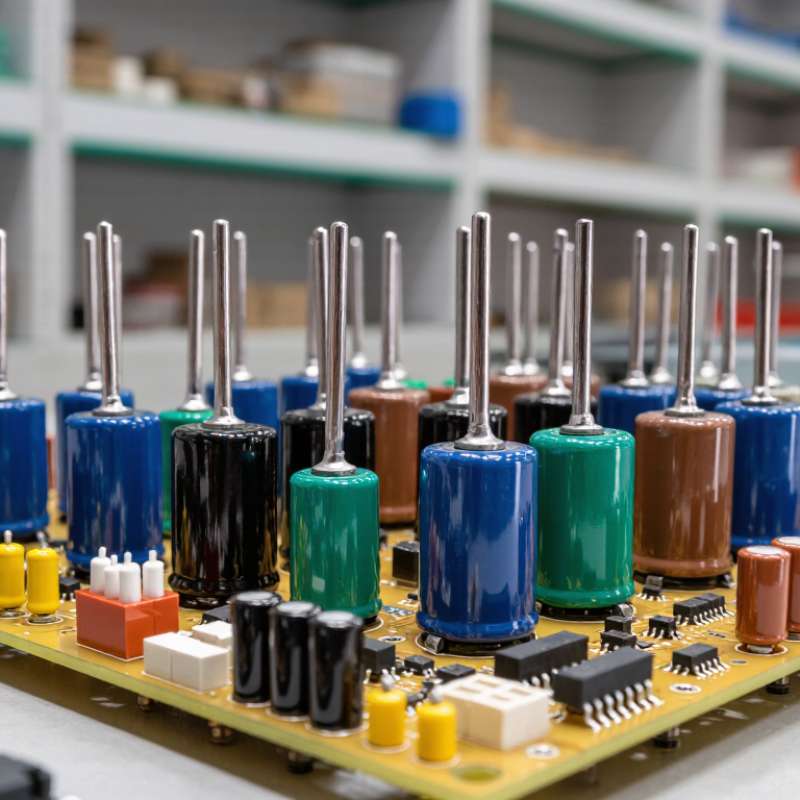
Radial lead capacitors use two wires exiting the same end of a cylindrical case. Aluminum electrolytic types contain etched foil, electrolyte, and a separator; their polarity matters. The marked negative stripe identifies the negative lead, while the longer lead is often positive—but trimming can remove that clue. Reverse voltage can damage the dielectric and shorten service life. IEC 60384-4 specifies qualification checks for aluminum electrolytic capacitors, including endurance, leakage current, and capacitance change. It does not provide one universal lifetime for every component.
Read the rated capacitance, voltage, temperature, and ripple-current limit together. A 1,000 μF part rated at 25 V is not automatically a safe replacement for one rated at 35 V. Ripple current creates heat inside the case, and higher temperature generally accelerates aging. IEC 60384-1 provides the generic framework for fixed capacitors, while IEC 60384-4 covers aluminum electrolytic types. Check the manufacturer’s datasheet for test conditions; numbers without temperature and frequency context can mislead. Small detail, big consequence.
Tips: Before installation, match the polarity stripe to the circuit diagram and confirm the voltage rating exceeds the circuit’s maximum. Leave space around the body for cooling. If a capacitor feels warm in operation, investigate ripple current and airflow rather than assuming the rating alone tells the whole story.
How to Rank 10 Chinese Manufacturers Using IEC 60384-4 Criteria
A credible ranking starts with comparable evidence, not catalogue claims. IEC 60384-4 covers fixed aluminium electrolytic capacitors, including solid and non-solid electrolyte types. Compare manufacturers within matching capacitance, rated voltage, temperature range, and endurance conditions. Check documented capacitance tolerance, leakage current, dissipation factor, and endurance-test results. Ask for dated test reports and traceable production-lot records. A polished datasheet is useful, but it cannot prove every batch performs alike.
Tips: Build a scoring sheet with separate points for IEC qualification evidence, test completeness, delivery consistency, and technical support. Do not treat missing data as a pass. Grand View Research’s Aluminum Electrolytic Capacitor Market report estimated the global market at about US$7.4 billion in 2023. That figure signals a substantial, competitive sector; it does not verify any supplier’s product quality. Keep market context separate from technical scoring.
For a fair top-ten list, compare samples under identical test conditions and record deviations, not just pass results. Inspect radial lead spacing, sleeve condition, and markings on physical samples. Confirm that the tested series matches the offered series. Small gaps matter. Some suppliers may provide strong laboratory data but limited batch history, so rankings should state their evidence limits.
A proposed framework for comparing manufacturers against IEC 60384-4 evidence. The standard specifies requirements and tests; it does not rank manufacturers.
Each criterion is assigned an equal 20% share as a transparent comparison rubric, not as a weighting mandated by IEC 60384-4. A defensible Top 10 requires comparable product-level test reports and technical documentation; no manufacturer scores are shown here.
Profiles of ten Chinese radial-capacitor manufacturers are most useful when they compare engineering choices, not catalog size. Fortune Business Insights’ Capacitor Market report estimated the global market at USD 22.55 billion in 2023. That figure covers many capacitor types, not radial parts alone. It signals broad demand, but is not a radial-capacitor sales estimate. A useful starting point.
Compare each manufacturer’s product lines: general-purpose aluminum electrolytic, low-impedance, high-temperature, long-life, and radial polymer capacitors. Check capacitance, voltage, case dimensions, operating temperature, endurance, and ripple-current ratings. These details matter when a capacitor must fit a crowded power-supply board or withstand heat near a transformer. Catalog breadth alone proves little.
The strongest profiles also explain testing and documentation. Look for stated endurance conditions, tolerance ranges, and datasheets that match the offered series. Product lines may serve LED drivers, industrial controls, and consumer power supplies, but application labels need verification against actual ratings. One limitation remains: published test conditions can differ, making direct comparisons imperfect. Buyers should confirm samples and current specifications before choosing a series.
For leaded aluminum electrolytic capacitors, ±20% capacitance tolerance is a common catalog benchmark, not a universal requirement. A 1,000 µF part could therefore measure from 800 to 1,200 µF at its specified test conditions. IEC 60384-4:2016 sets requirements for aluminum electrolytic capacitors, while individual datasheets define measurement frequency, temperature, and permitted tolerance. Check those conditions before comparing suppliers.
ESR matters because it converts ripple current into heat: power loss is approximately I² × ESR. Even a small ESR rise can increase case temperature when ripple current is high. Datasheets usually state ripple-current limits at particular frequencies and temperatures; those figures are not directly comparable without matching conditions. A useful benchmark is the actual circuit’s ripple spectrum, not a single headline rating.
Easy to overlook.
Tips: Compare parts at the same capacitance, voltage, frequency, and temperature. Verify ESR at the operating frequency, then check ripple-current derating and expected capacitor temperature. Leave margin. A tidy comparison table helps, but it can still hide differences in test methods and service-life assumptions.
Reading 105°C Load-Life Ratings: Common 2,000–10,000-Hour Ranges
A 105°C load-life rating describes a controlled endurance test, not a guaranteed service life inside every product. Common ratings range from 2,000 to 10,000 hours. The test applies specified temperature, voltage, and ripple current, then checks whether the capacitor remains within stated limits. Check the datasheet conditions carefully. Two parts with the same hour rating may have different test requirements. Small details matter.
In real equipment, temperature near the capacitor can rise above the surrounding air temperature. Ripple current adds internal heating, while higher operating voltage can increase stress. These factors may shorten useful life. Lower temperatures often help, but simple life-doubling rules are estimates, not promises. A 5,000-hour rating can be reassuring, yet it cannot predict a specific device’s lifetime without its operating conditions. That part is easy to overlook.
Tips: Measure the temperature near the capacitor, not just room temperature. Compare expected ripple current and voltage with the datasheet limits, and leave practical margin where possible. Record assumptions during design review; estimates sometimes get copied forward without being checked.
„Thanks to the LUVIR technology, the solder resist process could be switched directly from the previously used mask exposure to direct exposure. As an outstanding digital solution on the market, this technology has been able to demonstrate fast process times and superior quality on our certified conventional ink in production. This allowed us to fully digitize the solder mask process at low cost – without process or ink adjustments. An excellent benefit to our production in Rot am See.“
Ralf Göhringer (Head of Production WE Rot am See)
I would definitely recommend the Limata machine and team for a future company purchase
Michael Greenaway
Compunetics Inc.
“The Limata ldi has been amazing!! Best thing we did was buy this machine”
Richard Brady
GM
Circuitlabs
“Since 2019, we have been running the Limata X1000 LDI system (including LUVIR for solder mask imaging) in daily production as an addition to our current process with film. The machine was capable of properly exposing Taiyo PSR-4000 BN (DI) solder mask types on normal to high-copper boards using a new and unique direct imaging process. The machine operating interface is very user friendly which allowed for a quick technical training curve. The pre-registration processing reduced several seconds of production time at every print. Limata support and service staff is incomparable. They supported our team every step of the way at basically any time of the day or night, with literally, an immediate response time, customizing the software interface to best fit our Operations and needs.
We have exposed more than 8,000 prints since end of October, on various solder mask colors and some resist film panels. Limata, has proven to be very capable and innovative. They are a strong contender in the industry.
We have very much enjoyed this project, and working with the team!
Thank you Limata for the continued support and being a part of our growth.”
Bill Sezate
Vice President, GM
Summit Interconnect
As a replacement to our current contact exposure process with film, the LIMATA X2000 system including LUVIR-Technology was capable of properly exposing non-LDI solder mask types using a direct imaging process. The machine offers cutting edge software with a very intuitive operating interface which allowed for quick technician training curve. The dual drawer system combined with pre-registration processing reduced several seconds of production time at every machine cycle. Limata support and service staff is world class. They added software patches to keep production running at shortest possible response times, customized the software interface to best fit our in-house Operations system, and even wrote a step-by-step machine processing manual. As a result of the project, we have exposed more than 16,000 times on various product types and solder mask brands/colors. Limata, in a very short timeframe as a company, has definitely shown they are truly innovative and will be challenging the industry of direct imaging for the top spot.
Kevin Beattie
Process Engineer
TTM Technologies
Forest Grove Division
