China’s top ten Polymer Tape Casting Machine manufacturers are worth comparing by more than price or catalog specifications. For battery separators, ceramic-filled films, and specialty polymer sheets, buyers need steady coating width, a controllable casting gap, and drying that does not leave visible waves or uneven edges. Small variations matter. A web that looks smooth at the machine may still show thickness drift after drying. This guide introduces ten Chinese manufacturers and considers their equipment, customization options, production experience, and available technical support. Claims should be checked against real trial data, not just polished brochures.
R. E. Mistler and E. R. Twiname are established authors on tape casting. A practical paraphrase of the process-control principles in their work is: “Treat slurry, casting gap, and drying as one connected system.” That is useful guidance, not a verified verbatim quotation. When assessing a Polymer Tape Casting Machine, ask how it handles viscosity changes, adjustable blade settings, web tension, and temperature control across drying zones. Request sample tapes, measured thickness results, and details about commissioning and spare parts. A neat machine photo proves little. This comparison also has limits: public company information can be incomplete, and factory capabilities change. Verify important specifications directly before making a decision.
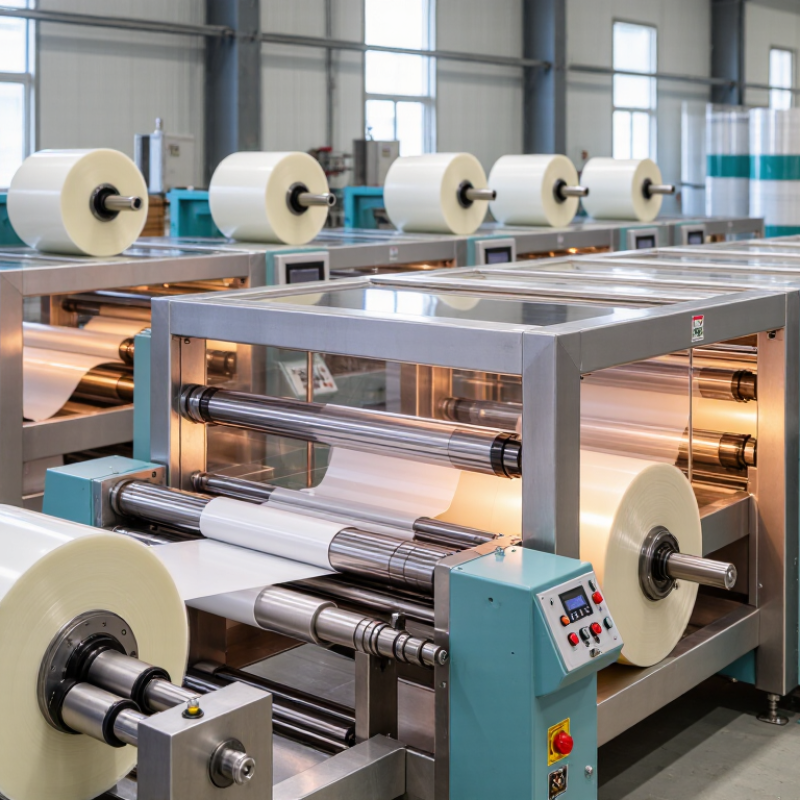
Polymer tape casting forms a continuous, thin web by spreading polymer onto a moving carrier or chill roll. In solution casting, a metered liquid film passes through a controlled drying zone; melt casting instead sends heated polymer through a flat die and onto cooled rolls. The choice depends on polymer chemistry, thickness targets, and solvent-handling needs. Common equipment includes knife-over-roll and slot-die coaters, plus T-die extrusion lines.
Material selection shapes the process. Flexible films may use thermoplastic elastomers or polyolefins, while specialty tapes can use polymer dispersions or blends.
Operators monitor web tension, coating gap, melt temperature, and drying conditions; small changes can cause wrinkles, pinholes, or uneven thickness. Plastics Europe’s Plastics—The Fast Facts 2024 reports 413.8 million tonnes of global plastics production in 2023. This is broad industry context, not a measure of tape-casting demand. A practical limitation: laboratory settings may not transfer cleanly to full-width production.
Tips: Check coating weight across the web, not only at its center. Record temperature and line speed together. Keep samples from each trial. Small details matter.
Comparing China’s top ten polymer tape casting machine manufacturers requires more than checking line speed. Thickness control should be verified against ISO 4593, which describes mechanical scanning for plastic film and sheeting. A useful trial records readings across the web, not only at the center. Small errors matter. Edge beads, bubbles, and a drifting die gap can create uneven tape, even when the average thickness looks acceptable. Ask for raw measurement logs and gauge calibration records.
Tensile performance needs separate scrutiny. ASTM D882 covers tensile properties of thin plastic sheeting, including strength and elongation; test results depend on specimen preparation and test conditions. Compare results from the same resin, thickness, and conditioning protocol. PlasticsEurope’s Plastics – the Fast Facts 2024 reports global plastics production of 413.8 million tonnes in 2023. That broad figure is not a tape-market estimate, but it shows the scale of material processing behind film applications. A practical weakness remains: many machine brochures show averages, not cross-web profiles or repeated tensile results. Buyers should request both, then check whether the casting line can reproduce them during a sustained run.
Manufacturer-neutral evaluation framework. The entries below define measurable comparison criteria; machine-specific results and acceptance limits should be established through documented factory and site acceptance tests.
| No. | Benchmark dimension | Data to record | Unit / verification basis |
|---|---|---|---|
| 1 | Finished tape thickness | Record thickness readings across the web and along the roll, with sampling locations and test conditions. | µm; ISO 4593 mechanical scanning method for film and sheeting thickness |
| 2 | Thickness variation | Report the measured minimum, maximum, mean, and variation using the same sampling plan for each machine. | µm and %; readings obtained using ISO 4593 |
| 3 | Tensile strength at break | Test specimens cut in both machine and transverse directions; document specimen dimensions and test conditions. | MPa; ASTM D882 |
| 4 | Elongation at break | Report elongation separately for machine-direction and transverse-direction specimens. | %; ASTM D882 |
| 5 | Usable casting width | Measure the usable finished width after edge trimming and identify the tested material and die setup. | mm; measured at the finished web |
| 6 | Stable production speed | Record sustained line speed while meeting the agreed thickness and product-quality requirements; distinguish it from maximum mechanical speed. | m/min; acceptance-test run log |
| 7 | Output rate | Record net conforming output and the corresponding material, width, thickness, and operating speed. | kg/h; weighed production over a documented run |
| 8 | Start-up and steady-state consistency | Record time to reach agreed product limits after start-up or a defined process change, plus the amount of nonconforming material. | min and kg; documented trial protocol |
| 9 | Winding quality | Assess roll edge alignment, telescoping, wrinkles, and roll hardness using agreed inspection criteria. | Inspection record; defined roll and visual criteria |
| 10 | Energy consumption per output | Measure electricity use during the same stable production run used to determine conforming output. | kWh/kg of conforming product; metered run data |
A useful profile of China’s ten polymer tape casting machine manufacturers should compare engineering choices, not just catalogue claims. PlasticsEurope’s Plastics—the Fast Facts 2024 reports 413.8 million tonnes of global plastics production in 2023, with China accounting for 33.3%. This is a broad industry indicator, not a measure of tape-casting machine sales. That distinction matters. For each manufacturer, examine whether its product range covers laboratory coaters, pilot lines, or continuous production equipment. Check working width, coating-thickness control, dryer zones, and winding tension. These details shape the finished web, especially when thin polymer layers show uneven edges or wrinkles.
Process capability deserves equal attention. Compare slurry or solution handling, metering methods such as doctor-blade coating, drying control, and options for water-based or solvent-based formulations. Ask for trial data on the buyer’s actual material; a stated line speed alone proves little. Useful profiles also explain available inspection systems, cleaning access, changeover time, and after-sales technical support.
The ranking is imperfect.
Public specifications may omit tolerances, and similar machines can perform differently with different formulations. A careful comparison should separate verified test results from sales estimates, and record product ranges by substrate, coating method, and production scale.
When comparing China’s top polymer tape casting machine manufacturers, look beyond the advertised maximum line speed. A fast line is useful only if the melt stays uniform and the web remains stable. Ask for trial data at your target resin, width, and thickness. Watch the edge of the film, not just the control screen. Small details matter.
Casting width affects more than output. A wider die may raise production capacity, but it can also make cross-web thickness control harder. Compare usable width with your actual product range, and check whether the machine supports quick, repeatable die adjustments. Request thickness measurements from several points across a sample roll. One reading is not enough. The figures should reflect real operating conditions, not an ideal setup.
Temperature control deserves equal attention. Ask how many heating zones are used, where sensors sit, and how quickly the system recovers after a change. Stable readings can reduce defects, but they do not guarantee a consistent film if material feed or cooling varies. During a factory acceptance trial, record speed, width, thickness variation, and temperature together. These comparisons take time, and the test conditions may not match your plant perfectly. That uncertainty is worth noting before choosing a machine.
When comparing China’s top 10 polymer tape casting machine manufacturers, look beyond quoted line speed. Ask for usable coating width, stable production speed, dryer-zone temperatures, and achievable wet and dry thickness ranges. Request trial data using a polymer slurry similar to yours, not just a polished demonstration. Small details matter.
Automation should improve repeatability, not merely add screens. Check whether tension control, web guiding, temperature logging, and alarms are integrated. The International Federation of Robotics reported 4.28 million industrial robots operating worldwide in 2023, a 10% increase from 2022, in its World Robotics 2024 report. This wider shift toward automation makes controls and operator training important purchasing questions. No specification sheet captures every startup problem.
Review quality records, traceability, guarding, and environmental controls, then confirm which standards and conformity documents apply in your destination market. Ask how the supplier handles installation, spare parts, remote troubleshooting, and response times. Get service commitments in writing. A lower purchase price can become expensive when a coating line sits idle. Factory acceptance tests help, but they cannot reproduce every production condition; leave room for adjustments after installation.
„Thanks to the LUVIR technology, the solder resist process could be switched directly from the previously used mask exposure to direct exposure. As an outstanding digital solution on the market, this technology has been able to demonstrate fast process times and superior quality on our certified conventional ink in production. This allowed us to fully digitize the solder mask process at low cost – without process or ink adjustments. An excellent benefit to our production in Rot am See.“
Ralf Göhringer (Head of Production WE Rot am See)
I would definitely recommend the Limata machine and team for a future company purchase
Michael Greenaway
Compunetics Inc.
“The Limata ldi has been amazing!! Best thing we did was buy this machine”
Richard Brady
GM
Circuitlabs
“Since 2019, we have been running the Limata X1000 LDI system (including LUVIR for solder mask imaging) in daily production as an addition to our current process with film. The machine was capable of properly exposing Taiyo PSR-4000 BN (DI) solder mask types on normal to high-copper boards using a new and unique direct imaging process. The machine operating interface is very user friendly which allowed for a quick technical training curve. The pre-registration processing reduced several seconds of production time at every print. Limata support and service staff is incomparable. They supported our team every step of the way at basically any time of the day or night, with literally, an immediate response time, customizing the software interface to best fit our Operations and needs.
We have exposed more than 8,000 prints since end of October, on various solder mask colors and some resist film panels. Limata, has proven to be very capable and innovative. They are a strong contender in the industry.
We have very much enjoyed this project, and working with the team!
Thank you Limata for the continued support and being a part of our growth.”
Bill Sezate
Vice President, GM
Summit Interconnect
As a replacement to our current contact exposure process with film, the LIMATA X2000 system including LUVIR-Technology was capable of properly exposing non-LDI solder mask types using a direct imaging process. The machine offers cutting edge software with a very intuitive operating interface which allowed for quick technician training curve. The dual drawer system combined with pre-registration processing reduced several seconds of production time at every machine cycle. Limata support and service staff is world class. They added software patches to keep production running at shortest possible response times, customized the software interface to best fit our in-house Operations system, and even wrote a step-by-step machine processing manual. As a result of the project, we have exposed more than 16,000 times on various product types and solder mask brands/colors. Limata, in a very short timeframe as a company, has definitely shown they are truly innovative and will be challenging the industry of direct imaging for the top spot.
Kevin Beattie
Process Engineer
TTM Technologies
Forest Grove Division
