Choosing a single Jersey machine supplier involves more than comparing catalogue prices. Buyers need to match machine specifications with their fabric, production volume, and operating conditions. This guide to China’s top 10 manufacturers offers a starting point for that assessment, not a universal ranking. Different factories value different things.
A practical comparison should look at machine diameter, gauge, feeder configuration, control systems, and the availability of spare parts. Ask manufacturers for clear technical documents and references from installations with similar production needs. A sample fabric can also help reveal stitch consistency, surface appearance, and whether the machine suits the intended yarn. Small details matter. So does service.
Some suppliers may focus on high-volume production, while others offer more flexible configurations or customer support. These differences can be hard to judge from a website alone. Price, delivery time, and advertised output are useful signals, but they do not tell the whole story. Buyers should confirm what is included, how output figures were measured, and who provides installation or maintenance guidance. Not every mill needs the same setup. And a ranked list can simplify a complicated decision too much. Treat it as a shortlist, then verify each manufacturer’s capabilities against your own requirements.
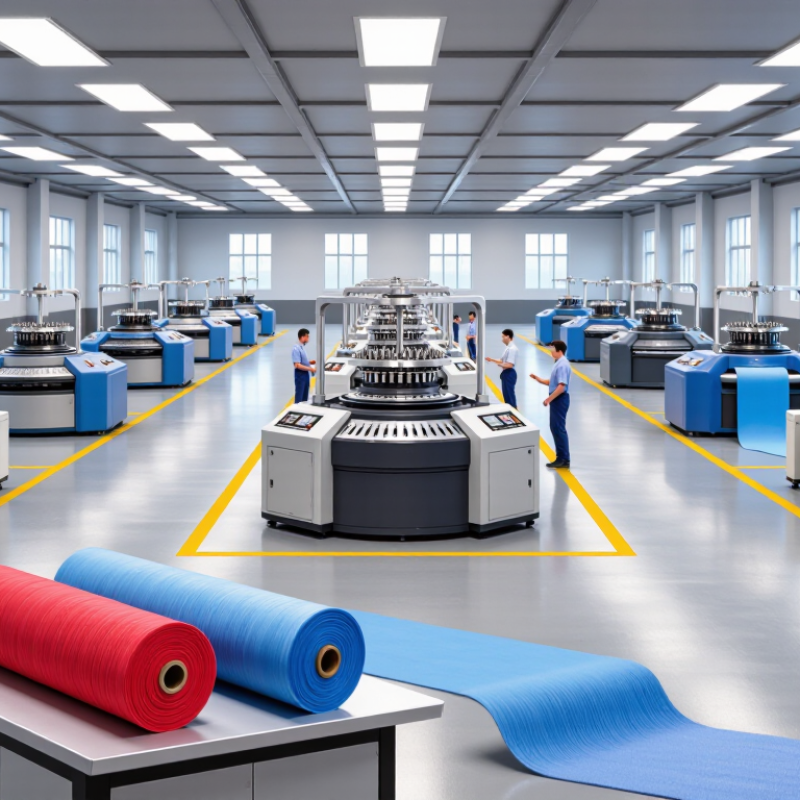
A single jersey knitting machine forms lightweight, plain-knit fabric using one needle bed arranged in a cylinder. As the cylinder rotates, needles rise and fall to catch yarn and make loops. Feeders supply yarn around the machine, while a take-down system draws the fabric downward. The result is a flexible fabric with a smooth face and a looped back. Simple in structure, but sensitive to setup.
Manufacturers configure machines for different diameters, gauges, and production speeds. These choices affect fabric width, stitch size, and the yarns a machine can handle. Single jersey fabric commonly goes into T-shirts, underwear, sportswear, and lightweight linings. A factory might use cotton yarn for a soft everyday shirt, or synthetic yarn for quicker drying. The best setting depends on the fabric specification, not speed alone.
Operators monitor yarn tension, needle condition, and fabric take-down during a run. Uneven tension can create visible stripes; damaged needles may leave small holes or dropped stitches. A swatch check under consistent lighting helps reveal problems before a full roll is made. It is not foolproof. Even a well-adjusted machine may need changes when yarn lots vary, so production records and repeated checks matter. For buyers comparing manufacturers in China, ask about gauge options, sample testing, maintenance support, and the fabrics demonstrated on the proposed machine.
Evaluating Chinese single jersey machine manufacturers requires more than comparing catalog prices. A credible assessment examines machine stability, fabric quality, production capacity, and after-sales support. Buyers can request sample fabric knitted at the stated gauge and machine speed, then check loop consistency, fabric weight, and visible defects. Details matter. Technical documentation should clearly list cylinder diameter, needle count, feeder configuration, and compatible yarn ranges. Clear specifications make comparisons more useful.
Factory visits and independent inspections can reveal practical differences. Review assembly areas, component traceability, testing records, and how finished machines are packed. Ask how technicians handle setup problems and how quickly common spare parts can be supplied. A polished showroom is not enough. Rankings should weigh verified operating performance more heavily than promotional claims, while considering the needs of different mills. A small workshop and a high-volume producer may value different features. Any ranking has limits: sample tests do not represent every yarn, operator, or production schedule. I would also revisit scores when service records or long-term operating data become available. A careful ranking is a starting point, not a purchase decision.
Profiles of China’s top single jersey machine manufacturers are best compared by engineering focus, not slogans. A useful ten-maker review should examine machine diameter, gauge range, feeder layout, take-down control, and service access. Some suppliers prioritize high-speed basics; others build flexible platforms for sportswear, rib structures, or finer gauges. Ask for a fabric sample. A glossy brochure cannot show loop consistency.
The ITMF’s 2023 International Textile Machinery Shipment Statistics reported about 32,000 large circular knitting machines shipped worldwide in 2022, down roughly 13% from 2021. This shows that machinery demand can shift sharply, so a profile should include delivery lead times and spare-part availability, not only output claims. Chinese makers differ in control systems, needle access, and customization depth. These differences matter on the factory floor. Yet public data rarely supports a reliable league table, so any “top ten” ranking deserves caution.
Tips: Compare the same fabric, yarn, gauge, and running speed during trials. Check the stitch quality at the selvage and center. Small details matter. Ask how quickly technicians can diagnose a fault; this is often less clear than the machine specification.
Comparing single-jersey machines means looking beyond headline speed. Cylinder diameter determines fabric width, while gauge affects stitch density and the yarn range a machine can handle. A 30-inch cylinder may suit wider fabric orders; a finer gauge can produce smoother surfaces but may require slower operation with delicate yarns. Feeder count, sinker design, and take-down control also influence loop formation and fabric consistency. Small details matter: a poorly matched take-down setting can leave streaks or uneven fabric rolls.
Production figures need context. A machine’s rated revolutions per minute do not equal saleable output; yarn type, stitch length, gauge, and downtime all affect daily production. Textile Exchange’s Materials Market Report 2024 estimates that global fiber production reached 124 million tonnes in 2023, with polyester accounting for 57%. That mix makes yarn compatibility an important comparison point, not just a specification-sheet detail. I would still treat catalog speed as a best-case figure. It can mislead. When evaluating the top ten makers, compare equivalent gauges and fabric constructions, then check sample rolls for weight variation, defects, and edge stability. A technically impressive setup may be a poor fit for a mill running frequent style changes.
| Comparison Profile | Machine Design | Typical Cylinder Diameter | Typical Gauge | Approx. Feeder Count | Typical Operating Speed | Production Characteristics | Common Fabric Applications |
|---|---|---|---|---|---|---|---|
| 1 — Standard single jersey | Single-cylinder circular machine with latch needles and conventional sinkers | 26–34 in | 18–28 needles per inch | 78–102 | About 18–28 rpm | General-purpose construction for continuous production of plain knitted fabric | T-shirts, casualwear, basic underwear fabrics |
| 2 — Fine-gauge single jersey | Single-cylinder design configured for finer needles and lightweight yarns | 30–38 in | 28–32 needles per inch | 90–114 | About 16–26 rpm | Produces finer, lighter fabrics; yarn quality and machine setup strongly affect speed | Lightweight tops, fine underwear, lightweight linings |
| 3 — Coarse-gauge single jersey | Single-cylinder design with a coarser needle pitch and larger stitch-forming elements | 26–34 in | 14–20 needles per inch | 66–102 | About 18–30 rpm | Suitable for thicker yarns and more open constructions; output depends on yarn and stitch length | Heavier T-shirts, casual fabrics, selected sportswear |
| 4 — Single jersey with elastane attachment | Single-cylinder machine with an elastane feeding attachment and controlled yarn delivery | 30–38 in | 20–32 needles per inch | 90–114 | About 15–25 rpm | Feeds elastane with ground yarn; requires careful tension and feeding adjustment | Stretch T-shirts, fitted tops, activewear, underwear |
| 5 — Single jersey with positive yarn feeding | Single-cylinder machine using positive feeders to regulate yarn delivery | 30–38 in | 18–32 needles per inch | 90–114 | About 16–26 rpm | Helps maintain more consistent yarn feed and fabric weight across production runs | Apparel fabrics requiring repeatable weight and stitch length |
| 6 — Single jersey with electronic selection | Single-cylinder machine with electronic needle selection for programmed patterns | 30–38 in | 18–28 needles per inch | 90–114 | About 12–22 rpm | Pattern flexibility is higher; speed and achievable design depend on selection system and pattern | Patterned T-shirts, motifs, selected fashion and sportswear fabrics |
| 7 — Single jersey with mechanical patterning | Single-cylinder construction using mechanical patterning components | 26–34 in | 18–28 needles per inch | 78–102 | About 14–24 rpm | Suitable for repeat patterns; pattern changes may require mechanical setup adjustments | Repeating patterned apparel and decorative single jersey |
| 8 — Single jersey with open-width take-down | Circular knitting machine fitted with an open-width fabric take-down arrangement | 30–38 in | 18–28 needles per inch | 90–114 | About 14–24 rpm | Delivers fabric in an open-width form to reduce the need for tubular fabric slitting | Open-width jersey for dyeing and finishing processes |
| 9 — High-output single jersey | Large-diameter single-cylinder design with multiple feeders and production-focused drive systems | 34–38 in | 18–28 needles per inch | 102–114 | About 20–30 rpm | Higher potential output on suitable yarns and constructions; actual performance varies by setup | Large-volume production of basic jersey fabrics |
| 10 — Compact single jersey | Smaller-diameter single-cylinder design for shorter runs or limited floor space | 24–30 in | 18–28 needles per inch | 72–90 | About 18–28 rpm | Smaller fabric tube and machine footprint; production width is more limited than on larger diameters | Sampling, shorter production runs, narrower tubular fabrics |
Note: These are indicative technical ranges for single jersey circular-knitting machine configurations, not verified rankings of manufacturers or specifications for particular models. Actual feeder counts, operating speeds, fabric width, and output depend on the machine, gauge, yarn, stitch length, fabric construction, and operating conditions.
A single-jersey machine should match your yarn, fabric weight, and planned output—not just its advertised speed. Textile Exchange’s Materials Market Report 2024 estimates global fiber production reached 124 million tonnes in 2023, up from 116 million tonnes in 2022. That growth signals a changing raw-material landscape, but it does not predict demand for your specific fabric. Ask manufacturers which yarn counts and fiber blends their machine handles reliably, then request trial fabric using your own yarn.
Compare cylinder diameter, gauge, feeder configuration, and take-down settings against your target width and GSM. Ask for measured output, power use, and defect rates from a comparable production run. A polished demonstration can still leave gaps. Check what happens when elastane tension varies or a yarn lot behaves differently. Confirm spare-part lead times, technician availability, and training details in writing. ITMF’s International Textile Machinery Shipment Statistics tracks machinery shipments by segment and region; use its market context when planning investment timing, not as proof that one supplier builds better machines.
Tips: Bring a specification sheet and yarn cones to supplier discussions. Request a machine test with your fabric design, and inspect the finished roll for spirality, holes, and uneven loop density. Record the test conditions. One successful sample is useful, but it is not a full production history.
„Thanks to the LUVIR technology, the solder resist process could be switched directly from the previously used mask exposure to direct exposure. As an outstanding digital solution on the market, this technology has been able to demonstrate fast process times and superior quality on our certified conventional ink in production. This allowed us to fully digitize the solder mask process at low cost – without process or ink adjustments. An excellent benefit to our production in Rot am See.“
Ralf Göhringer (Head of Production WE Rot am See)
I would definitely recommend the Limata machine and team for a future company purchase
Michael Greenaway
Compunetics Inc.
“The Limata ldi has been amazing!! Best thing we did was buy this machine”
Richard Brady
GM
Circuitlabs
“Since 2019, we have been running the Limata X1000 LDI system (including LUVIR for solder mask imaging) in daily production as an addition to our current process with film. The machine was capable of properly exposing Taiyo PSR-4000 BN (DI) solder mask types on normal to high-copper boards using a new and unique direct imaging process. The machine operating interface is very user friendly which allowed for a quick technical training curve. The pre-registration processing reduced several seconds of production time at every print. Limata support and service staff is incomparable. They supported our team every step of the way at basically any time of the day or night, with literally, an immediate response time, customizing the software interface to best fit our Operations and needs.
We have exposed more than 8,000 prints since end of October, on various solder mask colors and some resist film panels. Limata, has proven to be very capable and innovative. They are a strong contender in the industry.
We have very much enjoyed this project, and working with the team!
Thank you Limata for the continued support and being a part of our growth.”
Bill Sezate
Vice President, GM
Summit Interconnect
As a replacement to our current contact exposure process with film, the LIMATA X2000 system including LUVIR-Technology was capable of properly exposing non-LDI solder mask types using a direct imaging process. The machine offers cutting edge software with a very intuitive operating interface which allowed for quick technician training curve. The dual drawer system combined with pre-registration processing reduced several seconds of production time at every machine cycle. Limata support and service staff is world class. They added software patches to keep production running at shortest possible response times, customized the software interface to best fit our in-house Operations system, and even wrote a step-by-step machine processing manual. As a result of the project, we have exposed more than 16,000 times on various product types and solder mask brands/colors. Limata, in a very short timeframe as a company, has definitely shown they are truly innovative and will be challenging the industry of direct imaging for the top spot.
Kevin Beattie
Process Engineer
TTM Technologies
Forest Grove Division
