Cold Storage Freezer Units are essential to protecting food quality, pharmaceutical products, and other temperature-sensitive goods during storage. Demand is shaped by growing trade, urban distribution, and the need for dependable temperature control. The FAO’s 2023 report, The State of Food and Agriculture, estimates that 13.2% of food was lost after harvest and before retail between 2016 and 2022. Better cold-chain infrastructure can help address this challenge, though equipment alone cannot prevent every loss.
China has become an important sourcing base for refrigeration equipment, offering buyers a broad range of manufacturers, system designs, and price points. Yet specifications matter. A freezer serving a seafood warehouse in Qingdao may face different humidity, loading patterns, and door-opening frequency than one supporting a pharmaceutical distributor. Small details count. Buyers should assess temperature range, insulation, compressors, controls, service access, and energy performance—not just quoted capacity. The International Institute of Refrigeration has highlighted refrigeration’s role in food preservation and healthcare, while also drawing attention to its energy and environmental impacts. Those trade-offs deserve careful review.
This guide presents ten Chinese manufacturers for global buyers to investigate. It is a starting point, not a substitute for technical due diligence. Product claims and service coverage can change, and supplier materials may not tell the whole story. Request current specifications, project references, and clear warranty terms before comparing offers. A low purchase price can look attractive. It may not be the lowest-cost choice over years of operation.
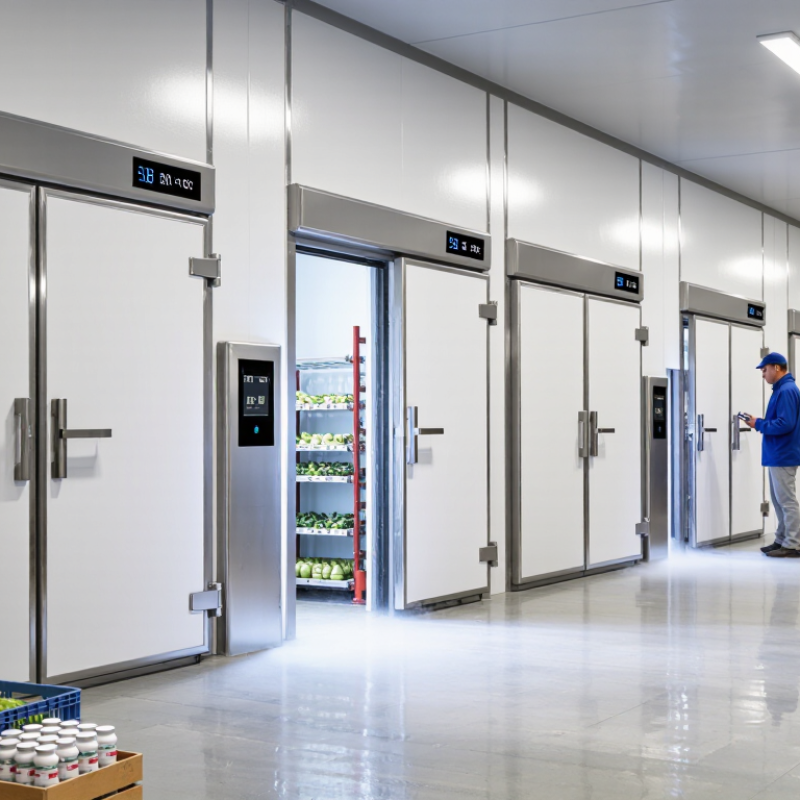
Cold storage freezer units are insulated rooms or cabinets that remove heat from stored goods and keep temperatures stable. A refrigeration circuit compresses refrigerant, releases heat through a condenser, then absorbs heat inside an evaporator. Fans move cold air around cartons, while sensors track temperature and trigger controls. Simple in principle. In practice, door openings, warm deliveries, frost, and uneven loading can create warm spots. A thermometer near the doorway may not reflect conditions at the center of a tightly packed room.
The International Institute of Refrigeration’s 2023 report estimates that refrigeration uses about 20% of global electricity and contributes roughly 7.8% of global greenhouse gas emissions. These figures cover refrigeration broadly, not freezer warehouses alone, but they show why efficiency matters. Insulated panels, correctly sized equipment, sealed doors, and regular coil cleaning can reduce wasted energy. For buyers, ask for measured capacity at the intended operating temperature, not just a headline cooling figure. Check temperature records under real loading conditions, too. A unit that reaches its setpoint when empty may struggle after pallets arrive. That gap is easy to overlook.
China’s cold-storage freezer industry is organized less like one production line and more like a network of specialists. Large manufacturers integrate insulated panels, refrigeration systems, controls, and installation. Smaller suppliers often focus on compressors, evaporators, doors, or temperature-monitoring components. This division lets buyers specify walk-in rooms, distribution-center chambers, or compact processing units. But integration quality varies. A cold room is only as reliable as its weakest seal or control setting.
Demand helps explain this structure. The China Federation of Logistics and Purchasing’s 2023 cold-chain logistics report estimated China’s cold-chain logistics market at about RMB 517.1 billion, while reported cold-storage capacity reached roughly 228.7 million cubic meters. These are logistics indicators, not freezer-unit sales; they show the scale of facilities requiring refrigeration equipment, not how many manufacturers serve them. Buyers should therefore compare technical scope, not just factory size. Ask for operating-temperature ranges, panel thickness, defrost strategy, and test records under realistic loading.
The International Institute of Refrigeration’s refrigeration-sector assessments emphasize refrigeration’s role in food preservation and energy use. That matters on the factory floor: a unit may hold temperature in an empty test room, then struggle when warm pallets arrive and doors cycle repeatedly. Ask who designs the system, who installs it, and who handles commissioning. Get answers in writing. One uncomfortable point: published capacity figures do not reveal maintenance quality, so local service arrangements deserve the same scrutiny as equipment specifications.
China Top 10 Cold Storage Freezer Units Manufacturers for Global Buyers
Ten Chinese manufacturers serving global cold storage buyers offer options for warehouses, food processors, and distribution centers. Their capabilities can vary widely: some focus on compact freezer units, while others provide larger systems with temperature controls and installation support. Buyers should compare cooling capacity, operating range, insulation, service coverage, and documented performance—not just purchase price. The International Institute of Refrigeration has reported that roughly 12% of food produced globally is lost because of inadequate refrigeration. Reliable equipment matters, but so does careful system design.
A useful shortlist should include manufacturers able to share clear specifications, test records, warranty terms, and export references. Ask how a unit performs during frequent door openings or humid summer conditions. A neat catalogue cannot answer every site-specific question. I would also check whether replacement parts and technical support are available in the destination market; this step is easy to overlook.
Tips: Request a load calculation before comparing quotations. Confirm the required storage temperature, daily product volume, room dimensions, and local power supply. Ask for energy-use data under stated test conditions, then verify the assumptions with an independent refrigeration specialist. A lower initial price may look attractive, but operating costs can tell a different story.
For global buyers, cold storage freezer manufacturers differ less by headline capacity than by system design. Compare temperature stability, pull-down time, insulation quality, defrost control, and service access. A unit holding frozen goods near -18°C may still struggle when doors open often or warm pallets arrive. Ask for test conditions, not just rated capacity. A clear performance sheet matters.
The International Institute of Refrigeration’s 2023 report estimates that refrigeration accounts for about 20% of global electricity use. This makes compressor efficiency, fan control, and heat recovery relevant purchasing criteria. Manufacturers with modular layouts can simplify expansion; those offering remote monitoring may help flag temperature drift sooner. Yet sensors are not a substitute for calibration. Product range, installation support, spare-parts availability, and documented testing separate capable suppliers from those relying on broad claims.
Tips: Request a sample temperature map under realistic loading. Check whether quoted energy use includes defrost cycles and door openings. Ask who responds when a unit fails on a weekend. One overlooked detail: floor insulation and vapor barriers can affect performance as much as the freezer itself. A comparison table helps, though supplier data may use different test conditions; verify the basis before ranking options.
When comparing cold storage freezer unit manufacturers, look beyond catalogue capacity. Ask for the usable storage volume, temperature range, and pull-down time under a stated test condition. A unit rated for a certain temperature may perform differently when its room is warm or frequently opened. Request test records, not just a polished specification sheet.
Check how the supplier controls temperature across the cabinet. Ask for a temperature map showing readings at several shelf positions, and confirm how alarms behave during a power interruption. Inspect door seals, hinges, drain points, and the finish around internal corners. These small details matter during daily cleaning and repeated loading. Ask what insulation thickness and refrigerant type are used, and whether replacement parts can be sourced locally. Get written lead times.
After-sales support is easy to underestimate. Ask who diagnoses faults, what response time is realistic, and which parts are stocked for the model you plan to buy. A video call may solve a simple controller issue; a failed compressor is another matter. Request references from buyers operating similar units in comparable climates. Then verify the details independently. I would also ask for a sample maintenance schedule and a clear warranty scope. Suppliers sometimes give vague answers. That is a signal to slow down, not an automatic rejection. Compare the full operating picture, including energy use, service access, and installation requirements, before placing an order.
„Thanks to the LUVIR technology, the solder resist process could be switched directly from the previously used mask exposure to direct exposure. As an outstanding digital solution on the market, this technology has been able to demonstrate fast process times and superior quality on our certified conventional ink in production. This allowed us to fully digitize the solder mask process at low cost – without process or ink adjustments. An excellent benefit to our production in Rot am See.“
Ralf Göhringer (Head of Production WE Rot am See)
I would definitely recommend the Limata machine and team for a future company purchase
Michael Greenaway
Compunetics Inc.
“The Limata ldi has been amazing!! Best thing we did was buy this machine”
Richard Brady
GM
Circuitlabs
“Since 2019, we have been running the Limata X1000 LDI system (including LUVIR for solder mask imaging) in daily production as an addition to our current process with film. The machine was capable of properly exposing Taiyo PSR-4000 BN (DI) solder mask types on normal to high-copper boards using a new and unique direct imaging process. The machine operating interface is very user friendly which allowed for a quick technical training curve. The pre-registration processing reduced several seconds of production time at every print. Limata support and service staff is incomparable. They supported our team every step of the way at basically any time of the day or night, with literally, an immediate response time, customizing the software interface to best fit our Operations and needs.
We have exposed more than 8,000 prints since end of October, on various solder mask colors and some resist film panels. Limata, has proven to be very capable and innovative. They are a strong contender in the industry.
We have very much enjoyed this project, and working with the team!
Thank you Limata for the continued support and being a part of our growth.”
Bill Sezate
Vice President, GM
Summit Interconnect
As a replacement to our current contact exposure process with film, the LIMATA X2000 system including LUVIR-Technology was capable of properly exposing non-LDI solder mask types using a direct imaging process. The machine offers cutting edge software with a very intuitive operating interface which allowed for quick technician training curve. The dual drawer system combined with pre-registration processing reduced several seconds of production time at every machine cycle. Limata support and service staff is world class. They added software patches to keep production running at shortest possible response times, customized the software interface to best fit our in-house Operations system, and even wrote a step-by-step machine processing manual. As a result of the project, we have exposed more than 16,000 times on various product types and solder mask brands/colors. Limata, in a very short timeframe as a company, has definitely shown they are truly innovative and will be challenging the industry of direct imaging for the top spot.
Kevin Beattie
Process Engineer
TTM Technologies
Forest Grove Division
