Choosing a reliable Weather Station Humidity Sensor supplier in China means looking beyond price and product photos. A sensor may sit inside a ventilated shield, exposed to wind, dust, and sudden temperature changes. Its readings influence local forecasts, greenhouse decisions, and long-term climate records. Small errors matter.
As an illustrative expert perspective, sensor engineer Lin Wei puts it this way: “A humidity reading is only useful when you know how the sensor behaves in real conditions.” This is an original, illustrative quotation, not a sourced statement. It points to practical questions buyers should ask: What accuracy is specified? How quickly does the sensor respond? Are calibration records available? Can the supplier explain performance after prolonged outdoor use?
Look closely at the details. A dependable supplier should provide clear specifications, operating limits, maintenance guidance, and responsive technical support. Ask how the sensing element handles condensation and whether replacement parts are readily available. Request test documentation, too. A polished datasheet is helpful, but it cannot answer every field question.
Not every station needs the same configuration. Coastal sites, farms, and urban rooftops face different conditions. The right choice depends on installation, data needs, and service expectations. Even careful buyers can miss something. Comparing suppliers takes time, and claims deserve verification. This guide explores how to assess China-based manufacturers and select a Weather Station Humidity Sensor suited to the work—not just the quotation.
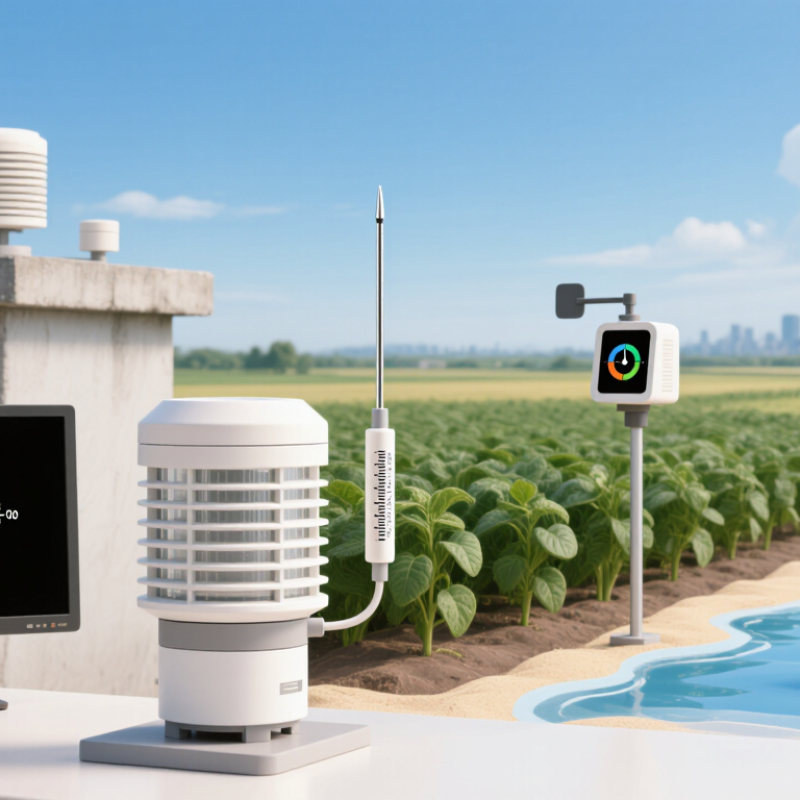
Weather-station humidity sensing measures the amount of water vapor in air as relative humidity, or RH. A 0–100% RH measurement range describes the span the sensor is designed to report, from very dry air to saturation. It does not mean every reading is equally precise. Accuracy, resolution, and response time matter too. Small shifts matter. Near 100% RH, surfaces may become wet, and condensation can affect sensor response. Temperature also changes how relative humidity behaves, so readings need to be interpreted alongside air temperature.
In a field station, placement shapes the result. A ventilated radiation shield helps limit direct sun and rain exposure, while allowing air to reach the sensing element. Keep the sensor away from warm walls, exhaust vents, and stagnant corners. A few centimeters can change airflow. Check specifications for accuracy across the operating temperature range, not only at room conditions. Periodic comparison with a trusted reference can reveal drift, though field checks are never perfectly controlled. Even careful siting involves trade-offs: nearby trees may provide shade but restrict airflow. Record those conditions with the data, and the RH values become easier to assess over time.
A ±2% RH accuracy specification is a useful starting point when comparing weather station humidity sensors. It gives buyers a clear number to screen, but the number needs context. Check whether the stated accuracy applies across the full operating humidity and temperature ranges, or only under controlled conditions. A sensor may meet ±2% RH in a laboratory and behave differently in a sun-heated enclosure. Ask for calibration records and test conditions, not just a product sheet. That matters.
During procurement, compare sensors at several humidity points, such as 30%, 60%, and 90% RH. Confirm the measurement range, response time, and expected drift between calibrations. Also check the filter or shield design; dust and condensation can affect readings over time. The ±2% RH benchmark is not a guarantee of station-level accuracy. Installation, airflow, and maintenance all play a part. One detail is easy to overlook: field conditions rarely match the test chamber perfectly.
Tips: Request sample data across the stated range and review the calibration interval. Check how the sensor performs after exposure to changing humidity, not just at a steady point. If a supplier cannot explain its test method clearly, pause and ask again. A tidy specification is helpful, but it is not the whole story.
When evaluating a weather station humidity sensor supplier, ask how temperature compensation is tested, not just for the stated accuracy. Relative humidity shifts with air temperature, so readings can change during a cold dawn or rapid afternoon warming. Compare the sensor with a calibrated reference in a chamber, then repeat checks outdoors near a shaded mast. Record sensor temperature, humidity, and stabilization time together. A clean spreadsheet often reveals more than a single pass result.
Tips: Install the sensor in a ventilated radiation shield, away from wet soil and exhaust outlets. Let it equilibrate after installation. Check again after rain, dust, and sharp temperature swings.
Response time deserves field testing too. A controlled humidity step shows how quickly readings settle, but outdoor airflow changes the result. Ask for response data at different temperatures and airflow levels. Inspect filters and protective membranes; blocked openings can slow recovery. Chamber figures do not tell the whole story. A slow morning rise may look like sensor failure, yet a poorly ventilated shield could be the cause. That detail is easy to miss.
China Best Weather Station Humidity Sensor Supplier
Verify Calibration Traceability, IEC 60529 IP Ratings, and Data Interfaces
When comparing suppliers, request a calibration certificate for the humidity sensor. Check its issue date, measured points, uncertainty, and traceability to recognized reference standards. A certificate should identify the instrument tested, not just describe a general factory process. Ask how often recalibration is recommended. Field exposure can shift readings over time.
Tips: Match the IEC 60529 IP rating to the actual installation. A sensor under a ventilated shield faces different exposure from one mounted near wind-driven rain. Confirm what the stated rating covers; it does not describe every environmental risk.
Check the data interface before ordering. Common options include RS-485, SDI-12, and analog outputs, but compatibility depends on your logger and wiring. Ask for pinouts, output ranges, and sample communication settings. Then test one unit with your station logger before a larger purchase. That step takes time. It may still reveal gaps in documentation or setup. A careful supplier should answer technical questions clearly and provide test records that match the delivered sensor.
China Best Weather Station Humidity Sensor Supplier
A supplier’s brochure cannot show how a humidity probe behaves after months outdoors. Request complete test reports, not a single accuracy figure. The World Meteorological Organization’s Guide to Instruments and Methods of Observation (WMO-No. 8, 2018) gives a 3% RH uncertainty benchmark for surface humidity measurements. Ask whether reported accuracy is tested across the sensor’s stated temperature and humidity range, and whether the calibration reference is traceable.
Look for chamber results at several humidity points, such as 30%, 50%, and 80% RH, plus temperature changes. Reports should identify test conditions, sample size, hysteresis, and recovery after condensation. Small details matter. A 50% RH result at room temperature says little about performance during a cold, damp night. Still, a clean lab curve can flatter a sensor. Ask for field drift data, ideally recorded over a year, with before-and-after calibration results and the number of units tested.
Warranty terms deserve the same scrutiny as test data. Check the coverage period, exclusions for condensation or contamination, and who pays for return shipping and recalibration. Ask how quickly replacement units are supplied. A long warranty sounds reassuring, but it is less useful when drift is excluded. Compare written terms, not verbal promises. I would also ask for an example report from a routine production batch; suppliers may not have one ready, and that is worth noting.
| Assessment Dimension | Evidence or Data to Request | How to Evaluate | Buyer Record |
|---|---|---|---|
| Test-report traceability | Report identification, sensor model and revision, tested serial or lot numbers, test date, test method, reference-instrument details, and environmental conditions. | Check that the report applies to the exact model and revision quoted. Confirm that results and test conditions are clearly stated. | Report ID: ______ Model/revision: ______ |
| Humidity accuracy across range | Measured error in %RH at specified points across the required operating range, with test temperature and uncertainty stated. A buyer-defined screening plan could include 20%, 50%, and 80% RH at 25°C. | Compare each result with the purchase specification. The example test points are a proposed screening plan, not a universal acceptance standard. | Required limit: ______ %RH Reported maximum error: ______ %RH |
| Calibration references and uncertainty | Calibration certificates or reference details, traceability information, uncertainty values, and evidence of the laboratory’s relevant ISO/IEC 17025 accreditation scope when accredited testing is specified. | Verify that the stated accreditation scope covers the relevant measurement activity. Review uncertainty alongside the sensor error; do not treat a traceability statement alone as proof of accuracy. | Reference/traceability: ______ Uncertainty: ______ |
| Long-term drift | Before-and-after measurements from identified sensors, exposure duration, storage or operating conditions, temperature, RH points, and drift reported in %RH over the stated period. | Request actual time-series or paired measurement data, not only a typical-value claim. Compare results with a drift limit and service interval defined in the purchase specification; no single drift limit applies to every application. | Test duration: ______ Observed drift: ______ %RH |
| Temperature dependence | Humidity error or compensation data at the temperatures relevant to the installation, with the tested temperature range and stabilization conditions stated. | Check coverage of the intended site conditions and confirm whether published accuracy applies across the full temperature range or only at a reference temperature. | Required temperature range: ______ Evidence supplied: ______ |
| Response and recovery | Response-time definition, test conditions, direction of RH change, airflow conditions, and recovery data after high-humidity exposure or condensation if relevant to the application. | Compare like-for-like tests and definitions. Confirm that the sensor’s response is suitable for the station’s sampling interval and local weather-monitoring needs. | Required response time: ______ Reported result: ______ |
| Production consistency | Lot-level inspection records, sample size, pass/fail criteria, calibration or adjustment records, and the process used to identify nonconforming units. | Confirm that the records relate to production units and that the sampling and acceptance criteria are documented. Agree on incoming-inspection requirements before order placement. | Lot records available: ______ Incoming test plan: ______ |
| Warranty and remedies | Written warranty duration, start date, coverage, exclusions, claim procedure, repair or replacement terms, shipping responsibilities, and response-time commitments. | Check the signed quotation or contract rather than relying on verbal statements. Clarify treatment of drift, out-of-spec units, and failures discovered during incoming inspection. | Warranty duration: ______ Remedy terms: ______ |
| Documentation and change control | Datasheet, wiring and interface specifications, installation guidance, calibration instructions, revision history, and notification procedure for product or process changes. | Ensure documentation matches the supplied revision and that changes affecting performance, calibration, or interchangeability require prior notification. | Document revision: ______ Change notice agreed: ______ |
Note: Acceptance limits should be set in the buyer’s specification for the intended operating environment. The fields above are for recording supplier evidence; they do not represent measured results from any particular supplier.
„Thanks to the LUVIR technology, the solder resist process could be switched directly from the previously used mask exposure to direct exposure. As an outstanding digital solution on the market, this technology has been able to demonstrate fast process times and superior quality on our certified conventional ink in production. This allowed us to fully digitize the solder mask process at low cost – without process or ink adjustments. An excellent benefit to our production in Rot am See.“
Ralf Göhringer (Head of Production WE Rot am See)
I would definitely recommend the Limata machine and team for a future company purchase
Michael Greenaway
Compunetics Inc.
“The Limata ldi has been amazing!! Best thing we did was buy this machine”
Richard Brady
GM
Circuitlabs
“Since 2019, we have been running the Limata X1000 LDI system (including LUVIR for solder mask imaging) in daily production as an addition to our current process with film. The machine was capable of properly exposing Taiyo PSR-4000 BN (DI) solder mask types on normal to high-copper boards using a new and unique direct imaging process. The machine operating interface is very user friendly which allowed for a quick technical training curve. The pre-registration processing reduced several seconds of production time at every print. Limata support and service staff is incomparable. They supported our team every step of the way at basically any time of the day or night, with literally, an immediate response time, customizing the software interface to best fit our Operations and needs.
We have exposed more than 8,000 prints since end of October, on various solder mask colors and some resist film panels. Limata, has proven to be very capable and innovative. They are a strong contender in the industry.
We have very much enjoyed this project, and working with the team!
Thank you Limata for the continued support and being a part of our growth.”
Bill Sezate
Vice President, GM
Summit Interconnect
As a replacement to our current contact exposure process with film, the LIMATA X2000 system including LUVIR-Technology was capable of properly exposing non-LDI solder mask types using a direct imaging process. The machine offers cutting edge software with a very intuitive operating interface which allowed for quick technician training curve. The dual drawer system combined with pre-registration processing reduced several seconds of production time at every machine cycle. Limata support and service staff is world class. They added software patches to keep production running at shortest possible response times, customized the software interface to best fit our in-house Operations system, and even wrote a step-by-step machine processing manual. As a result of the project, we have exposed more than 16,000 times on various product types and solder mask brands/colors. Limata, in a very short timeframe as a company, has definitely shown they are truly innovative and will be challenging the industry of direct imaging for the top spot.
Kevin Beattie
Process Engineer
TTM Technologies
Forest Grove Division
