Choosing the right H13 Hepa Filter can significantly impact air quality in your home or office. According to a report by the Association of Home Appliance Manufacturers (AHAM), HEPA filters can capture up to 99.97% of particles as small as 0.3 microns. This includes dust, pollen, and even some bacteria. Industry expert Dr. Emily Chen states, "Selecting a quality H13 Hepa Filter is vital for optimal indoor air purification."
H13 Hepa Filters are designed to meet strict efficiency standards. They provide superior filtration compared to lower-rated filters. However, not all H13 filters are created equal. Some manufacturers may overstate their capabilities. It's essential to research and verify the specifications before purchasing. Filter performance can diminish over time, affecting its ability to trap contaminants effectively. Regular maintenance is crucial for sustained efficacy.
Understanding your specific needs is also key. Factors such as room size and types of pollutants present will influence your choice. While H13 Hepa Filters provide excellent filtration, they may not fit every scenario. Weighing cost against performance is also necessary. Ultimately, a well-informed decision can lead to healthier indoor air quality.
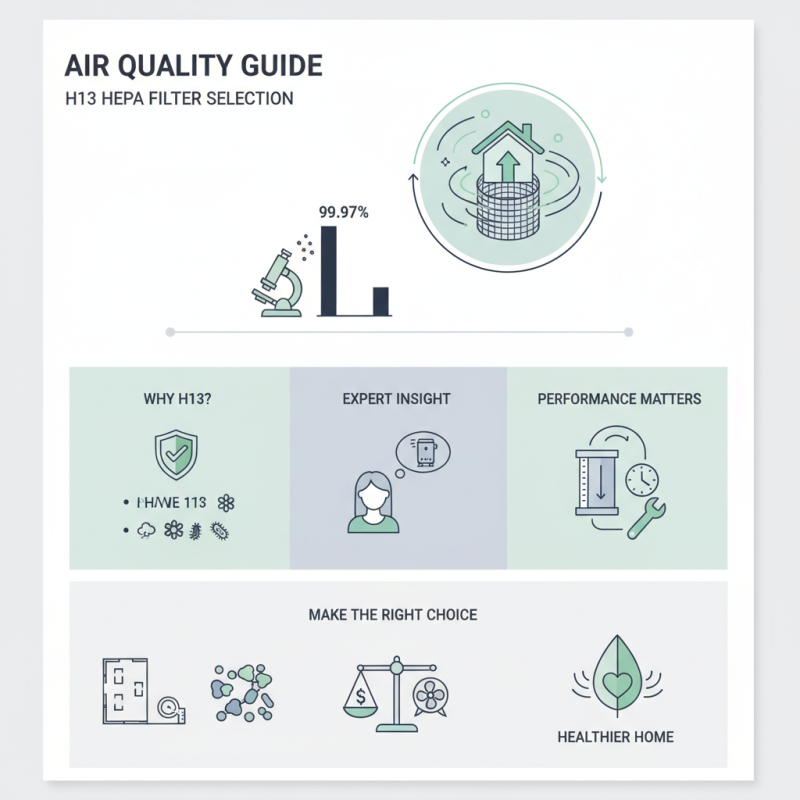
When selecting an H13 HEPA filter, it's essential to understand what makes these filters unique. H13 filters are designed to capture at least 99.95% of airborne particles. This level of filtration is crucial for maintaining a clean indoor environment. They effectively trap allergens, dust, and even some viruses. The distinction of H13 HEPA filters lies in their efficiency in filtering out small particles, which makes a noticeable difference in air quality.
Choosing the right filter can be challenging. Here are some tips to help you make an informed decision. Check the filter's specifications clearly. Look for certifications that validate its H13 classification. Also, consider the filter's lifespan and replacement schedule. You want a filter that offers longevity without compromising performance. Think about your specific needs. Do you have allergies, or live in a polluted area? This can influence your choice, as higher exposure levels may require more frequent replacements.
It's a good idea to compare options before purchasing. Research different models to find one that fits your space and filtration requirements. Pay attention to reviews from users. However, remember that individual experiences can vary. Don't hesitate to ask for expert advice if needed. Balancing quality and price is vital but can be tricky. Keep an open mind and be prepared to adapt your choices based on your findings.
Choosing the right H13 HEPA filter involves various key factors. The filtration efficiency is paramount. H13 filters capture at least 99.95% of particles down to 0.3 microns. This includes allergens, dust, and smoke. Understand the specifications to ensure they meet your air quality needs.
Another important consideration is the size and compatibility of the filter. Ensure it fits your air purifier or HVAC system perfectly. A well-fitting filter operates more effectively. Pay attention to the manufacturer’s guidelines for dimensions. It’s easy to overlook this, leading to inefficient filtration.
Lastly, consider the replacement frequency. Some filters last longer than others. Regular changes are essential for optimal performance. Not changing filters when needed can reduce air quality. Reflect on your environment. High pollen or pollution levels might require more frequent replacements.
When choosing an H13 HEPA filter, it’s vital to consider the efficiency ratings. H13 filters capture at least 99.95% of airborne particles, including allergens and pollutants. This high level of filtration makes them ideal for asthma sufferers and those with allergies. Not all filters labeled as HEPA meet the same standards, so thorough evaluation is crucial.
Look for filters that specify their efficiency rating. Not all H13 filters perform equally. Some may have higher airflow resistance, affecting the overall effectiveness. A filter should balance efficiency with airflow. This ensures that your air purifier operates efficiently without straining the motor.
Keep in mind that your specific needs may vary. A filter that works for one household may not suffice for another. Consider factors like room size and air quality. You may find that the higher-rated filters are not always the best fit for your space. Take time to assess what works for you; this trial and error can lead to better air quality in the long run.
When selecting an H13 HEPA filter, it's essential to compare different brands and models. The H13 designation indicates that the filter captures 99.95% of airborne particles, which is crucial for allergy sufferers and those with respiratory issues. A report from the World Health Organization highlights that indoor air quality can be twice as polluted as outdoor air. This emphasizes the importance of effective filters.
Many popular brands offer H13 HEPA filters, but they vary widely in specifications. Look for specifications that indicate a high filter efficiency and airflow capacity. Common models often have different sizes, and choosing the right fit for your air purifier is critical. A study found that filters with a higher surface area tend to last longer and maintain performance better.
However, not all H13 filters are created equal. Some might have similar ratings but differing material quality. It's worth noting that while price can indicate quality, it's not a universal rule. Some affordable options perform just as well as high-end filters, which raises questions about value. Always check for third-party testing and certifications to ensure you're making an informed choice. Remember, selecting the right filter is a balance of efficiency, durability, and budget.
Maintaining your H13 HEPA filter is essential for optimal air quality. Regular upkeep prevents dust and allergens from clogging the filter, maximizing its efficiency. It’s important to check the filter every month. A simple visual inspection can reveal if it’s time for a clean or replacement.
Vacuuming the outer layer can help remove accumulated particles. Make sure to use a soft brush attachment to avoid damage. This method can extend the filter's lifespan. If you notice a significant drop in airflow, it’s a sign you may need to replace it soon.
Humidity can affect filter performance as well. Keep the installation area dry to prevent mold growth. Storing spare filters in a cool, dry place is also wise. Reflect on your filter usage regularly. Even with proper care, filters have a limited life. Being aware of this can ensure you always have clean air to breathe.
| Filter Type | Filtration Efficiency | Recommended Usage | Maintenance Frequency | Expected Lifespan |
|---|---|---|---|---|
| H13 HEPA Filter | 99.95% at 0.3 microns | Homes, Offices, Hospitals | Every 6-12 months | 2-5 years |
| H13 Activated Carbon HEPA Filter | 99.95% at 0.3 microns, plus odor removal | Homes, Smoky Environments | Every 6-12 months | 1-3 years |
| H13 Pre-Filter | N/A | Dusty Environments | Every 3 months | 6-12 months |
„Thanks to the LUVIR technology, the solder resist process could be switched directly from the previously used mask exposure to direct exposure. As an outstanding digital solution on the market, this technology has been able to demonstrate fast process times and superior quality on our certified conventional ink in production. This allowed us to fully digitize the solder mask process at low cost – without process or ink adjustments. An excellent benefit to our production in Rot am See.“
Ralf Göhringer (Head of Production WE Rot am See)
I would definitely recommend the Limata machine and team for a future company purchase
Michael Greenaway
Compunetics Inc.
“The Limata ldi has been amazing!! Best thing we did was buy this machine”
Richard Brady
GM
Circuitlabs
“Since 2019, we have been running the Limata X1000 LDI system (including LUVIR for solder mask imaging) in daily production as an addition to our current process with film. The machine was capable of properly exposing Taiyo PSR-4000 BN (DI) solder mask types on normal to high-copper boards using a new and unique direct imaging process. The machine operating interface is very user friendly which allowed for a quick technical training curve. The pre-registration processing reduced several seconds of production time at every print. Limata support and service staff is incomparable. They supported our team every step of the way at basically any time of the day or night, with literally, an immediate response time, customizing the software interface to best fit our Operations and needs.
We have exposed more than 8,000 prints since end of October, on various solder mask colors and some resist film panels. Limata, has proven to be very capable and innovative. They are a strong contender in the industry.
We have very much enjoyed this project, and working with the team!
Thank you Limata for the continued support and being a part of our growth.”
Bill Sezate
Vice President, GM
Summit Interconnect
As a replacement to our current contact exposure process with film, the LIMATA X2000 system including LUVIR-Technology was capable of properly exposing non-LDI solder mask types using a direct imaging process. The machine offers cutting edge software with a very intuitive operating interface which allowed for quick technician training curve. The dual drawer system combined with pre-registration processing reduced several seconds of production time at every machine cycle. Limata support and service staff is world class. They added software patches to keep production running at shortest possible response times, customized the software interface to best fit our in-house Operations system, and even wrote a step-by-step machine processing manual. As a result of the project, we have exposed more than 16,000 times on various product types and solder mask brands/colors. Limata, in a very short timeframe as a company, has definitely shown they are truly innovative and will be challenging the industry of direct imaging for the top spot.
Kevin Beattie
Process Engineer
TTM Technologies
Forest Grove Division
