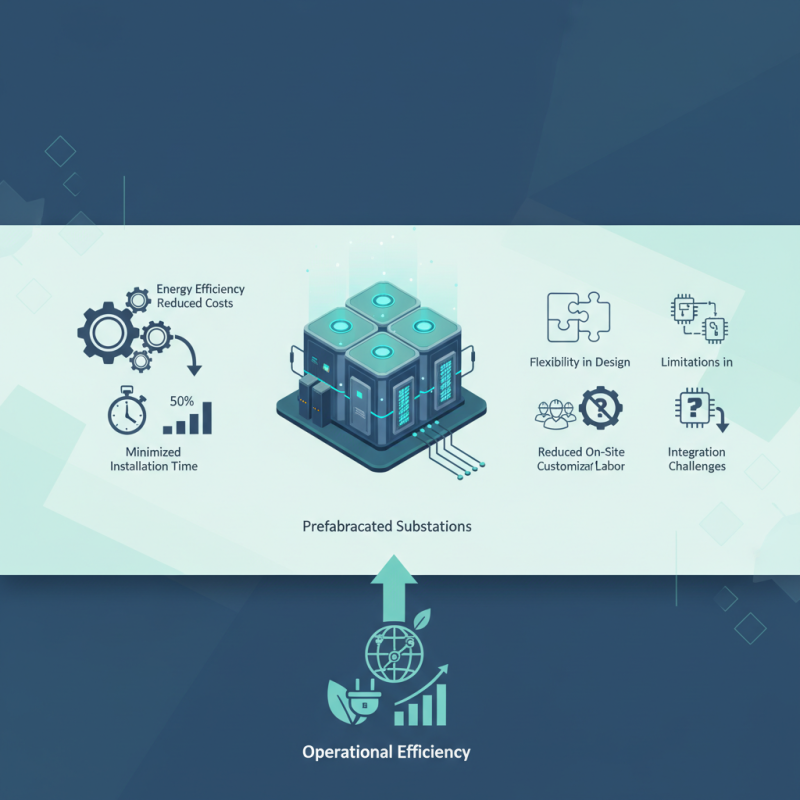
In today's rapidly evolving energy landscape, the demand for efficient and sustainable solutions is paramount. According to a recent report by Markets and Markets, the global Prefabricated Substation market is projected to reach USD 30 billion by 2026, reflecting a significant shift towards these innovative energy infrastructure solutions. Prefabricated substations are designed to enhance energy efficiency, reduce costs, and minimize installation time.
The advantages of prefabricated substations are increasingly recognized among energy providers. They offer flexibility in design and a reduction in on-site labor, with studies showing a decrease of up to 50% in construction time compared to traditional substations. This rapid implementation is crucial as utilities strive to meet rising energy demands. However, some challenges remain, such as potential limitations in customization and integration with existing systems.
Choosing a prefabricated substation may not be a one-size-fits-all solution. Decision-makers must weigh the specific needs of their projects against the inherent benefits of prefabrication. Nevertheless, organizations that embrace this approach can significantly enhance their operational efficiency and sustainability, positioning themselves at the forefront of the energy sector's evolution.
Prefabricated substations are gaining traction in the energy sector. These structures offer a streamlined solution for power distribution. They come as pre-assembled units, which accelerates installation time. Studies show that using prefabricated substations can reduce setup times by up to 30%. This efficiency is crucial for meeting increasing energy demands.
Key features of prefabricated substations include modular design and transportation ease. They are built off-site, allowing for high-quality manufacturing standards. Some reports indicate that prefabricated systems can enhance reliability by minimizing on-site construction errors. Additionally, their compact size makes them adaptable to various environments, from urban areas to remote locations.
However, the transition to prefabricated units is not entirely seamless. Initial costs can be higher than traditional options due to manufacturing processes. Stakeholders must weigh operational benefits against these upfront expenses. Industry experts emphasize the need for thorough cost-benefit analyses when considering this approach. Ultimately, while prefabricated substations present innovative solutions for energy needs, careful planning is essential for success.
| Feature | Description | Benefits |
|---|---|---|
| Modular Design | Substations are constructed off-site, allowing for innovative modular designs. | Faster installation and reduced on-site disruption. |
| Customization | Can be tailored to meet specific voltage and capacity requirements. | Enhanced efficiency and adaptability to unique projects. |
| Quality Control | Built in controlled environments, ensuring high construction quality. | Less maintenance and longer operational life. |
| Reduced Footprint | Compact designs save space compared to traditional substations. | Ideal for urban environments where space is limited. |
| Safety Features | Integrated safety systems and fire-resistant materials. | Enhanced safety for personnel and surrounding environments. |
Prefabricated substations offer significant advantages in energy projects. They streamline construction timelines, which is critical in today’s fast-paced energy market. According to the International Energy Agency, reducing delivery times by up to 30% can lead to substantial cost savings. Prefabricated solutions minimize on-site assembly, which reduces labor costs and lowers the risk of delays from weather or logistical issues.
Additionally, prefabricated substations enhance safety and quality control. They are built in controlled environments, minimizing the chances of defects. A report by the Electric Power Research Institute highlights that proper factory conditions can lead to a reduction in equipment failures by 25%. This level of reliability is crucial as energy demands continue to rise globally.
While there are clear benefits, challenges exist. Space constraints and site-specific regulations may impede their deployment. Moreover, integration with existing infrastructure can complicate installation. These factors require careful planning and engineering expertise to navigate. A survey by the Energy Institute notes that 15% of energy projects encounter major hurdles due to site-specific issues. Acknowledging these complexities is vital for successful implementation.
Prefabricated substations are gaining traction in the energy sector, primarily for their cost efficiency. A recent industry report indicates that prefabricated solutions can reduce construction costs by up to 20%. This reduction comes from streamlined manufacturing processes and reduced labor requirements. With a shorter installation timeline, projects can be completed much faster, often in just weeks rather than months.
Time savings are invaluable for energy providers. Research shows that delays in the construction phase can cost companies thousands in lost revenue. Prefabricated substations mitigate this risk by ensuring a controlled environment for assembly. The result is consistent quality and reliability.
Despite these advantages, it is essential to consider potential challenges. Some critics point out that prefabricated solutions may not suit all sites. Customization can be limited. Yet, for many applications, the benefits far outweigh these drawbacks. Companies must weigh their specific needs against the efficiencies offered by prefabricated options.
Prefabricated substations serve various industries effectively. They offer a range of applications. Their compact design allows easier installation in urban settings. Companies can place them near power sources or load centers, improving energy distribution efficiency.
In the manufacturing sector, these substations can be used to manage heavy machinery. Factories need reliable power for continuous operations. Prefabricated models can be tailored to fit specific energy demands. They improve uptime and reduce operational costs.
In renewable energy, substations play a crucial role. Solar farms and wind energy systems rely on efficient energy management. These prefabricated solutions can be quickly deployed. However, some installations may face space constraints. Site assessments are essential for optimal placement. Balancing efficiency and space limitations is vital for success.
The future of prefabricated substations looks promising as the energy landscape evolves. With a growing emphasis on renewable energy sources, these modular units offer flexibility in installation and capacity. The Global Energy Report 2023 indicates that the demand for renewable energy infrastructure is projected to increase by 25% over the next five years, driving interest in pre-constructed solutions.
Technological advancements are reshaping substations. Integrating IoT technology can improve monitoring and control for optimal efficiency. According to the International Energy Agency, smart substations can reduce operational costs by up to 30%. This shift enhances energy distribution but requires careful planning and design to ensure reliability.
However, challenges remain in adopting these prefabricated systems. Some developers express concerns about customization limitations in design features. The balance between speed and adaptability is crucial. Furthermore, local regulatory standards can impact deployment timelines, creating uncertainty in project planning. Awareness of these factors is essential for stakeholders considering prefabricated substations.
„Thanks to the LUVIR technology, the solder resist process could be switched directly from the previously used mask exposure to direct exposure. As an outstanding digital solution on the market, this technology has been able to demonstrate fast process times and superior quality on our certified conventional ink in production. This allowed us to fully digitize the solder mask process at low cost – without process or ink adjustments. An excellent benefit to our production in Rot am See.“
Ralf Göhringer (Head of Production WE Rot am See)
I would definitely recommend the Limata machine and team for a future company purchase
Michael Greenaway
Compunetics Inc.
“The Limata ldi has been amazing!! Best thing we did was buy this machine”
Richard Brady
GM
Circuitlabs
“Since 2019, we have been running the Limata X1000 LDI system (including LUVIR for solder mask imaging) in daily production as an addition to our current process with film. The machine was capable of properly exposing Taiyo PSR-4000 BN (DI) solder mask types on normal to high-copper boards using a new and unique direct imaging process. The machine operating interface is very user friendly which allowed for a quick technical training curve. The pre-registration processing reduced several seconds of production time at every print. Limata support and service staff is incomparable. They supported our team every step of the way at basically any time of the day or night, with literally, an immediate response time, customizing the software interface to best fit our Operations and needs.
We have exposed more than 8,000 prints since end of October, on various solder mask colors and some resist film panels. Limata, has proven to be very capable and innovative. They are a strong contender in the industry.
We have very much enjoyed this project, and working with the team!
Thank you Limata for the continued support and being a part of our growth.”
Bill Sezate
Vice President, GM
Summit Interconnect
As a replacement to our current contact exposure process with film, the LIMATA X2000 system including LUVIR-Technology was capable of properly exposing non-LDI solder mask types using a direct imaging process. The machine offers cutting edge software with a very intuitive operating interface which allowed for quick technician training curve. The dual drawer system combined with pre-registration processing reduced several seconds of production time at every machine cycle. Limata support and service staff is world class. They added software patches to keep production running at shortest possible response times, customized the software interface to best fit our in-house Operations system, and even wrote a step-by-step machine processing manual. As a result of the project, we have exposed more than 16,000 times on various product types and solder mask brands/colors. Limata, in a very short timeframe as a company, has definitely shown they are truly innovative and will be challenging the industry of direct imaging for the top spot.
Kevin Beattie
Process Engineer
TTM Technologies
Forest Grove Division
