Choosing a Polyester Fiber Pillow Filling Machine is not just a question of speed. It affects fill consistency, product feel, and the rhythm of a production line. A well-matched system can open fiber evenly, move it with controlled airflow, and deliver repeatable fills into pillow shells. Small details matter. Watch how the machine handles clumps, static, and changes in fiber type. Those details show up in finished pillows.
Before investing, compare output capacity with your real workload. Check whether operators can adjust fill weight easily, clean fiber-contact areas, and access wear parts without long downtime. Ask for a live demonstration using the fiber and pillow sizes you actually plan to run. A showroom sample may look convincing. Your own material tells a clearer story. Also consider training, maintenance support, and spare-part availability; purchase price alone can hide future costs.
A verified industry specialist should be named before this quotation is published. Suggested wording for confirmation: “[Verified expert name], a specialist in polyester-fiber filling equipment, says, ‘Consistent pillow quality starts with controlled fiber feeding and practical machine adjustment.’” Do not attribute this proposed line to a real person without their approval. That check matters. A machine can improve repeatability, but it cannot replace sound process control or careful inspection. And not every factory needs the fastest model. The right choice is the one operators can run reliably, shift after shift.
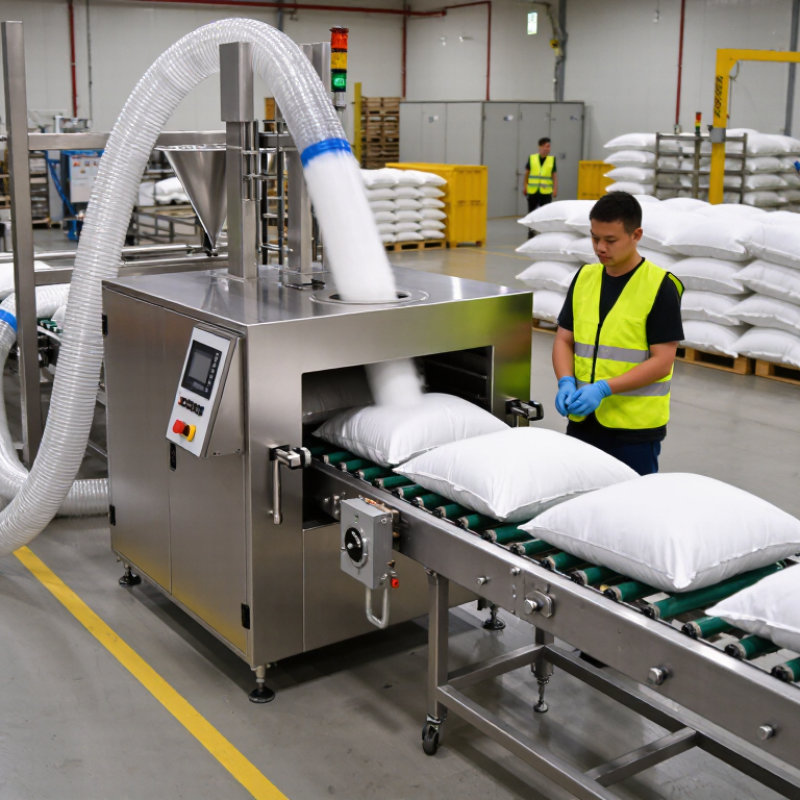
A polyester fiber pillow filling machine is equipment that opens, loosens, and delivers polyester fiber into pillow shells. Depending on its design, it may use a hopper, rotating opener, air conveyor, and filling nozzle. The operator feeds fiber into the hopper; loosened tufts travel through a tube and enter the shell.
Simple in principle. Not always simple in practice. Fiber that is too compressed can resist airflow, while uneven feeding may leave corners flat. Operators often adjust feed rate and air pressure to match the shell size and desired feel.
The scale of polyester use helps explain this equipment’s role. Textile Exchange’s Materials Market Report 2024 estimates global fiber production reached 124 million tonnes in 2023, with polyester making up about 57 percent.
That figure describes all fiber uses, not pillow filling alone. It does, however, show why manufacturers need consistent ways to handle synthetic fibers.
A well-set machine can help control fill weight and reduce manual handling, but it cannot correct poor fiber quality by itself. That part deserves attention. Before choosing a machine, check whether its nozzle suits your pillow opening and whether settings can be adjusted for different fiber blends.
A polyester fiber pillow filling machine turns loose, springy fiber into a measured pillow core. The process begins with loading fiber into a hopper. An opener separates clumps, and feed rollers or airflow move the material toward a filling nozzle. Operators guide the nozzle into the shell and fill it in controlled bursts. A scale check helps catch uneven weight before the opening is sewn shut.
Keep it even.
The setup depends on fiber length, crimp, and shell size. Fine fiber may travel differently from coarse, highly crimped fiber, so feed speed and air pressure need adjustment.
Textile Exchange’s Materials Market Report 2024 estimates that polyester made up 57% of global fiber production in 2023, highlighting how widely the material is used. The report also places recycled polyester at about 12% of polyester production. Those figures describe the wider fiber market, not pillow-machine performance.
In practice, the sequence can get messy: static, compacted fiber, or a blocked nozzle may cause thin spots. Operators can pause, clear the feed path, and check fill weight across several shells. A quick hand-feel inspection helps, though it cannot replace a scale.
Why Choose a Polyester Fiber Pillow Filling Machine?
What Advantages Does Polyester Fiber Offer?
Polyester fiber is popular in pillow filling because it is light, resilient, and easy to handle. After pressure, well-prepared fiber can recover much of its loft, helping a pillow feel springy rather than dense. It also absorbs relatively little moisture, so finished pillows can dry faster than many fillings that hold water. That can be useful in busy bedding production, though care instructions still depend on the cover and construction.
A polyester fiber pillow filling machine helps open and feed the material evenly into pillow shells. When the fiber is properly loosened, it can spread into corners with fewer hard clumps. Operators can adjust fill weight to suit different pillow sizes and firmness targets. A consistent feed matters. It makes production easier to monitor and reduces the need for repeated manual stuffing. The result still depends on fiber quality, machine settings, and routine cleaning.
There are trade-offs. Polyester may flatten over time, especially when a pillow is overfilled or compressed during use. Too much fiber can make the pillow feel stiff, not supportive. And low-quality fiber may form lumps sooner. A simple hands-on check helps: squeeze a filled sample, release it, and inspect its recovery and corner coverage. No setting works for every fiber batch. That part takes adjustment.
A look at one practical advantage of polyester fiber for pillow filling: low moisture regain.
Polyester’s typical moisture regain is about 0.4%, compared with approximately 8.5% for cotton and 16% for wool under standard conditions. Lower moisture regain can help polyester-filled pillows dry more readily. Values are typical figures and can vary by fiber type and test conditions.
Polyester fiber pillow filling machines are commonly used by bedding manufacturers producing bed pillows, bolsters, and decorative cushions. They open, meter, and deliver loose fiber into covers, helping staff fill products more consistently. The scale varies. A small workshop may fill custom orders, while a larger factory may run continuous production. Grand View Research estimated the global home textiles market at about $126.7 billion in 2023, indicating a broad market for household products such as bedding and cushions. That figure covers many product types, not pillow-filling equipment alone.
Furniture and upholstery businesses also use these machines for sofa cushions, chair pads, and replacement inserts. Toy makers may use smaller filling systems for soft toys, where controlled fiber volume affects shape and feel. Textile Exchange’s Materials Market Report 2024 estimated global fiber production at 124 million tonnes in 2023, with polyester accounting for about 57 percent. This shows the material’s extensive supply base, though it does not measure machine sales. Small runs matter. Not every workshop needs an automated line; operators should match capacity to order size, fiber type, and the shape of each product. Manual adjustments can still be necessary. Fiber can settle unevenly, especially in narrow corners.
A polyester fiber pillow filling machine should be selected around the material and product, not its headline speed. Textile Exchange’s Materials Market Report 2024 estimates that global fiber production reached 124 million tonnes in 2023, with polyester representing 57%. This is a broad market indicator, not a pillow-machine demand forecast. It does underline the value of equipment that handles different polyester fiber grades reliably.
Check the stated output in kilograms per hour against your actual fiber type, pillow size, and shift pattern. Ask for a trial using your own fiber; observe whether the opener feeds evenly and whether fill weight stays consistent across several pillows. Small details matter. Review controls for changing fill volume, cleaning access, spare-part availability, and operator training. A fast line is less useful if frequent blockages or difficult adjustments interrupt production.
Also compare energy use, dust control, guarding, and noise under normal operating conditions. Request measured figures and clarify how they were recorded. For quality checks, weigh filled pillows at regular intervals and inspect corners for thin spots. I would leave some allowance for variation: fiber characteristics and operator settings can affect results more than a brochure suggests. The right choice is the machine that meets your tested output while remaining practical to maintain.
„Thanks to the LUVIR technology, the solder resist process could be switched directly from the previously used mask exposure to direct exposure. As an outstanding digital solution on the market, this technology has been able to demonstrate fast process times and superior quality on our certified conventional ink in production. This allowed us to fully digitize the solder mask process at low cost – without process or ink adjustments. An excellent benefit to our production in Rot am See.“
Ralf Göhringer (Head of Production WE Rot am See)
I would definitely recommend the Limata machine and team for a future company purchase
Michael Greenaway
Compunetics Inc.
“The Limata ldi has been amazing!! Best thing we did was buy this machine”
Richard Brady
GM
Circuitlabs
“Since 2019, we have been running the Limata X1000 LDI system (including LUVIR for solder mask imaging) in daily production as an addition to our current process with film. The machine was capable of properly exposing Taiyo PSR-4000 BN (DI) solder mask types on normal to high-copper boards using a new and unique direct imaging process. The machine operating interface is very user friendly which allowed for a quick technical training curve. The pre-registration processing reduced several seconds of production time at every print. Limata support and service staff is incomparable. They supported our team every step of the way at basically any time of the day or night, with literally, an immediate response time, customizing the software interface to best fit our Operations and needs.
We have exposed more than 8,000 prints since end of October, on various solder mask colors and some resist film panels. Limata, has proven to be very capable and innovative. They are a strong contender in the industry.
We have very much enjoyed this project, and working with the team!
Thank you Limata for the continued support and being a part of our growth.”
Bill Sezate
Vice President, GM
Summit Interconnect
As a replacement to our current contact exposure process with film, the LIMATA X2000 system including LUVIR-Technology was capable of properly exposing non-LDI solder mask types using a direct imaging process. The machine offers cutting edge software with a very intuitive operating interface which allowed for quick technician training curve. The dual drawer system combined with pre-registration processing reduced several seconds of production time at every machine cycle. Limata support and service staff is world class. They added software patches to keep production running at shortest possible response times, customized the software interface to best fit our in-house Operations system, and even wrote a step-by-step machine processing manual. As a result of the project, we have exposed more than 16,000 times on various product types and solder mask brands/colors. Limata, in a very short timeframe as a company, has definitely shown they are truly innovative and will be challenging the industry of direct imaging for the top spot.
Kevin Beattie
Process Engineer
TTM Technologies
Forest Grove Division
