Choosing a Smart Street Light in 2026 is not simply a matter of replacing an old lamp with an LED. Cities must weigh light quality, energy use, controls, maintenance, and long-term compatibility. The International Energy Agency’s 2023 lighting analysis estimates that lighting accounts for about 15% of global electricity consumption and 5% of greenhouse gas emissions. Those figures make efficiency important, but a low wattage alone does not prove a good investment. A dark crossing or poorly lit sidewalk is still a failure.
Small details matter. Start with the street. Check the required light levels, pole spacing, road surface, and nearby homes before comparing products. Then examine optics, glare control, color temperature, dimming schedules, sensor performance, and documented energy savings. The U.S. Department of Energy’s solid-state lighting guidance highlights the value of evaluating performance and system compatibility, not just fixture specifications. A useful takeaway from Pacific Northwest National Laboratory lighting researcher Michael Poplawski’s work is this: connected controls should be judged by measurable results, not feature count. Treat that as a principle, not a substitute for a site-specific assessment.
A dependable Smart Street Light should also support practical maintenance. Ask how crews diagnose faults, obtain replacement parts, and manage software updates. Confirm how the system handles network outages and whether its interfaces can work with other equipment. Request a pilot on a representative block, then measure energy use, outages, and resident feedback over time. One uncomfortable truth: forecasts can look precise while local conditions remain uncertain. The best choice is the one that performs reliably on your streets, with evidence you can verify.
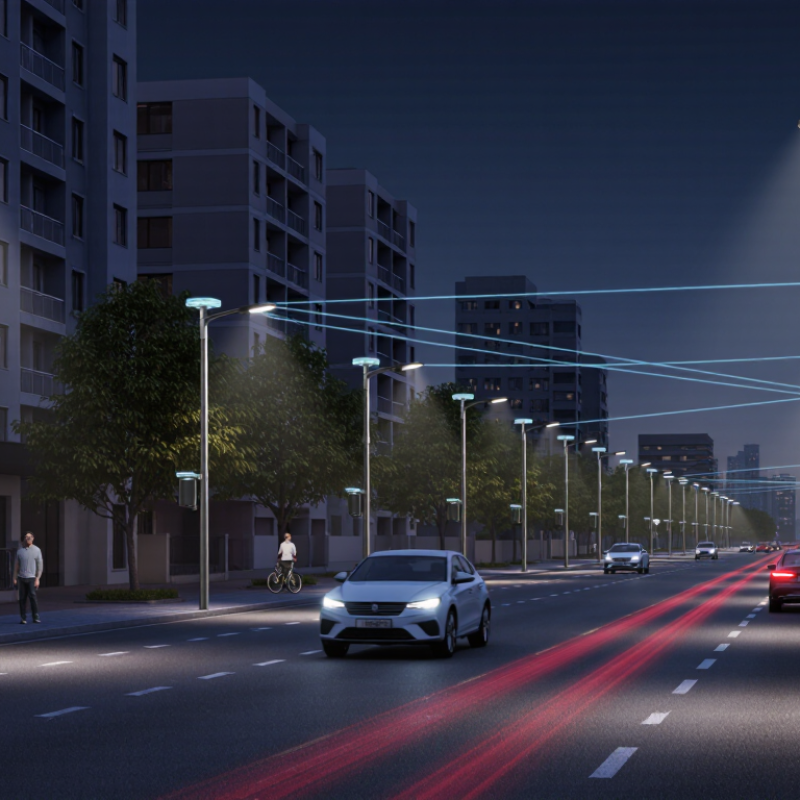
Start with the job each light must do, not the control system you hope to install. Is the road a fast arterial, a residential street, or a pedestrian path? IES RP-8-22 recommends setting roadway lighting around factors such as traffic, pedestrian activity, and conflict areas. That means a school crossing may need different coverage from a quiet side street. Define target illuminance, uniformity, glare limits, and operating hours before comparing fixtures. Be specific.
Then map the site at night. Note tree canopies, building shadows, wet pavement, pole spacing, existing wiring, and nearby homes where light spill matters. A plan drawn from daytime photos can miss a dark patch beneath a mature tree. It happens. U.S. Department of Energy street-lighting guidance indicates LED upgrades can reduce energy use by roughly 50–70%, depending on the existing equipment and controls. Treat that as a planning range, not a promised saving; dimming schedules and local conditions change the result.
Finally, record what the system must withstand and communicate: winter temperatures, dust, vibration, maintenance access, and available network coverage. Walk the route after dark, and measure representative points rather than relying only on a visual impression. Keep one uncertainty visible: future tree growth or construction may alter light levels. Specify how performance will be checked after installation, using the same targets set during design.
How to Choose a Smart Street Light in 2026?
Compare Smart Street Light Controls and Connectivity Options
Controls determine how a street light responds; connectivity determines how operators monitor and adjust it. A photocell switches lights based on daylight, while an astronomical clock follows scheduled sunrise and sunset times. Dimming schedules can reduce output during quiet hours. Motion sensors may raise brightness when people or vehicles approach, but they need careful placement to avoid abrupt changes or missed activity. No single control suits every road. A busy junction and a quiet residential street have different needs.
Tips: Check whether the controller supports the dimming level your LED fixture requires. Ask how schedules are updated during network outages. Test sensor coverage at night, not just on a site plan.
For connectivity, cellular links can simplify deployment across scattered sites, though coverage and recurring service costs need checking. Mesh networks can pass data between nearby lights, but performance depends on layout and reliable nodes. Long-range, low-power networks may suit basic status reports and commands, but can be less suitable for frequent, detailed data. Compare range, power use, maintenance, data access, and integration with existing systems. A small pilot can reveal dead zones and confusing controls before a full rollout. I would not assume the most connected option is automatically the best; sometimes a simpler setup is easier to maintain.
In 2026, judge a smart street light by the road it reveals, not its app. IES RP-8-22 recommends evaluating roadway lighting for visibility, uniformity, and glare. Ask for photometric files, then check them against the actual street layout. A warm color temperature of 3000K or below can be a useful starting point, though local conditions matter. Small details matter. A bright patch beneath a pole can still leave a dark crossing nearby.
The U.S. Department of Energy’s 2017 report, Adoption of Light-Emitting Diodes in Common Lighting Applications, estimated that LED street lighting could save about 50% of energy compared with conventional technologies. Treat that as a benchmark, not a guarantee: dimming schedules, traffic patterns, and standby loads affect real results. Check the fixture’s IP rating under IEC 60529, and request salt-mist test evidence for coastal locations. Ask how surge protection and operating-temperature limits were verified, too. I would still question any efficiency claim that lacks a clear test method. A tidy specification sheet does not show how a light performs after years of rain, dust, and heat.
A smart street light should meet the needs of its street, not just look impressive in a product sheet. Check applicable local standards for electrical safety, ingress protection, and photometric performance. Ask for current test reports, not only a list of claimed certifications. A wet coastal road and a dry residential lane place different demands on seals, materials, and light distribution. Details matter.
Cybersecurity deserves the same scrutiny as hardware. Ask how devices authenticate, how data is protected in transit, and how software updates are delivered. Confirm who can access system logs and how long security support will continue. A password shared across every pole is a weak point. So is an update process with no clear owner. Some specifications sound reassuring but remain vague; request measurable answers.
Compatibility can determine whether a system stays useful for years. Check whether controllers communicate with the existing management platform, and verify supported protocols and interfaces in writing. Test dimming schedules, fault alerts, and remote configuration with a small pilot before expanding. Include older equipment in the test. It may behave differently than expected. Compare not only purchase costs, but also integration work, training, and replacement options. A careful review takes time, and the checklist may still miss something. Revisit it with the people who will operate the lights every night.
| Selection Dimension | What to Check | Practical Evidence or Target | Why It Matters |
|---|---|---|---|
| Road-lighting safety | Confirm the luminaire is tested for the applicable road and outdoor-lighting requirements in the installation market. | Ask for test documentation covering IEC 60598-1 and, where applicable, IEC 60598-2-3 for luminaires used in road and street lighting. | These standards address luminaire safety and application-specific requirements. The exact applicable edition and local regulations should be verified for the project. |
| Ingress and impact protection | Check dust and water protection for the complete assembled luminaire, plus impact resistance where required. | Look for an IP rating classified under IEC 60529 and an IK rating classified under IEC 62262. Select ratings based on site exposure and the authority’s specification. | IP and IK ratings describe different properties: ingress protection and resistance to mechanical impact. They are not interchangeable. |
| Control interface | Verify the physical connector, pin arrangement, control method, and supported dimming functions. | ANSI C136.41 defines a standardized interface for roadway and area-lighting control devices. Confirm the luminaire and controller use compatible receptacles, contacts, and functions. | A matching connector does not by itself guarantee that every control feature or software function will work. |
| Sensor and node interchangeability | Check whether the luminaire accepts the intended sensing or communication module and whether the mechanical and electrical interfaces match. | For systems using the Zhaga interface, verify the relevant Zhaga Book 18 requirements and confirm that the specific luminaire and module have been tested together. | A standardized interface can support interchangeability, but it does not automatically ensure end-to-end network or application compatibility. |
| Lighting-control protocol | Identify the control protocol, device roles, dimming behavior, and whether the system is wired, wireless, or hybrid. | For DALI-based control, check the applicable IEC 62386 parts and verify product-level interoperability evidence. Confirm that gateways and management software support the same functions. | Protocol support can vary by device and feature. Confirm commissioning, group control, scheduling, status reporting, and fault monitoring in the actual system. |
| Cybersecurity baseline | Ask how devices are protected during onboarding, operation, maintenance, and decommissioning. | Look for documented device capabilities aligned with the NISTIR 8259A IoT device cybersecurity baseline, such as unique identification, secure configuration, data protection, access control, and secure software updates. | A published security process helps buyers assess device-level safeguards and maintenance responsibilities over the product’s service life. |
| Network and system security | Review network segmentation, authentication, encryption, logging, vulnerability handling, and update procedures. | Request a security architecture and update policy. Where relevant to the control environment, assess the system against applicable IEC 62443 requirements and the owner’s cybersecurity policies. | Street-light networks may connect to wider operational or municipal systems. Security depends on devices, gateways, networks, software, and operating practices. |
| Interoperability and data access | Check integration with the existing management platform, asset database, and maintenance workflow. | Require a written interface list, documented APIs or supported data exports, a test plan, and a demonstration of device discovery, alarms, energy data, and control commands. | Clear interfaces and data ownership terms reduce integration effort and help avoid dependence on undocumented system behavior. |
| Operational fit and lifecycle | Assess dimming schedules, power measurement, fault reporting, replacement parts, warranties, and long-term software support. | Compare documented operating temperatures, electrical ratings, expected maintenance arrangements, spare-part availability, and the duration of security and firmware support. | Lifecycle planning affects service continuity, maintenance costs, and the ability to keep the system secure after installation. |
| Procurement verification | Validate claims against project requirements and local rules before purchase or deployment. | Recommended Request certificates or test reports, compatibility matrices, cybersecurity documentation, and a pilot using the intended network and management platform. | Independent evidence and a realistic pilot help identify compliance gaps and integration issues before large-scale rollout. |
Note: Standards, editions, certification schemes, and local requirements can vary by country and project. Confirm the applicable requirements with the project authority and verify that documentation applies to the exact product configuration being procured.
How to Choose a Smart Street Light in 2026?
A smart street light’s purchase price is only the starting point. Compare energy use, software fees, replacement parts, and expected service life across the same time period. A fixture that costs less today may need more frequent repairs or consume more power. Check the details. Ask suppliers for measured power data, compatible control options, and clear warranty terms. Include installation costs, too, especially if poles need new wiring or access equipment.
Maintenance can shape the real cost. Find out whether drivers, sensors, and control nodes can be replaced separately, or whether a whole fixture must come down. Ask how spare parts are stocked and how quickly technical support responds. Get response times in writing. A dashboard is useful, but only if staff can interpret alerts and resolve faults. That matters. Supplier training, software updates, and support after installation deserve a place in your comparison. Talk through a realistic fault, such as a light that stops responding after heavy rain. A spreadsheet can still miss local conditions, and even a careful estimate may need revision after the first year. Don’t treat optimistic savings as guaranteed.
„Thanks to the LUVIR technology, the solder resist process could be switched directly from the previously used mask exposure to direct exposure. As an outstanding digital solution on the market, this technology has been able to demonstrate fast process times and superior quality on our certified conventional ink in production. This allowed us to fully digitize the solder mask process at low cost – without process or ink adjustments. An excellent benefit to our production in Rot am See.“
Ralf Göhringer (Head of Production WE Rot am See)
I would definitely recommend the Limata machine and team for a future company purchase
Michael Greenaway
Compunetics Inc.
“The Limata ldi has been amazing!! Best thing we did was buy this machine”
Richard Brady
GM
Circuitlabs
“Since 2019, we have been running the Limata X1000 LDI system (including LUVIR for solder mask imaging) in daily production as an addition to our current process with film. The machine was capable of properly exposing Taiyo PSR-4000 BN (DI) solder mask types on normal to high-copper boards using a new and unique direct imaging process. The machine operating interface is very user friendly which allowed for a quick technical training curve. The pre-registration processing reduced several seconds of production time at every print. Limata support and service staff is incomparable. They supported our team every step of the way at basically any time of the day or night, with literally, an immediate response time, customizing the software interface to best fit our Operations and needs.
We have exposed more than 8,000 prints since end of October, on various solder mask colors and some resist film panels. Limata, has proven to be very capable and innovative. They are a strong contender in the industry.
We have very much enjoyed this project, and working with the team!
Thank you Limata for the continued support and being a part of our growth.”
Bill Sezate
Vice President, GM
Summit Interconnect
As a replacement to our current contact exposure process with film, the LIMATA X2000 system including LUVIR-Technology was capable of properly exposing non-LDI solder mask types using a direct imaging process. The machine offers cutting edge software with a very intuitive operating interface which allowed for quick technician training curve. The dual drawer system combined with pre-registration processing reduced several seconds of production time at every machine cycle. Limata support and service staff is world class. They added software patches to keep production running at shortest possible response times, customized the software interface to best fit our in-house Operations system, and even wrote a step-by-step machine processing manual. As a result of the project, we have exposed more than 16,000 times on various product types and solder mask brands/colors. Limata, in a very short timeframe as a company, has definitely shown they are truly innovative and will be challenging the industry of direct imaging for the top spot.
Kevin Beattie
Process Engineer
TTM Technologies
Forest Grove Division
