Choosing the right Electric Forklift Battery is crucial for operational efficiency in industrial settings. According to a report by Market Research Future, the global forklift battery market is projected to grow significantly, emphasizing the need for informed decisions. This growth reflects an increase in demand for reliable power sources, as businesses prioritize productivity and sustainability.
Electric Forklift Batteries vary widely in type, capacity, and application. Lead-acid batteries, for example, are commonly used due to their affordability. However, lithium-ion batteries are gaining traction for their longer lifespan and faster charging times. The Battery University indicates that lithium-ion batteries can last up to three times longer than their lead-acid counterparts. Such information is vital for companies considering long-term investments in their equipment.
Understanding your specific needs is essential. Factors to consider include the duration of operation, weight capacity, and charging infrastructure. Some industries may require frequent heavy lifting, while others may prioritize quick turnover. Many companies overlook these factors, leading to mismatched battery choices that can hinder performance. Investing time in selecting the right Electric Forklift Battery can ultimately save costs and enhance productivity in the long run.
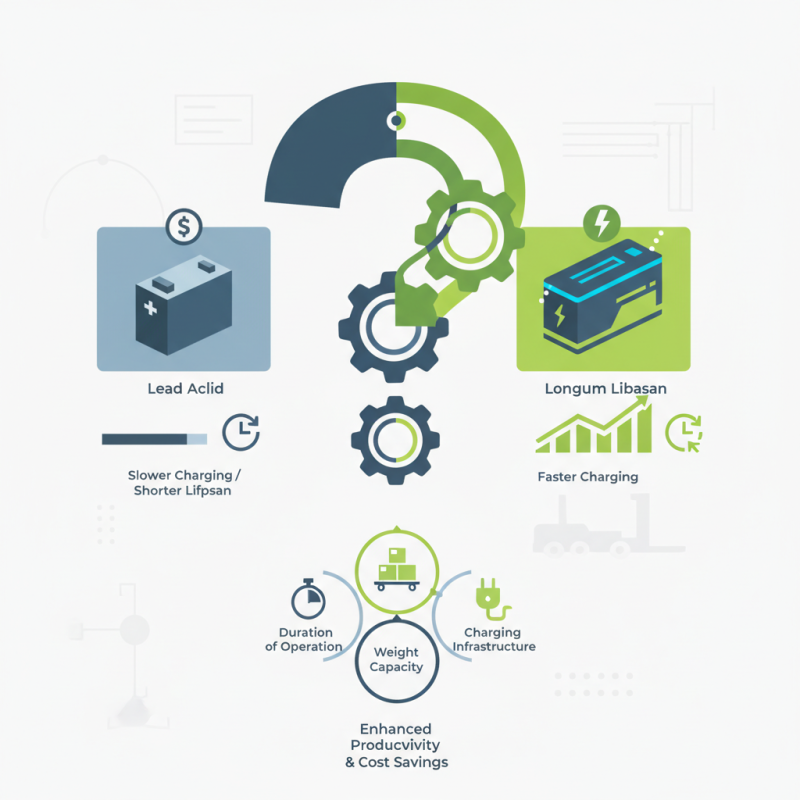
Choosing the right electric forklift battery can significantly impact your operations. It's essential to consider several factors when making your selection. The capacity of the battery matters. It determines how long you can run the forklift on a single charge. A battery with higher capacity offers more uptime but may be bulkier and heavier.
Charging times are also crucial. Some batteries charge faster than others. This can affect how frequently the forklift is available for use. Think about the work environment, too. A battery designed for cold storage may not perform well in warm conditions.
Finally, don't overlook maintenance requirements. Some batteries demand regular upkeep, while others are more forgiving. Evaluate your workforce's expertise to handle these tasks. Each decision you make can influence efficiency. Reflect on your specific needs before settling on a choice.
When selecting an electric forklift battery, it's vital to understand the different types available. There are primarily three categories: lead-acid, lithium-ion, and nickel-cadmium. Lead-acid batteries are the most common choice for many industries. They are cost-effective but require regular maintenance. They can last around 1,500 cycles, which may not be sufficient for high-demand operations.
Lithium-ion batteries have gained popularity due to their efficiency. They charge faster and have a longer lifespan, averaging about 5,000 cycles. According to a 2022 industry report, companies using lithium-ion technology reported a 30% increase in productivity. This type of battery also offers a lower weight, improving forklift maneuverability. However, the initial investment can be high, leading to hesitation in some businesses.
Nickel-cadmium batteries provide another alternative, especially where extreme temperatures can affect performance. These batteries are resilient and can operate in harsh conditions. However, the environmental concerns surrounding cadmium and strict disposal regulations create challenges. Companies should assess their operational needs before making a decision. Each battery type presents advantages and disadvantages that must match a company’s specific requirements for effective material handling.
This chart compares the average costs of different types of electric forklift batteries, providing a visual aid to help you choose the right battery for your specific needs.
Choosing the right electric forklift battery is crucial for efficient operations. Evaluating battery capacity and runtime ensures that your equipment meets your specific needs. According to industry reports, the average operational runtime for electric forklifts ranges from 4 to 8 hours, depending on the load and application. This makes understanding your operational demands essential to avoid unexpected downtime.
Tip: Consider the weight and type of loads. Heavier loads require more power, impacting battery life. For instance, a 48V battery may deliver 600-800 amp-hours. This translates to longer run time, but also a heavier weight. Analyze your daily tasks to choose an appropriate capacity.
If your operation runs multiple shifts, investing in high-capacity batteries is advisable. These batteries can reduce the number of charging cycles, increasing efficiency. Yet, keep in mind the initial cost. Ensure your budget aligns with your long-term needs. Reflect on your usage patterns to make informed choices. Assessing these factors leads to a battery selection that truly supports your operational goals.
Choosing the right electric forklift battery requires careful consideration of charging time and cycle life. Charging time is crucial for maximizing efficiency. A shorter charging period means less downtime, allowing your operations to run smoothly. It’s important to analyze how long your forklift will be out of service during charging.
Cycle life is another key factor. It refers to the number of complete charging cycles a battery can undergo before its capacity diminishes significantly. A battery with a higher cycle life will save you money in the long run. Frequent replacements can be costly and disruptive. Think about your workload demands—high-frequency use will require a more durable battery.
Assess your specific needs. A battery that works well for one operation might not suit another. Understand the charging infrastructure you have in place. Are there limitations in your facility? You may find that certain batteries require more sophisticated charging equipment. Be prepared to address these factors to ensure reliability and performance.
| Battery Type | Voltage (V) | Capacity (Ah) | Charging Time (hrs) | Cycle Life (Cycles) |
|---|---|---|---|---|
| Lead Acid | 12 | 220 | 8 | 800 |
| Lithium-ion | 24 | 120 | 4 | 2000 |
| Nickel Cadmium | 36 | 150 | 6 | 1500 |
| Gel | 48 | 200 | 10 | 1200 |
When considering electric forklift batteries, it’s crucial to examine both initial investments and long-term maintenance costs. A typical lead-acid battery can range from $2,000 to $4,000. While this upfront cost may seem manageable, maintenance can quickly add up. Data indicates that companies spend an average of 15-20% of the initial battery cost annually on maintenance and replacement parts. This statistic can significantly impact the total cost of ownership over a five-year period.
Lithium-ion batteries, despite a higher upfront cost of around $5,000 to $10,000, offer distinct advantages in longevity and reduced maintenance needs. Typically, they can operate for up to 10 years without major issues. Reports show that lithium-ion batteries can reduce maintenance costs by up to 50%. However, businesses must weigh the benefits of less frequent replacements against the initial financial barrier. Many companies have found that choosing the right battery requires a careful analysis of their specific usage patterns and operational needs.
Understanding the total cost of ownership is essential. A longer-lasting battery will save money in the long run but may require a significant initial outlay. Businesses should analyze their operational demands critically. Are they ready to invest wisely for better durability, or do they prioritize lower initial costs? Each choice carries risks, and reflecting on past decisions can help drive better future outcomes.
„Thanks to the LUVIR technology, the solder resist process could be switched directly from the previously used mask exposure to direct exposure. As an outstanding digital solution on the market, this technology has been able to demonstrate fast process times and superior quality on our certified conventional ink in production. This allowed us to fully digitize the solder mask process at low cost – without process or ink adjustments. An excellent benefit to our production in Rot am See.“
Ralf Göhringer (Head of Production WE Rot am See)
I would definitely recommend the Limata machine and team for a future company purchase
Michael Greenaway
Compunetics Inc.
“The Limata ldi has been amazing!! Best thing we did was buy this machine”
Richard Brady
GM
Circuitlabs
“Since 2019, we have been running the Limata X1000 LDI system (including LUVIR for solder mask imaging) in daily production as an addition to our current process with film. The machine was capable of properly exposing Taiyo PSR-4000 BN (DI) solder mask types on normal to high-copper boards using a new and unique direct imaging process. The machine operating interface is very user friendly which allowed for a quick technical training curve. The pre-registration processing reduced several seconds of production time at every print. Limata support and service staff is incomparable. They supported our team every step of the way at basically any time of the day or night, with literally, an immediate response time, customizing the software interface to best fit our Operations and needs.
We have exposed more than 8,000 prints since end of October, on various solder mask colors and some resist film panels. Limata, has proven to be very capable and innovative. They are a strong contender in the industry.
We have very much enjoyed this project, and working with the team!
Thank you Limata for the continued support and being a part of our growth.”
Bill Sezate
Vice President, GM
Summit Interconnect
As a replacement to our current contact exposure process with film, the LIMATA X2000 system including LUVIR-Technology was capable of properly exposing non-LDI solder mask types using a direct imaging process. The machine offers cutting edge software with a very intuitive operating interface which allowed for quick technician training curve. The dual drawer system combined with pre-registration processing reduced several seconds of production time at every machine cycle. Limata support and service staff is world class. They added software patches to keep production running at shortest possible response times, customized the software interface to best fit our in-house Operations system, and even wrote a step-by-step machine processing manual. As a result of the project, we have exposed more than 16,000 times on various product types and solder mask brands/colors. Limata, in a very short timeframe as a company, has definitely shown they are truly innovative and will be challenging the industry of direct imaging for the top spot.
Kevin Beattie
Process Engineer
TTM Technologies
Forest Grove Division
