Choosing the right Diesel Fuel Generator begins with an honest picture of the work it must handle. List the equipment that will run at the same time, including motors, pumps, refrigeration units, and lighting. Their starting demand can exceed their running load. A generator sized only from steady wattage may struggle when a large motor starts. Small details matter: a pump cycling at dawn, a freezer running overnight, or a workshop adding tools later.
Rudolf Diesel, the engine pioneer, offers a useful point of reference, though the following line is an editorial paraphrase, not a verified quotation: “Choose for the work, not the label.” That principle helps keep the decision grounded. Compare rated and standby output, expected runtime, fuel use, noise, maintenance access, and local service support. Check whether the unit can handle the site’s voltage and phase requirements. Ask how often filters and oil need attention. Look at the service panel, too; cramped access can turn routine maintenance into a chore.
There is no perfect model.
A larger generator is not automatically safer or more efficient. An undersized unit may overload, while an oversized one can run poorly under light demand. Be candid about uncertain future loads. This guide explains how to compare capacity, engine design, controls, and total operating costs, so you can choose a Diesel Fuel Generator that fits real conditions—not just a catalog headline.
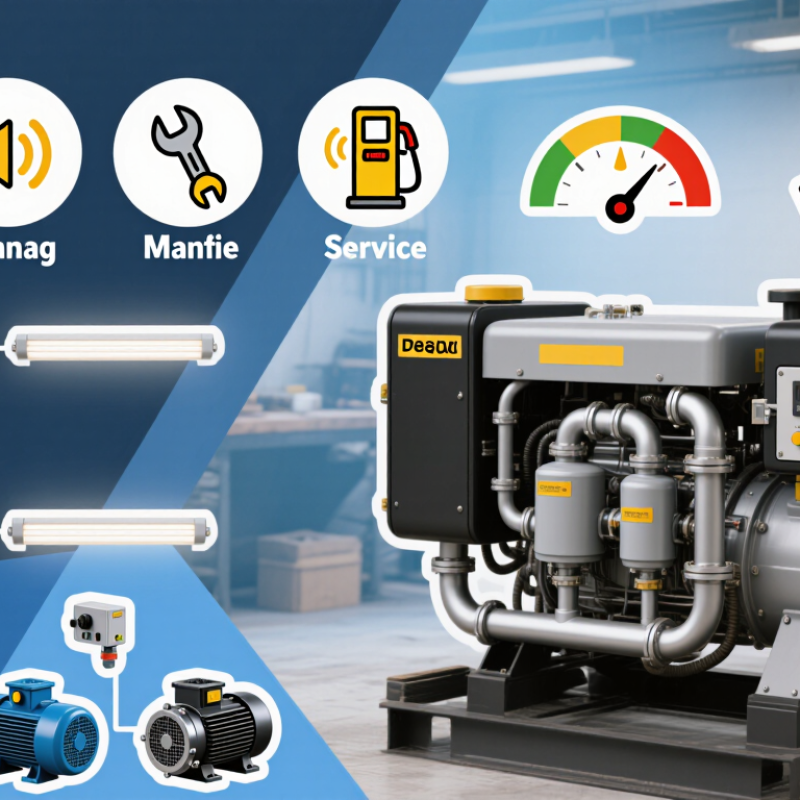
How to Choose the Best Diesel Fuel Generator
Determine Your Power Requirements and Intended Applications
Start with the loads. List every device that must run, from refrigeration and lighting to pumps, compressors, or medical equipment. Record each item’s running watts and starting demand; motor-driven equipment can draw much more power briefly when switched on. Add only loads that may operate at the same time, then allow headroom for future needs. A spreadsheet can still miss a real-world detail, like a pump starting while a heater is already running.
Match the generator to its job. A home backup system may need to support essential circuits, while a construction site may require steady power for tools and temporary lighting. For critical facilities, consider how long the generator must operate and which loads can be shed. The U.S. Energy Information Administration’s 2022 Electric Power Annual reported an average U.S. customer interruption duration of about 5.5 hours, including major events. That figure is a useful reminder: estimate outage needs for your location, not just a brief test run. Uptime Institute’s 2023 Annual Outage Analysis found that 60% of significant data-center outages cost at least $100,000, underscoring the value of reliable backup planning for sensitive operations. Leave room. Confirm the final load schedule with a qualified electrical professional, especially when equipment has large starting surges or several loads cycle unpredictably.
Compare estimated running and peak power needs for common applications. Choose a generator based on the equipment you will operate simultaneously, allowing extra capacity for motor-starting surges.
Illustrative planning estimates in kilowatts (kW); actual loads vary by appliances, tools, motors, and usage. Check equipment nameplates and consult a qualified electrician before sizing a generator.
Begin with the equipment you need to keep running, not the generator’s headline rating. Record each appliance or machine’s running watts from its nameplate or manual. For equipment labeled in amps, multiply volts by amps, then check the stated power factor if available. Add the loads expected to operate at the same time. Keep a simple list. A fridge, lights, and a well pump may be modest individually, yet their combined demand can add up.
Starting loads need special attention. Motors in pumps, compressors, and air conditioners can briefly draw several times their normal running power. Use the manufacturer’s starting-watt figure when available; otherwise, ask a qualified technician rather than relying on a broad guess. Map when each motor starts. If the pump can start after other large loads are switched off, you may not need to size for every surge at once. That assumption should be tested, not merely hoped for.
Compare your calculated peak with the generator’s rated output, and check both continuous and short-term ratings. Leave a practical margin for future equipment and avoid operating at full capacity for long periods. Site conditions matter, too: heat and high elevation can reduce available output, so consult the generator’s derating data. The estimate will still have uncertainty. Recheck it against actual nameplates and startup behavior before choosing a unit.
How to Choose the Best Diesel Fuel Generator
Compare fuel use at your actual load, not just the advertised maximum. The U.S. Energy Information Administration’s heat-content data puts diesel at roughly 137,000 Btu per gallon. That figure describes the fuel, not the electricity a generator delivers; engine losses matter. Ask for a fuel-consumption curve at 25%, 50%, 75%, and full load. A unit may use disproportionately more fuel when lightly loaded, so an oversized generator can cost more to run. Check the curve against the equipment you plan to power.
Runtime is simple to estimate: usable tank capacity divided by fuel use per hour. But treat the result as a planning figure. Refills, reserve fuel, temperature, maintenance, and changing loads can shorten real-world operation. For engine performance, compare rated and standby output, frequency stability, and response to motor-starting surges. The U.S. EPA’s stationary-engine technical guidance documents how operating conditions affect engine emissions and performance; the practical lesson is to compare units under equivalent conditions. A tidy spreadsheet can still mislead.
Tips: Request fuel-use data at your expected load, then test with real equipment if possible. Record hourly consumption during a sustained run. Keep a reserve. Also inspect service intervals and cooling requirements; a hot, dusty site can expose weaknesses that a showroom test misses. Weigh the noise and vibration, too. Small details, but they matter.
| Generator Size | Typical Fuel Use at 50% Load | Example Fuel Tank | Estimated Runtime at 50% Load | Typical Engine Performance | Best Suited For |
|---|---|---|---|---|---|
| 10 kW | About 0.8–1.0 US gal per hour | 20 US gal | About 22 hours, using a midpoint fuel-use estimate | Typically a compact, water-cooled diesel engine; many 60 Hz units operate at 1,800 rpm. | Essential household circuits, small workshops, and light-duty backup power. |
| 25 kW | About 1.6–2.0 US gal per hour | 40 US gal | About 22 hours, using a midpoint fuel-use estimate | Often a three-cylinder, water-cooled engine designed for steady operation under moderate loads. | Larger homes, small commercial buildings, and light industrial equipment. |
| 50 kW | About 3.1–3.8 US gal per hour | 80 US gal | About 23 hours, using a midpoint fuel-use estimate | Commonly uses a four-cylinder, water-cooled engine; a suitable choice for sustained commercial loads. | Retail sites, farms, workshops, and medium-sized commercial facilities. |
| 100 kW | About 6.0–7.5 US gal per hour | 150 US gal | About 22 hours, using a midpoint fuel-use estimate | Typically a larger four- or six-cylinder, water-cooled engine built for higher continuous output. | Large facilities, critical systems, and industrial or institutional backup power. |
| Fuel-use figures are broad illustrative ranges, not guaranteed ratings. Runtime estimates divide the example tank capacity by the midpoint of the stated fuel-use range; actual runtime varies with load, generator design, maintenance, fuel conditions, and usable tank capacity. Compare manufacturer-rated fuel consumption at the load you expect to run. | |||||
A diesel generator can look suitable on paper and still fail at the site. Check access for delivery, ventilation, drainage, and clearance around the exhaust. Measure the ground and note nearby windows, fences, and occupied rooms. Heat, altitude, and long cable runs can affect usable output, so compare the unit’s rating with the load measured at the equipment—not just its nameplate total. Leave capacity for motor-starting surges. I still see people overlook that detail.
Noise and exhaust need practical checks. NIOSH’s Criteria for a Recommended Standard: Occupational Noise Exposure (1998) recommends an exposure limit of 85 dBA over eight hours, with a 3 dB exchange rate. Ask for sound data at a stated distance, then measure at the nearest occupied area; walls and reflections can change the result.
For emissions, EPA’s Tier 4 standards include a particulate-matter limit of 0.02 g/kWh for many nonroad engines rated 56–560 kW. Confirm the engine’s power category and certification; a broad “clean” claim is not enough. Compare fuel consumption at the expected load, not only at full output.
Useful features depend on the job. Look for overload protection, clear alarms, accessible filters, and a runtime display. A transfer switch and automatic start may matter for unattended backup; a bunded base can simplify spill control.
Test the controls under load before relying on them. Small, but important.
Safety and upkeep deserve as much attention as rated output. Check that the generator has clear instructions for outdoor operation and exhaust placement. Never run it in a home, garage, or other enclosed space; carbon monoxide can build up quickly. Look for accessible emergency shutoff controls, sturdy guards, and a stable frame. Review the warranty closely: note its duration, covered parts, service requirements, and exclusions. A long warranty is less helpful if routine maintenance is difficult to document.
Maintenance needs vary with use and conditions. Ask how often the oil, filters, and fuel system require attention, and whether replacement parts are readily available. Keep a simple service log. Then estimate total cost, not just the purchase price: include fuel, scheduled service, delivery, installation, and likely repairs. A generator used only during outages may have different costs from one running daily. Estimates can be imperfect; local fuel prices and workload change the picture.
Tips: Compare warranty terms side by side. Price a year of routine service before buying. Check operating noise near bedrooms or neighboring work areas. Small details matter. If a maintenance task or warranty clause is unclear, ask the seller to explain it in writing.
„Thanks to the LUVIR technology, the solder resist process could be switched directly from the previously used mask exposure to direct exposure. As an outstanding digital solution on the market, this technology has been able to demonstrate fast process times and superior quality on our certified conventional ink in production. This allowed us to fully digitize the solder mask process at low cost – without process or ink adjustments. An excellent benefit to our production in Rot am See.“
Ralf Göhringer (Head of Production WE Rot am See)
I would definitely recommend the Limata machine and team for a future company purchase
Michael Greenaway
Compunetics Inc.
“The Limata ldi has been amazing!! Best thing we did was buy this machine”
Richard Brady
GM
Circuitlabs
“Since 2019, we have been running the Limata X1000 LDI system (including LUVIR for solder mask imaging) in daily production as an addition to our current process with film. The machine was capable of properly exposing Taiyo PSR-4000 BN (DI) solder mask types on normal to high-copper boards using a new and unique direct imaging process. The machine operating interface is very user friendly which allowed for a quick technical training curve. The pre-registration processing reduced several seconds of production time at every print. Limata support and service staff is incomparable. They supported our team every step of the way at basically any time of the day or night, with literally, an immediate response time, customizing the software interface to best fit our Operations and needs.
We have exposed more than 8,000 prints since end of October, on various solder mask colors and some resist film panels. Limata, has proven to be very capable and innovative. They are a strong contender in the industry.
We have very much enjoyed this project, and working with the team!
Thank you Limata for the continued support and being a part of our growth.”
Bill Sezate
Vice President, GM
Summit Interconnect
As a replacement to our current contact exposure process with film, the LIMATA X2000 system including LUVIR-Technology was capable of properly exposing non-LDI solder mask types using a direct imaging process. The machine offers cutting edge software with a very intuitive operating interface which allowed for quick technician training curve. The dual drawer system combined with pre-registration processing reduced several seconds of production time at every machine cycle. Limata support and service staff is world class. They added software patches to keep production running at shortest possible response times, customized the software interface to best fit our in-house Operations system, and even wrote a step-by-step machine processing manual. As a result of the project, we have exposed more than 16,000 times on various product types and solder mask brands/colors. Limata, in a very short timeframe as a company, has definitely shown they are truly innovative and will be challenging the industry of direct imaging for the top spot.
Kevin Beattie
Process Engineer
TTM Technologies
Forest Grove Division
