Choosing a Manual Ceramic Coffee Grinder is less about finding a universally “best” model and more about matching its design to your coffee routine. The National Coffee Association’s 2024 National Coffee Data Trends report found that 67% of U.S. adults had coffee in the previous day. That figure describes coffee drinking, not grinder preferences or performance. Still, it highlights why a dependable way to prepare fresh grounds matters to many households.
Small details make a real difference. Consider the burr alignment, grind adjustment range, handle comfort, and capacity before focusing on ceramic burrs alone. Ceramic can resist corrosion, but material by itself does not guarantee even particle size or a better cup. The Specialty Coffee Association’s brewing resources emphasize controlling variables such as dose and extraction; a grinder helps shape the grounds, but it cannot fix every brewing problem. A useful buying decision starts with what you brew: fine grounds for espresso, or coarser particles for a French press.
There are trade-offs. Hand grinding takes time, and some adjustment systems are harder to repeat than others. A compact grinder may fit neatly beside a kettle, yet hold too little coffee for multiple cups. Check how clearly it changes settings and whether its parts can be cleaned or replaced. Reviews can help, but treat unsupported claims about “perfect consistency” with care. Not every cup will be perfect. The aim is a grinder that feels comfortable, produces a suitable range of grounds, and earns its place in your daily routine.
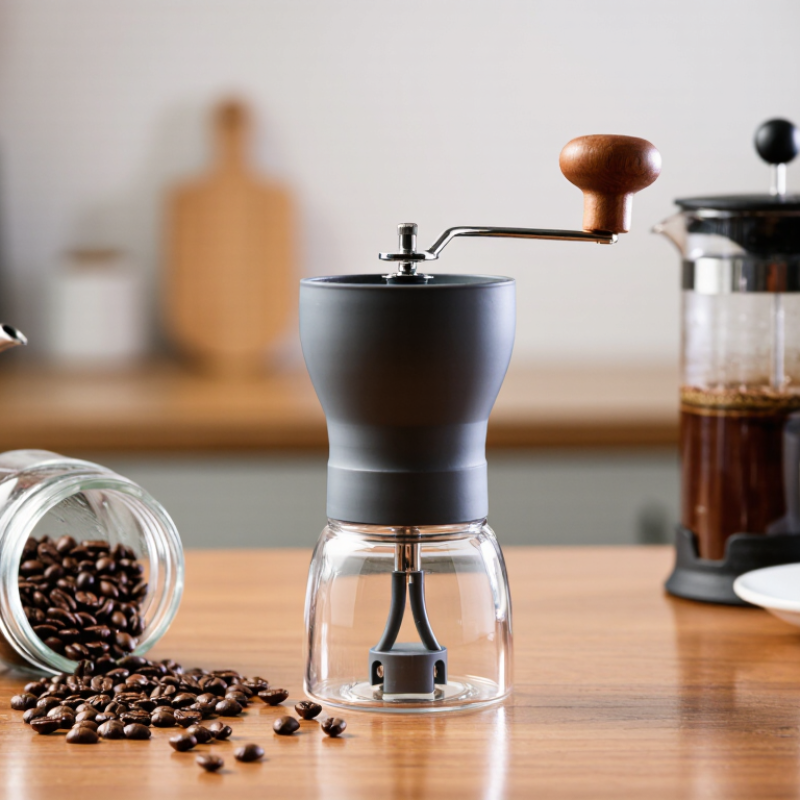
Before choosing a manual ceramic coffee grinder, decide how you usually brew. A pour-over needs a fairly even, medium grind; a French press works better with coarser particles. Espresso requires a much finer setting and careful adjustment. If you switch between methods, check that the grinder offers a useful range for both. A wide range sounds appealing, but it matters only if the settings are consistent.
Think about your daily routine, too. Grinding one cup by hand is manageable; preparing several cups can take longer than expected. Ceramic burrs resist rust and may stay sharp through regular use, but they do not guarantee perfectly uniform grounds. Check whether the adjustment mechanism feels clear and repeatable. Small setting changes should make a noticeable difference without leaving you guessing. Honestly, grind labels can be imperfect; testing a few settings with your own beans is more reliable.
Tips: Start with a medium setting for pour-over or a coarse one for French press. Brew, taste, and adjust one step at a time. If coffee tastes bitter, try a coarser grind; if it tastes weak or sour, try finer. Keep notes. Your preferred range may shift with the beans.
A ceramic burr’s material matters, but its geometry and alignment matter just as much. Look for evenly formed ridges, clean edges, and burrs that sit squarely without visible wobble. Turn the handle slowly with no beans; scraping or uneven resistance may suggest an alignment issue, though it is not a complete diagnosis. Check the fit. A chipped tooth or rough finish can contribute to uneven particle sizes. Ceramic can resist wear, but it is more brittle than steel, so avoid dropping the grinder.
Test consistency using the same beans, dose, and setting across several small batches. Spread each sample on white paper: a consistent grind should not have many powdery fines beside conspicuously large fragments. For a more useful comparison, brew each sample the same way and note drawdown time and taste; one cup alone proves little. That part is messy. Hand speed, bean age, and adjustment also affect results, so do not blame the burr immediately. A grinder that feels smooth may still produce a broad mix of particle sizes.
A manual ceramic coffee grinder should offer settings that match your brewing routine, not just an impressive number of clicks. Coarser settings suit many French press brews, while pour-over often needs a medium grind. Espresso requires a fine, even grind, and some hand grinders cannot adjust precisely enough for it. Check whether the adjustment ring moves in clear steps or turns continuously. Clicks are easier to repeat; stepless adjustment allows finer control but can be fiddly.
Tips: Before brewing, note the setting beside your chosen method. Turn the ring gently, then check that it locks or stays put. Small details matter. A few test cups can reveal whether one click makes a noticeable change in flow or taste.
Look for adjustment markings you can read and a mechanism that feels stable, even with coffee grounds nearby. Ceramic burrs can work well, but burr material alone does not guarantee consistent particle size. There is a trade-off: more settings may offer flexibility, yet tiny adjustments are not useful if they are hard to reproduce. It is also easy to blame the grinder when water temperature or pouring changes the result. Keep those variables steady, and compare one adjustment at a time. Not always perfect, but more informative.
Compare Grind Settings and Adjustment Mechanisms
These approximate particle-size bands show why useful adjustment range matters: espresso generally needs a finer grind than pour-over or French press. Stepped mechanisms move between set positions; stepless mechanisms allow continuous adjustment. Actual particle sizes and ideal settings vary with the grinder, coffee, and brewing method.
Check the grinder’s stated capacity against the coffee you make each time. A small chamber may suit one mug, but it can mean repeated loading for two people. Capacity figures can be confusing, so compare grams rather than cup counts. Cup sizes vary. If possible, measure your usual dose at home and check whether the grounds container holds it without spilling. A narrow counter or packed travel bag also changes what feels practical.
Portability is more than low weight. Look for a handle that folds or detaches securely, a lid that stays in place, and parts that are easy to clean. Ceramic burrs resist corrosion, but they can chip if dropped; a padded pouch may help. For ease of use, test the grip and crank movement if you can. A slippery body or stiff handle gets annoying before the beans are ground. Settings should be clear enough to adjust for different brewing methods, though tiny markings can still be hard to read. There’s a trade-off: a compact grinder may take longer to turn. I’d rather notice that before a rushed morning than after one.
Cleaning is not a minor detail when a grinder is used every morning. The National Coffee Association’s 2024 National Coffee Data Trends report found that 67% of U.S. adults had coffee the previous day. Frequent use makes trapped grounds and oily residue worth considering. Look for a hopper and burr assembly that can be reached with a small brush. Ceramic burrs should stay dry; rinsing them may leave moisture in tight spaces. Check the maker’s cleaning instructions before buying.
Durability depends on more than the burr material. Turn the handle and notice whether the shaft wobbles or the adjustment dial slips. A stable axle and replaceable parts can matter more over time than a polished wooden knob. Ceramic burrs resist corrosion, but they can chip if dropped or struck. It is easy to focus on the burrs and overlook the handle joint. That part takes daily strain.
Compare price with repairability and expected use, not just the first number on the tag. A low-cost grinder may be sensible for occasional brewing, while a sturdier model may suit several cups each day. Divide the price by a realistic number of years, then check whether replacement parts are available. This estimate is imperfect; use and care vary widely. Still, it makes comparisons more grounded than choosing by appearance alone.
„Thanks to the LUVIR technology, the solder resist process could be switched directly from the previously used mask exposure to direct exposure. As an outstanding digital solution on the market, this technology has been able to demonstrate fast process times and superior quality on our certified conventional ink in production. This allowed us to fully digitize the solder mask process at low cost – without process or ink adjustments. An excellent benefit to our production in Rot am See.“
Ralf Göhringer (Head of Production WE Rot am See)
I would definitely recommend the Limata machine and team for a future company purchase
Michael Greenaway
Compunetics Inc.
“The Limata ldi has been amazing!! Best thing we did was buy this machine”
Richard Brady
GM
Circuitlabs
“Since 2019, we have been running the Limata X1000 LDI system (including LUVIR for solder mask imaging) in daily production as an addition to our current process with film. The machine was capable of properly exposing Taiyo PSR-4000 BN (DI) solder mask types on normal to high-copper boards using a new and unique direct imaging process. The machine operating interface is very user friendly which allowed for a quick technical training curve. The pre-registration processing reduced several seconds of production time at every print. Limata support and service staff is incomparable. They supported our team every step of the way at basically any time of the day or night, with literally, an immediate response time, customizing the software interface to best fit our Operations and needs.
We have exposed more than 8,000 prints since end of October, on various solder mask colors and some resist film panels. Limata, has proven to be very capable and innovative. They are a strong contender in the industry.
We have very much enjoyed this project, and working with the team!
Thank you Limata for the continued support and being a part of our growth.”
Bill Sezate
Vice President, GM
Summit Interconnect
As a replacement to our current contact exposure process with film, the LIMATA X2000 system including LUVIR-Technology was capable of properly exposing non-LDI solder mask types using a direct imaging process. The machine offers cutting edge software with a very intuitive operating interface which allowed for quick technician training curve. The dual drawer system combined with pre-registration processing reduced several seconds of production time at every machine cycle. Limata support and service staff is world class. They added software patches to keep production running at shortest possible response times, customized the software interface to best fit our in-house Operations system, and even wrote a step-by-step machine processing manual. As a result of the project, we have exposed more than 16,000 times on various product types and solder mask brands/colors. Limata, in a very short timeframe as a company, has definitely shown they are truly innovative and will be challenging the industry of direct imaging for the top spot.
Kevin Beattie
Process Engineer
TTM Technologies
Forest Grove Division
