Choosing the right Wire Winder can influence production speed, coil quality, labor costs, and workplace reliability. A machine that looks impressive in a catalog may still fail your daily requirements. Wire diameter, material stiffness, coil width, winding tension, and target output must match the equipment. Measure twice.
Real production experience shows that small differences matter. A winder may handle thin copper wire smoothly but struggle with spring steel or insulated cable. Check its torque range, spindle design, speed control, and tension system. Ask suppliers for test results using wire similar to yours. Photos are useful, but samples are better. Fit matters.
Operators should also examine setup time, noise, guarding, maintenance access, and control simplicity. A clear digital panel can reduce training mistakes during busy shifts. Automatic stopping, stable alignment, and consistent tension can protect both the product and the operator. Do not overlook the footprint. The machine must fit your line without blocking material flow.
Cost deserves a wider view. A low purchase price may hide expensive tooling, frequent adjustments, or limited technical support. Review warranty terms, spare-part availability, installation guidance, and service response times. Reliable manufacturers explain limitations instead of promising everything. That honesty is valuable.
This guide explores how to compare Wire Winder options with practical judgment. It considers current production needs and possible future changes. A perfect machine may not exist. The best choice is usually the one that performs consistently, supports safe operation, and leaves room for informed improvement.
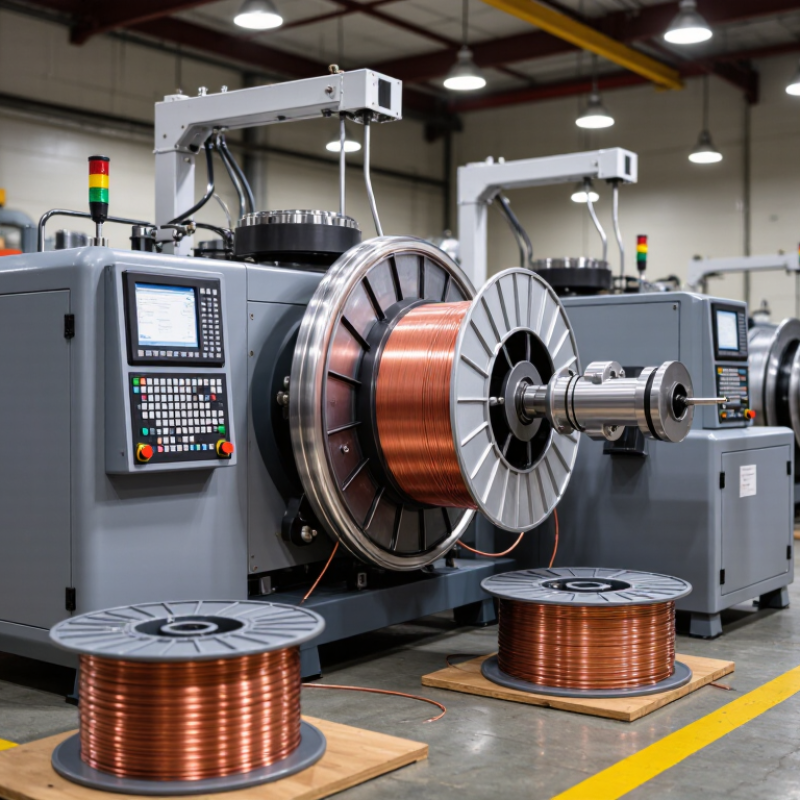
How to Choose the Best Wire Winder for Your Business
Define your wire winding requirements before comparing equipment. Identify the wire material, diameter, spool weight, and required coil length. Measure twice. These details determine the needed tension range, winding speed, and spindle capacity.
Consider your daily production targets and future business goals. A workshop producing a few custom coils needs different controls than a facility handling continuous orders. Record your current output, changeover time, rejected coils, and operator workload. These figures reveal whether speed, precision, or flexibility deserves priority. Keep records. They make equipment decisions more reliable.
Ask how the winder will fit your workspace and process. Check available floor space, power supply, noise limits, and material handling needs. Operators should reach controls safely and monitor tension without awkward movements. Select systems with adjustable parameters, clear measurements, and accessible maintenance points. Consult qualified technicians when evaluating electrical requirements or applicable workplace standards. Experience shows that a machine with impressive speed can still underperform when setup takes too long. I have seen businesses focus on maximum output and overlook changeover losses. That mistake is worth questioning. Define acceptable variation in coil diameter, winding tension, and production waste before requesting quotations. A practical specification will support consistent quality, safer operation, and more defensible purchasing decisions.
Choosing a wire winder starts with the winding job, not the machine’s advertised speed. A manual benchtop winder suits short runs, repairs, and frequent diameter changes. Its operator controls tension by hand, so results depend heavily on training. A semi-automatic unit adds powered rotation and guided traverse. It improves repeatability without requiring a fully automated line. Fully automatic winders control speed, traverse pitch, tension, and cut-off settings. They suit long runs, but setup errors can repeat faster.
Fortune Business Insights valued the global wire and cable market at USD 202.81 billion in 2023. Its report projects USD 329.78 billion by 2032. This growth supports automation, but automation is not always economical.
Compare operating methods carefully. Constant-tension winding uses brakes, clutches, or dancer arms to stabilize pay-off tension. Torque control helps when wire diameter and spool weight change. Speed control is simpler, but it can cause slipping or loose layers.
Traverse winding places each turn beside the previous turn. Random winding is faster for some flexible products, yet it may create uneven packs.
Before buying, record coil diameter, wire gauge, target length, and changeover time. Ask for a trial spool. Test it under load. Measure tension variation, winding density, noise, and operator intervention. The U.S. Department of Energy’s motor systems assessment reports that motor-driven systems consume roughly 68% of industrial electricity in the United States. Efficient drives deserve scrutiny. I would also question the neatest demonstration. It may use ideal wire, perfect spools, and unusually skilled setup.
How to Choose the Best Wire Winder for Your Business
Evaluate capacity before speed. Check the machine’s maximum spool diameter, wire range, coil width, and continuous operating load. A winder that accepts larger reels may reduce changeovers, but it can waste floor space and energy. The International Energy Agency reports that motor-driven systems consume about 46% of global electricity. Efficient sizing matters.
Speed should match the wire and product specification. Excessive RPM can create uneven tension, insulation damage, or loose turns. Ask for tested speed ranges under real production conditions, not only unloaded figures. Winding precision depends on tension control, traverse resolution, braking response, and repeatability. Inspect sample coils with a microscope or calibrated gauge. Even a small layer gap can affect downstream assembly. ISO 9001-based quality practices support documented testing, but certification alone does not guarantee good winding results. That needs verification.
Tips: Run a trial using your thinnest and thickest wires. Record RPM, tension, coil width, temperature, and rejection rate. Compare results after several cycles. A machine may look precise during one demonstration, then drift after hours of production. Include maintenance access in the evaluation. Operators need clear controls and quick adjustments. I would also question optimistic capacity claims; real output usually falls below brochure figures. That is not failure, but it must appear in your costing model.
| Machine Type | Recommended Production Volume | Compatible Wire Diameter | Maximum Coil Weight | Typical Winding Speed | Traverse Accuracy | Spool or Coil Width | Control System | Best-Fit Applications | Key Selection Consideration |
|---|---|---|---|---|---|---|---|---|---|
| Compact Bench Winder | Low-volume or prototyping work | 0.05–1.00 mm | Up to 5 kg | 300–1,500 rpm | ±0.10 mm | 20–100 mm | Digital speed control with manual setup | Small transformers, sensors, repair work, and laboratory samples | Choose for flexibility, low setup cost, and short production runs |
| Single-Spindle Production Winder | Small to medium batch production | 0.10–2.00 mm | Up to 15 kg | 500–2,500 rpm | ±0.05 mm | 30–180 mm | Programmable length, turns, speed, and acceleration | Inductors, relay coils, ignition coils, and general electrical components | A practical balance between capacity, speed, and winding control |
| Multi-Spindle Winder | Medium to high-volume production | 0.08–1.50 mm | Up to 25 kg per spindle | 800–3,000 rpm | ±0.03 mm | 25–160 mm | PLC-based synchronized control with recipe storage | Automotive coils, motor windings, transformers, and repeat production orders | Select when labor efficiency and consistent multi-unit output are priorities |
| Heavy-Duty Coil Winder | High-volume and large-coil manufacturing | 0.50–5.00 mm | Up to 100 kg | 100–1,200 rpm | ±0.10 mm | 100–500 mm | Industrial PLC with tension monitoring and overload protection | Power inductors, large transformers, motors, generators, and cable assemblies | Prioritize spindle torque, frame rigidity, braking, and safe load handling |
| Precision Tension-Control Winder | Quality-critical and fine-wire production | 0.02–0.80 mm | Up to 10 kg | 300–2,000 rpm | ±0.01 mm | 15–120 mm | Closed-loop tension, servo traverse, and programmable winding patterns | Medical components, miniature coils, aerospace electronics, and high-frequency devices | Best for uniform layers, controlled tension, and low defect rates |
| Automated Integrated Winder | Continuous production with reduced manual handling | 0.10–3.00 mm | Up to 40 kg | 500–2,500 rpm | ±0.03 mm | 30–250 mm | PLC/HMI control with wire cutting, taping, testing, and data logging options | Standardized components requiring repeatable, traceable production | Evaluate integration time, changeover speed, maintenance access, and automation return |
Note: The specifications shown are representative industry ranges for comparison. Actual performance depends on wire material, insulation type, coil geometry, tension requirements, tooling, and production conditions.
Safety should guide every wire winder decision, especially in busy production areas. Look for guards around rotating parts and a clearly marked emergency stop. Overload protection can prevent motor damage when a coil binds unexpectedly. Check whether the machine holds wire tension steadily without sudden release. That small detail matters.
Maintenance requirements also affect daily productivity. Ask how easily operators can reach bearings, guides, and tension components. A clear service manual should show lubrication points and inspection intervals. Inspect the frame for exposed fasteners, sharp edges, or areas that collect dust. Keep spare wear parts available. Some machines appear simple but require frequent adjustments after heavy use.
Ease of use becomes visible during a hands-on trial. Operators should load a coil without awkward lifting or complicated threading steps. Controls need readable labels, logical spacing, and feedback that confirms each setting. Try changing wire sizes before purchasing. I once tested equipment that worked smoothly with one diameter but slipped with another. That mistake was costly. Training still matters, even with simple controls. Choose a winder that supports safe, repeatable work during a rushed shift.
How to Choose the Best Wire Winder for Your Business
Select the Best Wire Winder Based on Total Value
The cheapest wire winder may become expensive after installation. Total value includes purchase cost, output, labor, maintenance, energy use, and downtime. In my experience, a machine that saves one operator hour daily can justify a higher initial price. Measure your actual wire sizes, coil weights, winding speeds, and shift hours before comparing equipment. A small mismatch can create waste.
Look closely at tension control and winding consistency. Uneven coils may cause tangles, damaged insulation, or slower packaging. Check whether the winder supports your current materials without complicated adjustments. Ask for operating demonstrations using wire similar to yours. Review service access, replacement parts, training, and warranty terms. These details often matter more than an impressive speed figure. Do not trust every specification blindly.
Tips: Build a simple three-year cost estimate. Include electricity, maintenance visits, tooling, rejected coils, and operator training. Then compare expected output per hour. Leave room for growth, but avoid paying for capacity you will not use. A practical test is better than a confident assumption. Also, record why each option scores well or poorly; decisions can look obvious until production conditions change.
„Thanks to the LUVIR technology, the solder resist process could be switched directly from the previously used mask exposure to direct exposure. As an outstanding digital solution on the market, this technology has been able to demonstrate fast process times and superior quality on our certified conventional ink in production. This allowed us to fully digitize the solder mask process at low cost – without process or ink adjustments. An excellent benefit to our production in Rot am See.“
Ralf Göhringer (Head of Production WE Rot am See)
I would definitely recommend the Limata machine and team for a future company purchase
Michael Greenaway
Compunetics Inc.
“The Limata ldi has been amazing!! Best thing we did was buy this machine”
Richard Brady
GM
Circuitlabs
“Since 2019, we have been running the Limata X1000 LDI system (including LUVIR for solder mask imaging) in daily production as an addition to our current process with film. The machine was capable of properly exposing Taiyo PSR-4000 BN (DI) solder mask types on normal to high-copper boards using a new and unique direct imaging process. The machine operating interface is very user friendly which allowed for a quick technical training curve. The pre-registration processing reduced several seconds of production time at every print. Limata support and service staff is incomparable. They supported our team every step of the way at basically any time of the day or night, with literally, an immediate response time, customizing the software interface to best fit our Operations and needs.
We have exposed more than 8,000 prints since end of October, on various solder mask colors and some resist film panels. Limata, has proven to be very capable and innovative. They are a strong contender in the industry.
We have very much enjoyed this project, and working with the team!
Thank you Limata for the continued support and being a part of our growth.”
Bill Sezate
Vice President, GM
Summit Interconnect
As a replacement to our current contact exposure process with film, the LIMATA X2000 system including LUVIR-Technology was capable of properly exposing non-LDI solder mask types using a direct imaging process. The machine offers cutting edge software with a very intuitive operating interface which allowed for quick technician training curve. The dual drawer system combined with pre-registration processing reduced several seconds of production time at every machine cycle. Limata support and service staff is world class. They added software patches to keep production running at shortest possible response times, customized the software interface to best fit our in-house Operations system, and even wrote a step-by-step machine processing manual. As a result of the project, we have exposed more than 16,000 times on various product types and solder mask brands/colors. Limata, in a very short timeframe as a company, has definitely shown they are truly innovative and will be challenging the industry of direct imaging for the top spot.
Kevin Beattie
Process Engineer
TTM Technologies
Forest Grove Division
