Choosing an Aluminum Dropper bottle is a packaging decision, not just a style choice. The pipette must fit the neck cleanly, draw liquid consistently, and return without drips. The bottle also needs to suit the formula, storage conditions, and expected handling. A polished finish helps, but it cannot fix a poor seal.
Grand View Research estimated the global aluminum packaging market at USD 45.15 billion in 2023. That figure covers aluminum packaging broadly; it does not measure dropper bottles alone. The International Aluminium Institute also publishes industry data on aluminum production and recycling, useful context when comparing material claims. Neither source can tell you whether a particular bottle will work with your product. Practical checks still matter: inspect the shoulder and neck, test the pipette fit, and evaluate leakage and material compatibility with the actual formula. Small details count.
A useful introduction should also be honest about its evidence. I could not verify a named Aluminum Dropper specialist’s published quotation on this specific selection topic, so I will not invent one. That gap is worth noting. A supplier’s sample can look excellent on a desk and behave differently after repeated use. This guide focuses on the questions buyers can test: bottle capacity, dropper performance, finish, protection, and quality consistency. The right choice is the one that performs reliably in real use—not merely the one that looks premium in a product photo.
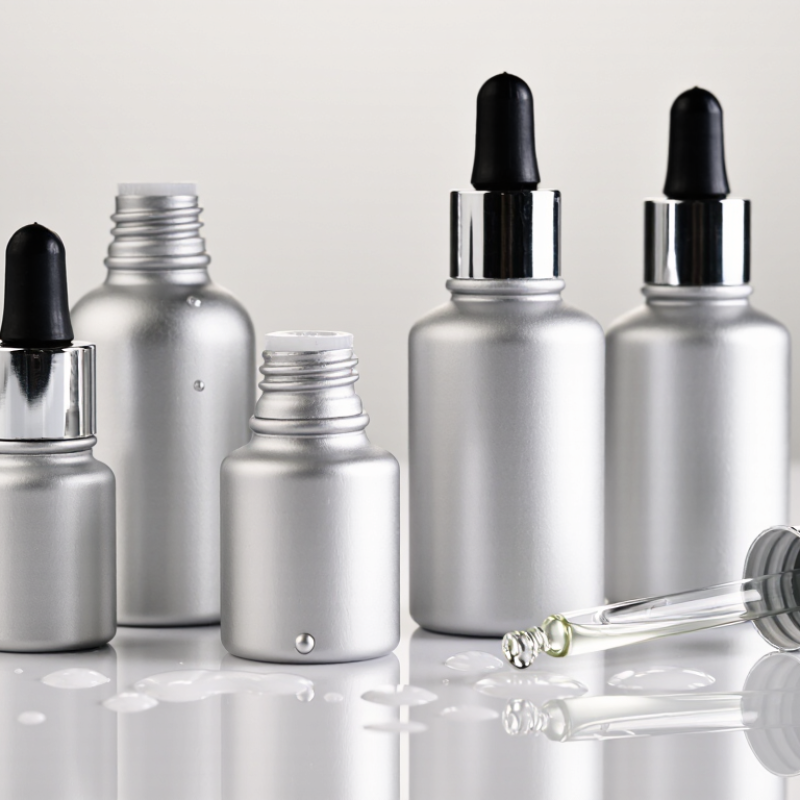
Begin by defining what the bottle must dispense: a thin facial serum, a viscous oil, or a water-based liquid. These behave differently. A narrow pipette may struggle with thicker formulas, while watery products can drip too quickly. Note the formula’s oils, acids, fragrance components, and solvents, then check their compatibility with the bottle’s inner surface, dropper bulb, and seals. Aluminum provides an opaque outer wall, but the dropper assembly still needs evaluation.
Intended use matters just as much. A bottle for daily bathroom use needs a secure closure and a pipette that feels controlled in damp hands. For travel, check leakage resistance and whether the bottle can withstand repeated packing. Ask suppliers for compatibility and stability testing using the actual formula, not a substitute. Test it first. Watch for changes in color, odor, texture, or dispensing after storage.
Material claims also deserve a careful look. The International Aluminium Institute reported a 71% global recycling rate for aluminum beverage cans in 2022; that figure does not establish the recycling rate of dropper bottles. Bottle construction and local collection systems differ. Ask whether the package separates into recyclable components, and confirm local disposal guidance before making an environmental claim. One detail is easy to miss: a premium-looking bottle can still dispense poorly. Check drop size and user handling with real samples.
Choosing bottle size starts with how much product you expect to use between refills. A 10 mL bottle fits a compact kit. A 30 mL bottle may mean fewer refills for regular use. Leave a little space below the neck so the dropper can be fitted without pushing liquid out. Small details matter.
Dropper capacity is different from bottle capacity. A pipette may hold only part of the bottle’s contents, and its marked volume can help with repeatable measuring. Check that the pipette reaches near the bottom when the bottle is nearly empty. Also consider the liquid itself: thicker liquids may move more slowly and form larger drops. Drop size can vary. Test it with the actual formula rather than relying only on a standard drop count.
Before ordering, compare the bottle’s usable fill volume, neck opening, and dropper dimensions. A sample fill can reveal awkward squeezing, slow flow, or a pipette that feels too short. This takes a minute. Size charts are useful, but they cannot show how the bottle feels in your hand. A slightly larger bottle is not always more convenient; it may be heavier to carry and slower to finish.
Choose a Suitable Bottle Size and Dropper Capacity
This illustrative guide pairs common bottle sizes with example full-pipette capacities. Choose based on the amount dispensed per use, and confirm that the dropper and closure fit the bottle neck securely. Actual capacities vary by dropper design.
A dropper bottle can look sound while its liner quietly changes the formula. The liner sits inside the cap and may contact liquid when the bottle tips. Check that its material is suitable for your formula, especially if it contains oils, acids, or fragrance components. Compatibility depends on the full mixture, not one ingredient alone.
Do a small, controlled test before filling a production run. Store samples upright and on their sides, then inspect them over time. Look for liner swelling, softening, cracks, leaks, or a new odor. Compare the formula’s color and texture with an untouched sample. These signs are clues, not proof; a stable appearance cannot rule out every interaction. Keep notes on the formula, liner type, temperature, and test duration. It is easy to skip that record when a sample seems fine.
The bottle itself matters, too. An interior coating can help separate the formula from aluminum, but the dropper assembly remains part of the contact system. Test the assembled package, not just the bottle. Check that the pipette draws smoothly and returns the expected amount after repeated use. A dropper that leaks or delivers unevenly can expose the formula to more air and make dosing less consistent. Real use can be messy. Include it in the test.
An aluminum dropper bottle combines a lightweight metal shell with a dispensing system that still depends on glass, plastic, and elastomer parts. Compare the full assembly, not just the bottle body. A glass pipette offers a clear view of the liquid and resists many formulations, but it can chip if it strikes a hard counter. Plastic pipettes are lighter, though clarity and chemical compatibility vary by material. Check the bulb and liner too: a poor match can swell, stiffen, or allow leakage. Small details matter.
Seal quality depends on the neck finish, closure fit, and liner compression. Ask suppliers for leakage and compatibility test results using the intended liquid, storage temperature, and shipping conditions. Then check dispensing control: pipette length, tip opening, and bulb rebound affect how steadily drops form. A drop count alone can mislead; viscosity and squeeze pressure also change the dose.
There is no perfect pairing. The U.S. Environmental Protection Agency’s 2018 materials report recorded recycling rates of 31.3% for glass containers and 50.4% for aluminum cans. These figures do not predict a dropper bottle’s recyclability: mixed components and coatings matter, and local systems differ.
One overlooked point is that the most durable-looking option may not be the easiest to separate or recycle.
A polished aluminum dropper bottle is not proof of consistent quality. Ask for written material specifications covering the bottle body, finish, pipette, and closure. Check that certificates name the tested material and explain which product or process they cover. Standards vary by intended use and market, so vague claims deserve follow-up. Ask for records.
Inspect a production sample under bright light. Look for uneven coating, rough threads, dents, and a dropper that sits crooked. Test the closure after filling with a compatible liquid, then store the bottle upright and on its side. Watch for seepage, changes in the finish, or a pipette that draws inconsistently. One sample is useful, but it cannot represent every production run.
Supplier reliability shows up in ordinary details. Can the supplier share batch records, inspection criteria, and a clear process for handling defects? Request recent test reports and confirm their scope with the issuing laboratory when practical. Compare a pre-production sample with a later shipment; small differences can reveal weak process control. That matters. Still, paperwork and a factory visit cannot guarantee every bottle will perform perfectly. Keep your own inspection notes, agree on tolerances in writing, and reassess the supplier when materials or processes change.
„Thanks to the LUVIR technology, the solder resist process could be switched directly from the previously used mask exposure to direct exposure. As an outstanding digital solution on the market, this technology has been able to demonstrate fast process times and superior quality on our certified conventional ink in production. This allowed us to fully digitize the solder mask process at low cost – without process or ink adjustments. An excellent benefit to our production in Rot am See.“
Ralf Göhringer (Head of Production WE Rot am See)
I would definitely recommend the Limata machine and team for a future company purchase
Michael Greenaway
Compunetics Inc.
“The Limata ldi has been amazing!! Best thing we did was buy this machine”
Richard Brady
GM
Circuitlabs
“Since 2019, we have been running the Limata X1000 LDI system (including LUVIR for solder mask imaging) in daily production as an addition to our current process with film. The machine was capable of properly exposing Taiyo PSR-4000 BN (DI) solder mask types on normal to high-copper boards using a new and unique direct imaging process. The machine operating interface is very user friendly which allowed for a quick technical training curve. The pre-registration processing reduced several seconds of production time at every print. Limata support and service staff is incomparable. They supported our team every step of the way at basically any time of the day or night, with literally, an immediate response time, customizing the software interface to best fit our Operations and needs.
We have exposed more than 8,000 prints since end of October, on various solder mask colors and some resist film panels. Limata, has proven to be very capable and innovative. They are a strong contender in the industry.
We have very much enjoyed this project, and working with the team!
Thank you Limata for the continued support and being a part of our growth.”
Bill Sezate
Vice President, GM
Summit Interconnect
As a replacement to our current contact exposure process with film, the LIMATA X2000 system including LUVIR-Technology was capable of properly exposing non-LDI solder mask types using a direct imaging process. The machine offers cutting edge software with a very intuitive operating interface which allowed for quick technician training curve. The dual drawer system combined with pre-registration processing reduced several seconds of production time at every machine cycle. Limata support and service staff is world class. They added software patches to keep production running at shortest possible response times, customized the software interface to best fit our in-house Operations system, and even wrote a step-by-step machine processing manual. As a result of the project, we have exposed more than 16,000 times on various product types and solder mask brands/colors. Limata, in a very short timeframe as a company, has definitely shown they are truly innovative and will be challenging the industry of direct imaging for the top spot.
Kevin Beattie
Process Engineer
TTM Technologies
Forest Grove Division
