Choosing an Automotive Motor Tester is not about buying the device with the longest feature list. It is about matching the tester to the motors, faults, and working conditions you actually encounter. A unit designed for quick resistance checks may not reveal intermittent winding faults or insulation problems. A more advanced model can offer deeper diagnostics, but only if its functions suit your technicians and workflow.
Measurement matters. Physicist Lord Kelvin is often credited with the line, “To measure is to know.” That principle applies directly to motor testing: reliable decisions depend on accurate readings, clear test procedures, and results technicians can interpret. Check the tester’s supported voltage and current ranges, measurement accuracy, safety protections, and compatibility with the motor types in your shop. Look closely at the leads, clamps, and display, too. Small details matter when readings are taken beside a noisy workshop bench or inside a cramped service bay.
A specification sheet is only part of the story. Ask whether the manufacturer provides calibration guidance, training, and accessible technical support. If possible, compare testers using the same motor and test conditions. That makes differences easier to spot. No tester removes every uncertainty. Even a precise reading can mislead when connections are poor or test conditions vary. It is worth admitting that selection involves trade-offs: price, portability, depth of testing, and ease of use rarely align perfectly. The right choice is the one your team can use consistently—and trust when a motor’s condition is not obvious.
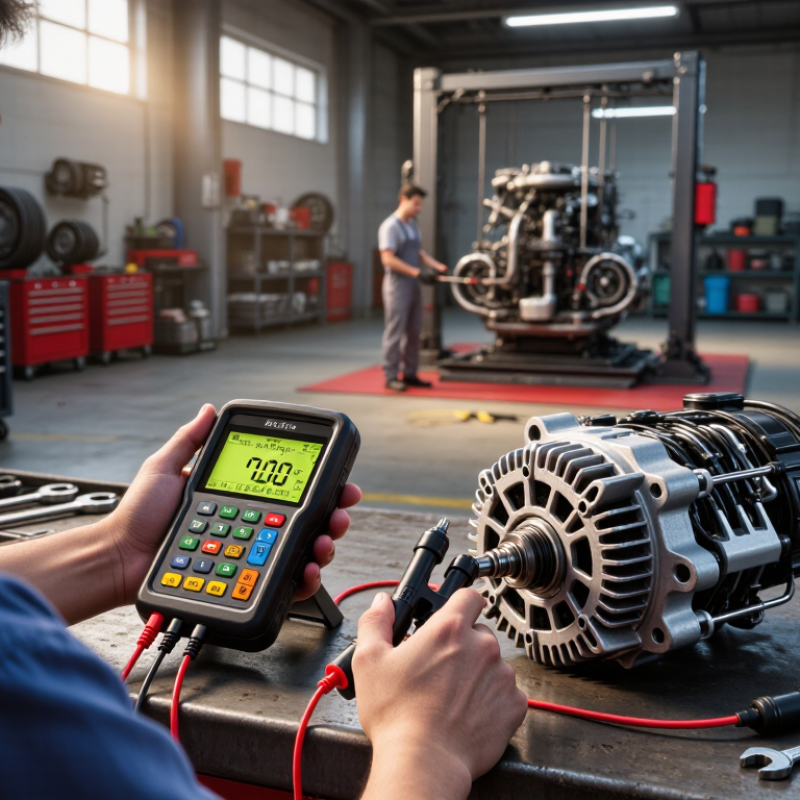
Before choosing an automotive motor tester, list the jobs it must handle. “Motor testing” can mean checking a starter’s current draw, testing an alternator’s output, or tracing a blower motor that runs intermittently. Write down the vehicle, motor type, and symptom for each task. A slow crank and a noisy bearing need different checks.
For starter diagnosis, you may need to measure cranking voltage and current while the motor is installed. Check whether the tester supports the expected current range and provides clear readings during brief, high-load tests. For alternators, confirm it can assess charging voltage and ripple. Small details matter. Loose connections or a weak battery can distort results, so the tester should help you verify the circuit, not just display a number.
Consider electronically controlled motors, too. Cooling fans, fuel pumps, and HVAC actuators may use pulse-width modulation or signals from a control module. A basic bench tester may not reproduce those conditions. If your work includes these systems, look for suitable signal measurement and safe, vehicle-level testing options. I would also consider how often a motor must be removed for testing; bench checks can be useful, but they may miss faults that appear only under real operating conditions. That distinction is easy to overlook.
Before choosing an automotive motor tester, match it to the vehicle’s electrical system, not just its connector. Conventional 12-volt starter and alternator checks require different ranges from high-voltage traction-motor diagnostics. Check supported voltage, current, waveform capture, and isolation-testing capability against the service data for the specific vehicle. Do not assume.
An inverter-driven permanent-magnet motor, an induction motor, and a brushed starter produce different signals and failure clues. Confirm support for the motor type, phase count, sensor inputs, and inverter interface you need. Read the tester’s manual alongside the vehicle wiring diagram.
Compatibility matters more as electric vehicles become common. The IEA’s Global EV Outlook 2024 reports nearly 14 million electric-car sales in 2023, around 18% of worldwide car sales. That figure does not mean every workshop needs a high-voltage tester, but it does make future coverage worth considering.
For electronically controlled charging or start-stop systems, check whether the tool supports the relevant network data and test leads. A tidy screen is not proof of a correct diagnosis. Compare readings with vehicle-specific specifications, and note where the tester lacks coverage.
Small detail. Big difference.
An automotive motor tester should measure more than resistance. Check whether it supports inductance, winding balance, current, speed, and back-EMF tests. These functions help distinguish a damaged winding from a weak connection or mechanical load. For three-phase motors, compare phase readings under the same test conditions; small differences can matter. Read the stated accuracy and resolution separately. A display showing extra digits is not necessarily more accurate. Look for calibration information, repeatability specifications, and clear test limits. Keep the test setup consistent. Probe contact can change a reading.
Data features matter in the workshop, too. The International Energy Agency’s Global EV Outlook 2024 reports nearly 14 million electric-car sales in 2023, about 18% of global car sales. That growth makes support for electric-drive motor testing increasingly relevant. Choose a tester that can save waveforms or readings with timestamps, then export records for comparison. A known-good baseline can make intermittent faults easier to spot. Still, a saved trace does not explain every failure. That is not always enough. Review how the tester handles different motor types, and check whether its software preserves units and test conditions. A feature list can look impressive; the real test is whether technicians can repeat the measurement and understand the result.
Compare measurement functions, accuracy, and data features. This illustrative 12 V DC motor startup trace shows why waveform capture matters: inrush current is highest at startup, then falls as the motor accelerates. When selecting a tester, check current and voltage measurement ranges, stated accuracy, waveform capture, RPM support, and the ability to save or export readings.
Choose a motor tester with clear input limits, fused leads, insulated probes, and a documented safety rating. Check that its instructions explain where to connect each lead before testing a motor circuit.
The IEC 61010-1 safety standard covers electrical test and measurement equipment; look for stated compliance, not just a rugged-looking case.
BLS’s 2022 Census of Fatal Occupational Injuries recorded 145 workplace deaths involving exposure to electricity. That figure covers many industries, not automotive repair, but it is a sobering reason to treat protection features seriously.
Small details matter.
Ease of use shows up during real work.
Can you read the display under a hood light? Do the probe tips stay steady when your hand is awkwardly positioned? A clear continuity tone and simple range selection can reduce missed steps. Still, an easy interface is not a substitute for checking the manual and isolating the circuit as directed.
Durability is more than a thick shell.
Inspect strain relief where leads meet the probes, the flexibility of the cable, and whether the case closes firmly after repeated use. If possible, hold the tester with gloves and try its controls before buying. A tool may survive a drop and still develop a loose lead.
That part is easy to overlook. Keep a record of damaged leads and failed checks; replacing worn accessories late is a habit worth questioning.
Calibration, support, and ownership costs can matter more than the purchase price. Ask for a calibration certificate showing measurement results, uncertainty, and traceability to recognized standards. NIST guidance explains that traceability depends on a documented chain of calibrations; a certificate alone does not guarantee a measurement is fit for your task. Check the recommended calibration interval and whether the service provider can meet it without long delays. Still, no interval is perfect. Heavy daily use, vibration, and temperature changes may justify more frequent checks.
Support affects real workshop costs. Confirm response times, repair options, replacement lead availability, and software-update terms before purchasing. The American Society for Quality’s quality-cost guidance estimates that poor quality can consume 15–20% of an organization’s sales, though this broad estimate is not specific to automotive testers. It does underline why repeat diagnostics and avoidable rework deserve attention. Compare total ownership cost over several years, including calibration, training, consumables, repairs, downtime, and retesting—not just the invoice.
Tips: Ask the supplier to quote one calibration cycle and a typical repair. Keep a simple log of faults, service dates, and repeat tests. That record may reveal costs a spreadsheet misses.
„Thanks to the LUVIR technology, the solder resist process could be switched directly from the previously used mask exposure to direct exposure. As an outstanding digital solution on the market, this technology has been able to demonstrate fast process times and superior quality on our certified conventional ink in production. This allowed us to fully digitize the solder mask process at low cost – without process or ink adjustments. An excellent benefit to our production in Rot am See.“
Ralf Göhringer (Head of Production WE Rot am See)
I would definitely recommend the Limata machine and team for a future company purchase
Michael Greenaway
Compunetics Inc.
“The Limata ldi has been amazing!! Best thing we did was buy this machine”
Richard Brady
GM
Circuitlabs
“Since 2019, we have been running the Limata X1000 LDI system (including LUVIR for solder mask imaging) in daily production as an addition to our current process with film. The machine was capable of properly exposing Taiyo PSR-4000 BN (DI) solder mask types on normal to high-copper boards using a new and unique direct imaging process. The machine operating interface is very user friendly which allowed for a quick technical training curve. The pre-registration processing reduced several seconds of production time at every print. Limata support and service staff is incomparable. They supported our team every step of the way at basically any time of the day or night, with literally, an immediate response time, customizing the software interface to best fit our Operations and needs.
We have exposed more than 8,000 prints since end of October, on various solder mask colors and some resist film panels. Limata, has proven to be very capable and innovative. They are a strong contender in the industry.
We have very much enjoyed this project, and working with the team!
Thank you Limata for the continued support and being a part of our growth.”
Bill Sezate
Vice President, GM
Summit Interconnect
As a replacement to our current contact exposure process with film, the LIMATA X2000 system including LUVIR-Technology was capable of properly exposing non-LDI solder mask types using a direct imaging process. The machine offers cutting edge software with a very intuitive operating interface which allowed for quick technician training curve. The dual drawer system combined with pre-registration processing reduced several seconds of production time at every machine cycle. Limata support and service staff is world class. They added software patches to keep production running at shortest possible response times, customized the software interface to best fit our in-house Operations system, and even wrote a step-by-step machine processing manual. As a result of the project, we have exposed more than 16,000 times on various product types and solder mask brands/colors. Limata, in a very short timeframe as a company, has definitely shown they are truly innovative and will be challenging the industry of direct imaging for the top spot.
Kevin Beattie
Process Engineer
TTM Technologies
Forest Grove Division
