Choosing the right Carbon Black Masterbatch is not simply a matter of selecting the darkest sample. The grade must disperse well in your specific polymer and run reliably on your actual equipment. Resin compatibility, carbon black loading, carrier type, and letdown ratio all affect the result. So do screw design, melt temperature, and mixing time. Small differences can show up as streaks, specks, uneven gloss, or inconsistent color across a molded part or film. That sounds simple. It is not.
A practical rule, consistent with polymer-filler specialist Roger Rothon’s published work, is: “Choose for dispersion in the real resin and process, not for blackness alone.” Treat this as a selection principle, not a verified verbatim quotation. Compare technical data sheets, but do not let a tidy table make the decision for you. Check carbon content, carrier compatibility, recommended processing conditions, and relevant test results. Then request a sample and run a controlled trial at your intended dosage. Inspect the finished part under consistent lighting, and check whether the material feeds smoothly and maintains the required properties. A useful supplier should explain the trade-offs and provide clear, traceable documentation. Even then, one trial may not reveal every production issue. Record the settings, review the results with your supplier, and adjust before scaling up. The right choice is the grade that performs consistently in your application—not merely the one with the most impressive specification.
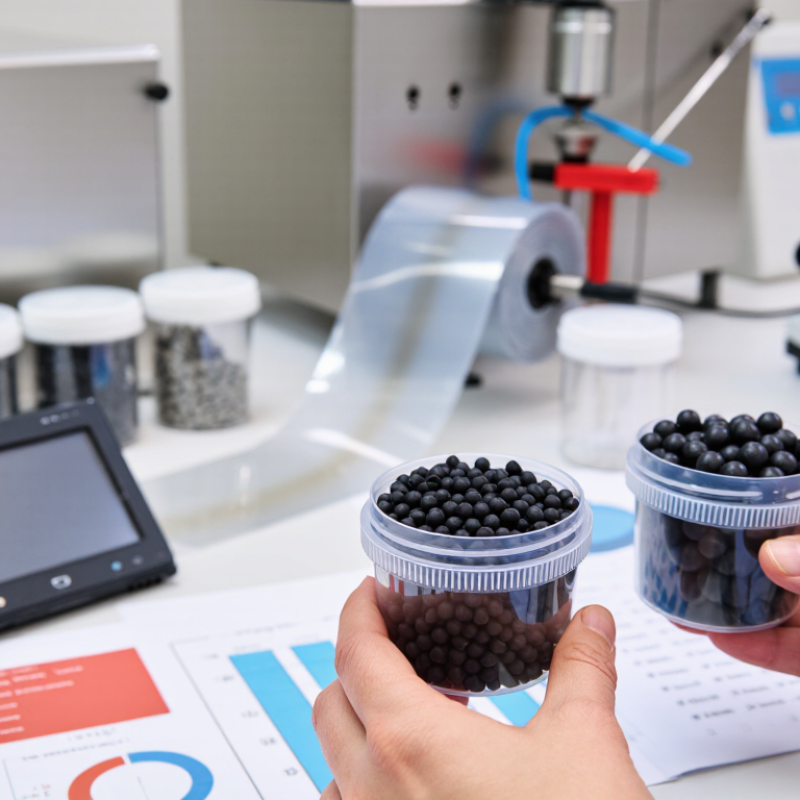
How to Choose the Right Carbon Black Masterbatch?
Identify the Polymer and End-Use Before Choosing a Carbon Black Grade
Choosing a carbon black grade starts with the polymer, not the darkest sample on a shelf. Polyethylene, polypropylene, and engineering plastics differ in melt temperature, polarity, and processing behavior. A carrier resin that matches the base polymer usually disperses more consistently. That matters. Poor compatibility can cause specks, uneven gloss, or weak weld lines in molded parts.
Next, consider what the finished product must do. Outdoor pipe may need strong resistance to ultraviolet exposure, while a thin film needs uniform color without sacrificing processability. A cable jacket, by contrast, may require careful attention to electrical properties. Share the processing temperature, target loading, and end-use conditions with your supplier. These details help narrow the options, though laboratory data cannot replace a trial on your own line. I have seen a promising sample behave differently at production scale.
Tips: Check the technical data sheet for carrier type, carbon black content, and recommended let-down ratio. Run a small trial using your actual resin and equipment. Inspect cut sections for dispersion, then check the part under consistent lighting. Record results, even if they seem obvious. Small changes in screw speed or temperature can shift the outcome.
Carbon black’s primary particles are tiny, but their effects are visible in the finished part. The International Carbon Black Association’s Carbon Black User’s Guide describes primary particle sizes broadly around 10–500 nm; grades in the 10–100 nm range therefore represent only part of the available spectrum. Smaller particles generally provide more surface area, supporting stronger blackness, tint strength, and UV screening. They can also raise compound viscosity and make dispersion harder. Start with function.
For a glossy film, a finer grade may deepen the black, but poor dispersion can leave specks and uneven color. In a pipe compound, processing stability or UV durability may matter more than maximum jetness. ASTM D3849 uses electron microscopy to characterize carbon black morphology, giving buyers a consistent way to compare primary-particle measurements.
Ask suppliers for that method, plus aggregate structure and dispersion data; primary size alone cannot predict performance. Not by size alone. A practical trial should track screw torque, surface appearance, and color strength at the intended loading. Results can shift with resin, mixing energy, and let-down ratio. I would not treat a datasheet value as a guarantee; it is a starting point, and sometimes an imperfect one.
For PE pipe, start with the finished compound target, not the masterbatch percentage alone.
ISO 4427-1:2019 specifies 2.0–2.5% carbon black by mass for black PE pipe compounds. A 40% carbon black masterbatch therefore needs a 5.0–6.25% share of the finished blend. That equals 5–6.25 kg per 100 kg of final compound.
Small difference. Check twice. If dosing against 100 kg of resin rather than final blend, the calculation changes slightly; state your basis clearly.
The Plastics Pipe Institute’s Handbook of Polyethylene Pipe identifies carbon-black pigmentation as an established route to UV protection. But correct loading alone does not prove a good compound.
ISO 6964 provides a method for measuring carbon black content, while ISO 18553 assesses pigment dispersion in polyolefin pipes and fittings. Ask suppliers for batch-specific results, then verify production samples with suitable testing.
Uneven dispersion can leave visible streaks or weak spots, even when the average carbon black level meets target. I would not assume a nominal “40%” grade delivers exactly 40% in every lot. Check the certificate, feeding accuracy, and mixing conditions. A small trial run can reveal problems before a long extrusion campaign.
Choosing carbon black masterbatch by color alone is risky. In polyolefins, visible streaks or specks can signal uneven pigment distribution. ISO 18553 offers a repeatable way to assess it: prepare thin sections, inspect them microscopically, then compare the observed dispersion with reference images. Small details matter. Section preparation and representative sampling can affect the result, so inspect multiple areas rather than one convenient spot. A clean-looking pellet surface proves little.
The OECD’s Global Plastics Outlook reports that global plastics production reached 460 million tonnes in 2019, nearly twice the 2000 level. That scale makes consistent quality checks consequential, though the figure does not measure masterbatch defects. When comparing batches, record the ISO 18553 assessment, sample location, and test conditions; otherwise, results can be hard to interpret. Look for evenly distributed particles and limited agglomeration across the viewed sections. Not just color. I would not trust one attractive micrograph; it can hide a poorly dispersed corner.
ASTM D1603 can help verify carbon black content in olefin-based materials. Confirm that the resin and sample preparation suit the method before relying on the result. Ask the supplier or testing laboratory for the test date, sample identification, and reported percentage. Keep a retained sample from the same production lot. Small differences in sampling can matter.
Replicate the test. A single result may not reveal uneven material. ASTM D1603 measures carbon black content; it does not show how well the pigment is dispersed. For a fuller assessment, inspect molded plaques or film for streaks, specks, and color variation. A neat spreadsheet can still hide a poor sample.
Then check masterbatch loading in your finished formulation. If a masterbatch contains 40% carbon black and you add 2.5% masterbatch, the compound receives 1.0% carbon black. Confirm whether the stated loading is based on total formulation weight, and account for other additives or carrier resin. Compare the calculated dose with the target for the application. That assumption can fail. Recheck the math when a formulation changes, even slightly.
| Check | Illustrative Data | How to Use It |
|---|---|---|
| Carbon black content test | ASTM D1603 is a test method for determining carbon black content in olefin plastics, such as polyethylene and polypropylene. | Request a test report for the masterbatch or a representative sample. Confirm with the testing laboratory that the sample composition and preparation are suitable for the method. |
| Example Sample A | Illustrative measured carbon black content: 40.2% by mass Planned masterbatch loading: 2.50% by mass | Estimated carbon black in the final compound: 40.2% × 2.50% = 1.005% by mass. |
| Example Sample B | Illustrative measured carbon black content: 49.6% by mass Planned masterbatch loading: 2.00% by mass | Estimated carbon black in the final compound: 49.6% × 2.00% = 0.992% by mass. |
| Example Sample C | Illustrative measured carbon black content: 30.1% by mass Planned masterbatch loading: 3.50% by mass | Estimated carbon black in the final compound: 30.1% × 3.50% = 1.054% by mass (rounded). |
| Loading calculation | Final carbon black content (%) = masterbatch carbon black content (%) × masterbatch loading (%)/100 | For example, a masterbatch containing 40% carbon black used at 2.5% loading gives an estimated final content of 1.0% by mass. |
| Batch loading check | For a 100 kg production batch at 2.5% masterbatch loading, weigh 2.5 kg of masterbatch and 97.5 kg of the remaining formulation. | Check the actual weighed quantities against the recipe and batch records. This verifies dosing; it does not replace a carbon black content test. |
| Acceptance limits | Set a buyer–supplier specification for carbon black content and dosing tolerance before production. ASTM D1603 provides a test method, not a universal acceptance limit. | Compare the laboratory result with the agreed specification and account for the measurement uncertainty and agreed sampling procedure. |
| Important limitation | Carbon black content is not the same as dispersion, color strength, or finished-part performance. | Evaluate dispersion and end-use properties separately using application-relevant tests and processing trials. |
„Thanks to the LUVIR technology, the solder resist process could be switched directly from the previously used mask exposure to direct exposure. As an outstanding digital solution on the market, this technology has been able to demonstrate fast process times and superior quality on our certified conventional ink in production. This allowed us to fully digitize the solder mask process at low cost – without process or ink adjustments. An excellent benefit to our production in Rot am See.“
Ralf Göhringer (Head of Production WE Rot am See)
I would definitely recommend the Limata machine and team for a future company purchase
Michael Greenaway
Compunetics Inc.
“The Limata ldi has been amazing!! Best thing we did was buy this machine”
Richard Brady
GM
Circuitlabs
“Since 2019, we have been running the Limata X1000 LDI system (including LUVIR for solder mask imaging) in daily production as an addition to our current process with film. The machine was capable of properly exposing Taiyo PSR-4000 BN (DI) solder mask types on normal to high-copper boards using a new and unique direct imaging process. The machine operating interface is very user friendly which allowed for a quick technical training curve. The pre-registration processing reduced several seconds of production time at every print. Limata support and service staff is incomparable. They supported our team every step of the way at basically any time of the day or night, with literally, an immediate response time, customizing the software interface to best fit our Operations and needs.
We have exposed more than 8,000 prints since end of October, on various solder mask colors and some resist film panels. Limata, has proven to be very capable and innovative. They are a strong contender in the industry.
We have very much enjoyed this project, and working with the team!
Thank you Limata for the continued support and being a part of our growth.”
Bill Sezate
Vice President, GM
Summit Interconnect
As a replacement to our current contact exposure process with film, the LIMATA X2000 system including LUVIR-Technology was capable of properly exposing non-LDI solder mask types using a direct imaging process. The machine offers cutting edge software with a very intuitive operating interface which allowed for quick technician training curve. The dual drawer system combined with pre-registration processing reduced several seconds of production time at every machine cycle. Limata support and service staff is world class. They added software patches to keep production running at shortest possible response times, customized the software interface to best fit our in-house Operations system, and even wrote a step-by-step machine processing manual. As a result of the project, we have exposed more than 16,000 times on various product types and solder mask brands/colors. Limata, in a very short timeframe as a company, has definitely shown they are truly innovative and will be challenging the industry of direct imaging for the top spot.
Kevin Beattie
Process Engineer
TTM Technologies
Forest Grove Division
