Choosing the right Solid-State Battery System is essential for various applications. These systems promise enhanced safety and efficiency compared to traditional batteries. However, the selection process can be confusing.
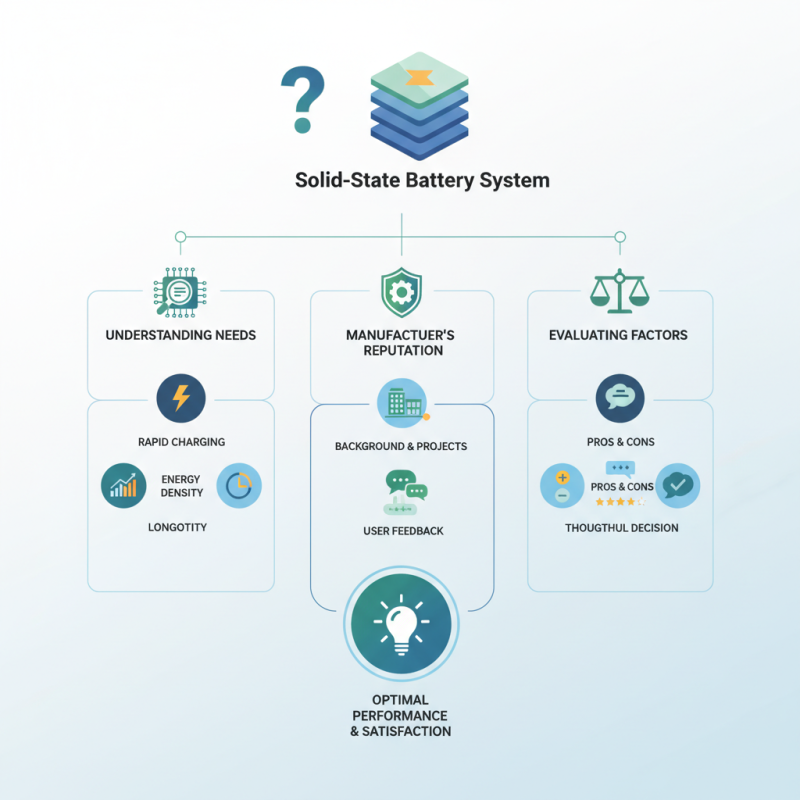
Understanding your specific needs is vital. Different solid-state batteries serve different purposes. Some offer higher energy density, while others focus on longevity or rapid charging. Evaluating these factors helps narrow your choices.
Consider the manufacturer's reputation. Research their background and past projects. Feedback from existing users is invaluable. Take time to weigh the pros and cons. A thoughtful decision will lead to better performance and satisfaction in your chosen Solid-State Battery System.
Solid-state battery technology is gaining traction as a promising alternative to traditional lithium-ion batteries. These batteries use solid electrolytes instead of liquid ones. This change can significantly improve energy density and safety. According to a recent report by the International Energy Agency, solid-state batteries could increase energy capacity by 30% to 50% compared to their liquid counterparts. This advancement positions them as a potential game-changer in electric vehicles and consumer electronics.
When choosing a solid-state battery system, consider factors like performance, temperature stability, and lifecycle. Reliability is crucial. Some studies suggest that solid-state batteries can operate effectively across a wider temperature range. However, the technology is still evolving. Not all solid-state designs have reached commercial viability yet. If you're exploring options, look for systems with proven test results.
Tips: Always check for independent validation of battery performance. This will provide a more reliable understanding of the technology. Also, consider the manufacturing processes involved. Some may face challenges in scaling production. Researching current market trends can lead to better decision-making when selecting a system. Ensure to evaluate both current performance metrics and future potential of the technology.
Choosing the right solid-state battery system requires careful consideration of several key factors. One primary aspect is energy density. This determines how much power can be stored in a given volume. Higher energy density translates to longer battery life, which is critical for applications like electric vehicles. You should also think about the weight. Lighter batteries enhance efficiency and performance.
Temperature tolerance is another crucial factor. Different applications require varying temperature ranges. For example, batteries used in aerospace must withstand extreme conditions, while consumer electronics may only need moderate stability. Battery lifespan also matters. A battery may perform well initially but degrade quickly. Understand the trade-offs involved, as a longer lifespan usually comes with a higher upfront investment.
Safety features cannot be ignored. Solid-state batteries are generally safer than traditional lithium-ion options, but thorough testing and certifications are vital. Evaluate options based on reliability and potential risks. Real-world applications often reveal unexpected challenges. Some users report issues that were not apparent during initial testing, highlighting the necessity of a rigorous evaluation process. Always seek guidance from industry experts to navigate these complexities effectively.
| Key Factor | Description | Importance Level (1-5) |
|---|---|---|
| Energy Density | The amount of energy stored per unit of weight or volume. | 5 |
| Cycle Life | The number of charge and discharge cycles before capacity degradation occurs. | 4 |
| Safety | Risk of thermal runaway and other safety hazards. | 5 |
| Cost | Total cost of ownership including initial investment and operating costs. | 3 |
| Temperature Stability | Performance consistency across different temperature ranges. | 4 |
| Manufacturing Scalability | Ability to mass-produce the battery efficiently. | 3 |
When selecting a solid-state battery system, evaluating energy density and power output is crucial. Energy density affects how much energy can be stored in a given volume. According to a recent study by the International Energy Agency, solid-state batteries can achieve energy densities exceeding 300 Wh/kg. This is significantly higher than traditional lithium-ion batteries, which average between 150-250 Wh/kg. Such figures indicate a clear advantage for applications in electric vehicles and portable electronics.
Power output is equally important. It determines how quickly a battery can deliver energy. Reports suggest that some advanced solid-state technologies can provide power outputs of over 10,000 W/kg. This is a game-changer for applications requiring rapid acceleration or high burst energy. However, achieving a balance between energy density and power output often leads to trade-offs. Some designs may excel in one area but fall short in another.
It is essential to consider thermal management as well. A significant concern arises from heat generation during high power demand. This could impact battery lifespan. Additionally, the lifecycle of solid-state batteries is still under investigation. Current estimates suggest that they may last over 2,000 cycles, but real-world data is limited. As the technology matures, ongoing evaluations will be necessary to fully understand these dynamics.
When evaluating solid-state battery systems, cost-effectiveness and long-term value are paramount. The initial investment can be significant, yet the savings over time might justify the cost. Solid-state batteries often offer longer life cycles and better energy density. This can reduce replacement frequency and lower overall energy costs.
When evaluating solid-state battery systems, safety features should be a primary concern. These batteries utilize solid electrolytes instead of liquid ones, potentially minimizing risks like leaks or fires. However, the level of safety varies across different technologies. It’s essential to assess how each battery design addresses thermal management and short-circuit protection. A comprehensive safety standard can significantly influence performance in extreme conditions.
Reliability standards also require close examination. What happens when batteries cycle through temperature extremes? How do they perform under stress? These factors can determine the lifespan of the battery. Testing methodologies should be transparent and rigorous. Certifications can offer guidelines, but the reality can differ. Some products may not withstand real-world applications as promised.
Understanding both safety and reliability can create an informed choice. Opt for systems that provide clear testing data. Seek expert opinions on the technologies involved. This nuanced approach aids in navigating the complex landscape of solid-state batteries. Balancing innovation and tradition often reveals unexpected insights.
„Thanks to the LUVIR technology, the solder resist process could be switched directly from the previously used mask exposure to direct exposure. As an outstanding digital solution on the market, this technology has been able to demonstrate fast process times and superior quality on our certified conventional ink in production. This allowed us to fully digitize the solder mask process at low cost – without process or ink adjustments. An excellent benefit to our production in Rot am See.“
Ralf Göhringer (Head of Production WE Rot am See)
I would definitely recommend the Limata machine and team for a future company purchase
Michael Greenaway
Compunetics Inc.
“The Limata ldi has been amazing!! Best thing we did was buy this machine”
Richard Brady
GM
Circuitlabs
“Since 2019, we have been running the Limata X1000 LDI system (including LUVIR for solder mask imaging) in daily production as an addition to our current process with film. The machine was capable of properly exposing Taiyo PSR-4000 BN (DI) solder mask types on normal to high-copper boards using a new and unique direct imaging process. The machine operating interface is very user friendly which allowed for a quick technical training curve. The pre-registration processing reduced several seconds of production time at every print. Limata support and service staff is incomparable. They supported our team every step of the way at basically any time of the day or night, with literally, an immediate response time, customizing the software interface to best fit our Operations and needs.
We have exposed more than 8,000 prints since end of October, on various solder mask colors and some resist film panels. Limata, has proven to be very capable and innovative. They are a strong contender in the industry.
We have very much enjoyed this project, and working with the team!
Thank you Limata for the continued support and being a part of our growth.”
Bill Sezate
Vice President, GM
Summit Interconnect
As a replacement to our current contact exposure process with film, the LIMATA X2000 system including LUVIR-Technology was capable of properly exposing non-LDI solder mask types using a direct imaging process. The machine offers cutting edge software with a very intuitive operating interface which allowed for quick technician training curve. The dual drawer system combined with pre-registration processing reduced several seconds of production time at every machine cycle. Limata support and service staff is world class. They added software patches to keep production running at shortest possible response times, customized the software interface to best fit our in-house Operations system, and even wrote a step-by-step machine processing manual. As a result of the project, we have exposed more than 16,000 times on various product types and solder mask brands/colors. Limata, in a very short timeframe as a company, has definitely shown they are truly innovative and will be challenging the industry of direct imaging for the top spot.
Kevin Beattie
Process Engineer
TTM Technologies
Forest Grove Division
