Color Coated Steel Coil is pre-finished steel designed to combine structural strength, corrosion resistance, and visual appeal. Its surface usually includes a metallic coating, chemical treatment, primer, and colored topcoat. These layers are applied continuously before fabrication begins.
ArcelorMittal chairman Lakshmi Mittal has described steel as “the backbone of modern civilization.” That idea remains visible in everyday construction. Color Coated Steel Coil becomes roofing sheets, wall panels, garage doors, HVAC parts, and appliance housings. A blue roof can leave the factory ready for installation. A matte gray panel can protect an industrial building without additional painting.
The manufacturing process matters greatly. Steel grade, coating thickness, paint chemistry, forming conditions, and storage humidity all influence final performance. A coil may look perfect under warehouse lighting, yet poor slitting or sharp bending can expose its edges. Small defects matter.
Selection should follow the real environment. Coastal buildings need stronger corrosion protection than dry inland warehouses. High temperatures, ultraviolet exposure, condensation, and industrial pollutants also affect coating life. Buyers should review technical data, warranty limits, and testing standards rather than trust color alone.
This is where practical judgment becomes important. Color is easy to compare. Long-term durability is harder to see. Even a premium product can fail when installers scratch the surface or store coils incorrectly. That uncomfortable point deserves attention.
This article explains how Color Coated Steel Coil is produced, what its coating layers do, and where it performs best. It also examines common limitations, application choices, maintenance needs, and details that are often missed during purchasing.
What Is Color-Coated Steel Coil?
Color-coated steel coil is flat steel supplied in a continuous roll and finished with protective layers before fabrication. The steel substrate is commonly galvanized or zinc-aluminum coated. A chemical pretreatment improves adhesion, followed by primer and colored topcoat. The result is a ready-to-form material with controlled appearance and improved resistance to moisture, ultraviolet exposure, and surface corrosion.
It is not simply painted steel.
The 2024 World Steel in Figures report recorded about 1.89 billion tonnes of crude steel production worldwide in 2023. That scale explains why prepainted coil matters: it supports efficient roofing, wall panels, doors, ceiling systems, and appliance housings. Manufacturers usually select coating systems by environment, forming requirements, and expected service life. ISO 12944 and EN 10169 provide useful frameworks for corrosion protection and organic-coated steel performance.
In production, operators inspect coating thickness, color difference, gloss, adhesion, and bending behavior. A small scratch can expose the substrate, so edge quality and handling deserve equal attention. ASTM A755 also describes requirements for steel sheet with metallic and organic coatings. Yet laboratory results are not the whole story. Coastal salt, trapped moisture, poor cutting, and incorrect fasteners can shorten service life. Color choice affects heat absorption, too, although roof design and insulation often matter more. Some technical articles make durability sound automatic. It is not. Consistent inspection remains essential.
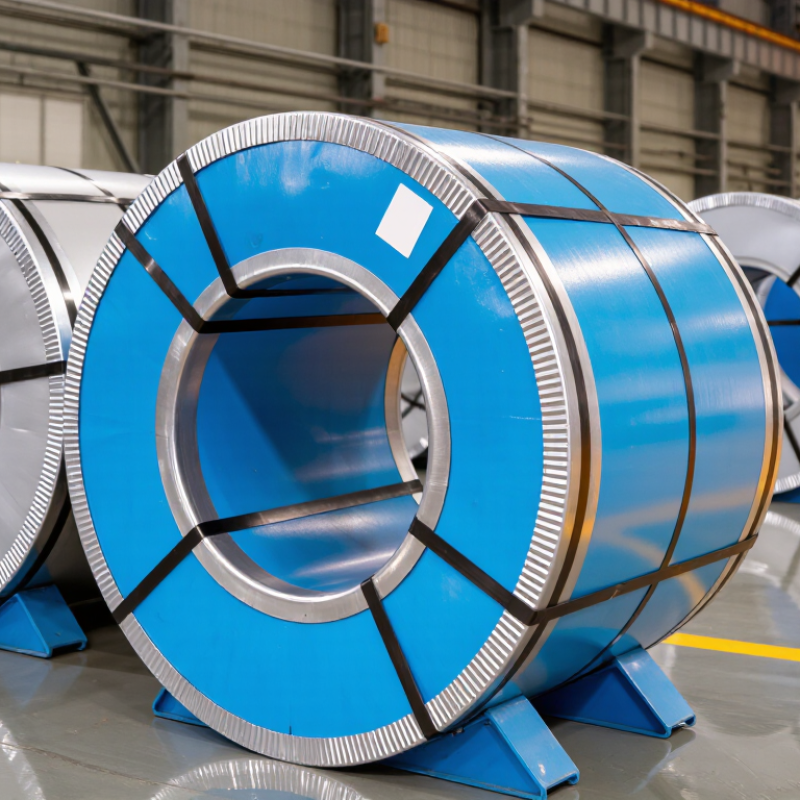
Color-coated steel coil is pre-painted steel supplied in continuous coils. Its metallic coating helps protect the steel substrate from corrosion, while the organic paint system provides color, appearance, and additional weather resistance. The chart shows common nominal coating-mass classes for galvanized and aluminum-zinc-coated steel substrates, measured as the total coating mass on both sides.
Color-coated steel coil begins as a thin steel strip wound into a large roll. The manufacturing process controls its strength, surface, and appearance. The strip is uncoiled and cleaned to remove oil, dust, and loose scale. Clean surfaces matter. A chemical treatment then improves paint adhesion and corrosion resistance.
The coil usually receives a primer before the colored topcoat. Rollers apply each layer at a controlled thickness, while an oven cures the coatings. Some products also receive a protective back coat. The finished strip passes through cooling, inspection, and rewinding stages. Technicians check color consistency, coating thickness, gloss, and surface defects. Small scratches can expose the metal beneath. That weakness deserves attention, especially in humid or coastal environments.
Tips: Store coils indoors on stable supports, away from standing water. During forming, use clean tools and avoid dragging the strip across rough surfaces. Match the coating system to the building’s climate and end use. A roof panel and an indoor partition face different stresses. In practice, even accurate production data cannot replace careful handling on site. That is where preventable damage often begins.
Color-coated steel coil starts with a carefully selected metal substrate. Cold-rolled steel offers a smooth surface and precise thickness. Galvanized steel adds zinc protection against moisture and scratches. Zinc-aluminum alloy-coated steel can improve corrosion resistance in exposed conditions. Aluminum is lighter, but it behaves differently during forming. The right substrate depends on climate, shaping depth, fire requirements, and service life.
The coating system usually contains a pretreatment, primer, and topcoat. Polyester is economical and suitable for general roofing and wall panels. Silicone-modified polyester provides better color retention and weather resistance. Fluoropolymer coatings perform well under intense sunlight, though their higher cost needs justification. Plastisol creates a thicker, textured film for demanding forming applications. Epoxy primers improve adhesion but are rarely used alone outdoors.
According to the World Steel Association’s World Steel in Figures 2024, global crude steel production reached about 1.89 billion tonnes in 2023. That scale explains why small coating improvements can affect major material flows. The International Energy Agency reports that steelmaking produces roughly 7%–9% of global energy-related carbon dioxide emissions. Coating does not erase that footprint. It can, however, slow corrosion and extend panel replacement cycles. In practice, poor edge treatment can defeat an excellent topcoat. A laboratory result is not a building guarantee. Humidity, salt spray, forming damage, and maintenance still matter. Industry guidance and accelerated testing should support the specification, not replace field judgment.
Color-coated steel coil is galvanized or zinc-aluminum steel with a factory-applied organic finish. Its main advantage is controlled, repeatable protection. Common topcoat thicknesses range from 15 to 25 micrometers, while the reverse coat is often thinner. A coating designation such as AZ150 indicates 150 grams of aluminum-zinc alloy per square meter, measured across both sides.
The surface resists moisture, ultraviolet exposure, and moderate chemical contact. However, performance depends on the coating system and environment. ISO 12944 corrosion categories show why a coastal warehouse needs more protection than an indoor partition. Factory curing also improves adhesion and forming consistency. ASTM D3359 tests cross-cut adhesion, while ISO 9227 salt-spray testing exposes weaknesses quickly. Salt spray is useful, but it does not perfectly predict outdoor service life.
Color-coated coil is lightweight, easy to cut, and suitable for roofing, wall panels, doors, and appliance housings. Its reflective finish can reduce solar heat gain, although the result depends on color, insulation, and ventilation. The International Energy Agency estimates that iron and steel production creates about 8% of global energy-related carbon dioxide emissions, so material efficiency matters. The World Steel Association’s 2024 sustainability indicators also describe steel as highly recyclable, with recovery exceeding 80% in many construction streams. That figure should not encourage careless design. Scratched edges, trapped water, and poor fasteners can defeat an otherwise durable panel. Real buildings are less tidy than laboratory samples.
Color-coated steel coil is flat steel supplied in large, continuous rolls. Its surface usually includes a metallic coating, primer, and colored protective paint. Manufacturers later form the coil into roofing sheets, wall panels, or structural profiles. The factory-applied finish provides consistent color and controlled film thickness.
Its largest application is in commercial and industrial construction. Warehouses often use it for roofs, wall cladding, gutters, and insulated sandwich panels. A typical roof may show long blue-gray sheets, concealed fasteners, and overlapping joints designed to shed rain. Retail buildings and workshops also use these panels because they install quickly and reduce on-site painting.
Agricultural buildings use coated coil for barns, storage sheds, and equipment shelters. Residential projects may include it in roofing, garage doors, fencing, and exterior trim. Interior applications include ceiling panels and partition systems where clean surfaces matter. The material also appears in ventilation ducts, electrical enclosures, and some transport equipment.
Site conditions should guide the coating choice. Coastal air, fertilizer dust, and heavy condensation can shorten service life. Edges and cut areas deserve careful inspection, especially after drilling or bending. In practice, color matching can also disappoint when panels come from different production batches. That detail is easy to overlook. Engineers should check coating performance, steel thickness, forming direction, fastener compatibility, and local weather exposure before approving the coil.
„Thanks to the LUVIR technology, the solder resist process could be switched directly from the previously used mask exposure to direct exposure. As an outstanding digital solution on the market, this technology has been able to demonstrate fast process times and superior quality on our certified conventional ink in production. This allowed us to fully digitize the solder mask process at low cost – without process or ink adjustments. An excellent benefit to our production in Rot am See.“
Ralf Göhringer (Head of Production WE Rot am See)
I would definitely recommend the Limata machine and team for a future company purchase
Michael Greenaway
Compunetics Inc.
“The Limata ldi has been amazing!! Best thing we did was buy this machine”
Richard Brady
GM
Circuitlabs
“Since 2019, we have been running the Limata X1000 LDI system (including LUVIR for solder mask imaging) in daily production as an addition to our current process with film. The machine was capable of properly exposing Taiyo PSR-4000 BN (DI) solder mask types on normal to high-copper boards using a new and unique direct imaging process. The machine operating interface is very user friendly which allowed for a quick technical training curve. The pre-registration processing reduced several seconds of production time at every print. Limata support and service staff is incomparable. They supported our team every step of the way at basically any time of the day or night, with literally, an immediate response time, customizing the software interface to best fit our Operations and needs.
We have exposed more than 8,000 prints since end of October, on various solder mask colors and some resist film panels. Limata, has proven to be very capable and innovative. They are a strong contender in the industry.
We have very much enjoyed this project, and working with the team!
Thank you Limata for the continued support and being a part of our growth.”
Bill Sezate
Vice President, GM
Summit Interconnect
As a replacement to our current contact exposure process with film, the LIMATA X2000 system including LUVIR-Technology was capable of properly exposing non-LDI solder mask types using a direct imaging process. The machine offers cutting edge software with a very intuitive operating interface which allowed for quick technician training curve. The dual drawer system combined with pre-registration processing reduced several seconds of production time at every machine cycle. Limata support and service staff is world class. They added software patches to keep production running at shortest possible response times, customized the software interface to best fit our in-house Operations system, and even wrote a step-by-step machine processing manual. As a result of the project, we have exposed more than 16,000 times on various product types and solder mask brands/colors. Limata, in a very short timeframe as a company, has definitely shown they are truly innovative and will be challenging the industry of direct imaging for the top spot.
Kevin Beattie
Process Engineer
TTM Technologies
Forest Grove Division
