A medal is small, but the moment around it can stay with a player for years. Custom Soccer Medals help teams mark that moment with a tangible reminder of effort, teamwork, and a hard-fought result. Legendary football coach Vince Lombardi captured the team spirit behind recognition: “The achievements of an organization are the results of the combined effort of each individual.” His words fit a tournament medal: every player contributes, even when only a few names appear on the final score sheet.
Details matter. A deep blue ribbon, a raised soccer-ball design, or a team crest in crisp enamel can make an award feel connected to its event. Yet a striking design is not enough. Organizers should also check medal size, material, engraving space, quantity, and delivery timing before placing an order. Small choices count. A medal that arrives late, or carries an unclear event date, can weaken an otherwise memorable presentation. That is easy to overlook.
This guide explores Custom Soccer Medals for youth teams, school leagues, clubs, and tournament organizers. It considers design options, personalization, practical ordering questions, and ways to match an award to the occasion. No single medal suits every event. A participation award may call for a different look than a championship medal, and budgets can limit the available finishes. Thoughtful planning helps teams choose awards that feel meaningful without adding needless complexity.
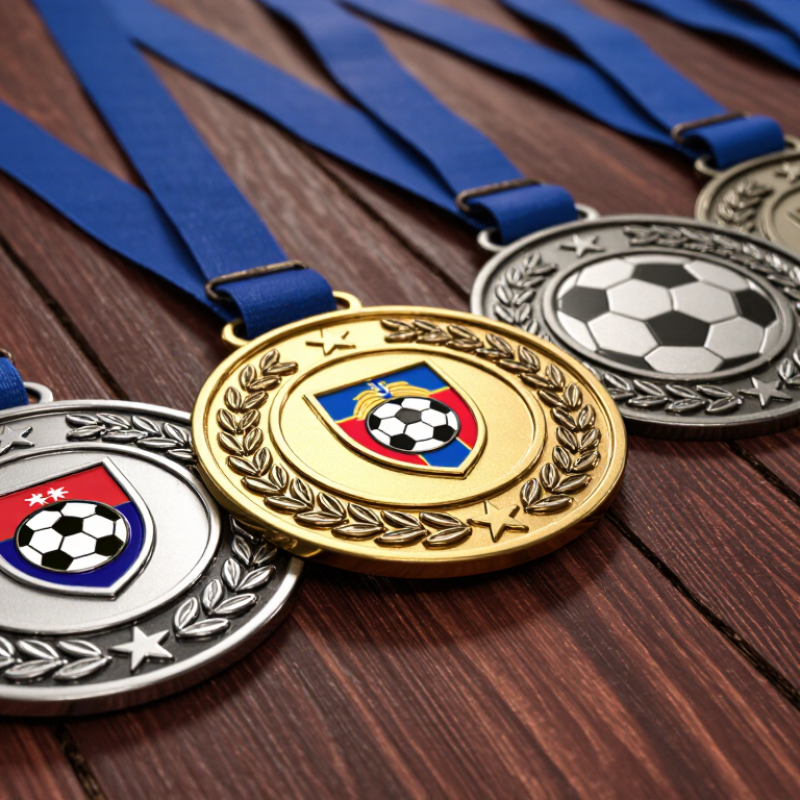
Custom soccer medals are made for a particular team, tournament, or season rather than selected from a standard design. They can include a club name, event date, age group, or a small soccer-ball image. Teams often choose metal, enamel colors, ribbon length, and engraving before ordering. A clear design brief helps avoid misspelled names and crowded artwork.
Teams use medals to recognize tournament winners, participation, sportsmanship, or personal milestones. For a weekend event, organizers might give finalists different ribbon colors and engrave the year on the back. Youth coaches may award every player a medal, while reserving a distinct design for a goalkeeper or team captain. The purpose should guide the design. A heavy medal can feel substantial, but it may be awkward for younger players to wear. Small details matter.
Before production, check the spelling, quantity, delivery date, and whether the artwork will remain readable at medal size. Ask for a proof when possible. Not every first draft works. A detailed crest can become a blur when reduced, and shiny finishes may show fingerprints. Simple shapes and short text usually hold up better. After the event, keeping one sample can help organizers compare quality and plan more accurately next season.
Custom soccer medals recognize tournament placements, individual achievements, and participation. Teams often present them at an awards ceremony after the competition.
A standard adult match has two 45-minute halves. The halftime interval must not exceed 15 minutes; additional time may be added for time lost during play. Match structure provides context for when teams and tournament organizers present medals: after the final whistle.
Custom soccer medals work best when their style matches the event and survives years in a drawer—or on a shelf. Die-struck medals create crisp crests and raised lettering. Soft enamel adds clear team colors, while printed designs suit small gradients or detailed artwork. For a traditional look, choose antique gold, silver, or bronze finishes. Polished surfaces shine under stadium lights, but fingerprints show easily.
Common bases include zinc alloy, iron, brass, and aluminum. Zinc alloy suits molded shapes and dimensional details; iron offers a sturdy, straightforward option. Lightweight aluminum may suit younger players or large tournament orders. The International Aluminium Institute estimates that about 75% of all aluminum ever produced remains in use. That industry figure supports aluminum’s long service life, but it does not confirm recycled content in any specific medal. Ask suppliers for material documentation. I sometimes overlook that step.
Tips: Match medal thickness to the event’s budget and feel. Request a physical sample before approving color and finish. Check ribbon width, edge smoothness, and whether small text stays readable. A matte finish can hide handling marks better than a mirror polish. Tiny lettering still fails on some samples. Better to catch it early.
Choose a medal design that reflects the event, not just the team colors. For a school tournament, a ball, goal, or pitch outline makes the purpose clear. For a league season, add the year and division so the medal remains meaningful later. Keep the team name readable. Tiny lettering often disappears once engraved.
The Sports & Fitness Industry Association’s 2024 Topline Participation Report estimates that 14.5 million Americans aged six and older played soccer in 2023. That broad audience includes young players, adult leagues, and varied skill levels. Consider medal size, weight, and ribbon length for the people receiving them. A heavy medal can feel awkward for younger players. A bright ribbon also helps distinguish age groups or tournament placements at a busy awards table.
Before approving production, check a physical sample or a clear proof. Confirm spelling, year, finish, and the contrast between raised details and recessed areas. Gold, silver, and bronze are familiar, but team-specific colors can make the award feel more personal. There is no perfect layout. One extra emblem may crowd the lettering, so remove details that do not matter to recipients.
Personalization works best when it stays readable at medal size. A team name, event date, and simple emblem usually stand out better than several lines of text. Check the design at its actual diameter, not just on a computer screen. Tiny lettering can blur on a metal face. Short names help.
Before approving artwork, confirm spelling, colors, and the order of details. A coach may want every player’s name, but individual engraving can raise costs and extend production time. For many tournaments, a shared design with a year or division keeps medals consistent. Ask for a digital proof and compare it with your original request. Small differences matter.
Order quantity affects the price per medal, but buying extras is not always the best deal. Estimate players, coaches, and awards, then add a modest reserve for late registrations or damaged pieces. For example, a 24-player roster might need a few additional medals. Set a total budget before choosing ribbons, finishes, or custom packaging. These upgrades can look appealing, though some add little value for a one-day event. I’d rather spend carefully than discover the “premium” details were hard to notice. A clear quote should list setup fees, personalization charges, delivery costs, and the expected timeline.
A soccer medal works best when its design is planned around the event, not just the artwork. Decide the medal’s diameter, thickness, finish, and ribbon length before approving production. A raised ball or goal-line detail can add depth, while small lettering may become hard to read. Request a proof at actual size and check names, dates, and spelling carefully. Details matter. For a tournament with several divisions, consistent medal sizes make awards easier to prepare, while distinct ribbon colors can help staff sort them quickly. Confirm the delivery date with time for inspection; a late shipment can leave little room to correct an error.
Presentation shapes the moment of recognition. Arrange medals by division in labeled trays, and keep ribbons untangled before the ceremony begins. A simple tablecloth and clear signage are often enough. Avoid stacking medals face to face, since edges can leave marks on polished surfaces. After the event, wipe each medal with a soft, dry cloth and store it in a cool, dry place. For enamel or plated finishes, skip abrasive pads and strong cleaners; they may dull the surface. Check the maker’s care guidance when materials are unclear. One easy detail to overlook is damp ribbon storage: let ribbons dry fully before packing them away. It is not a complicated routine, but busy organizers sometimes miss it—and the medals deserve better.
„Thanks to the LUVIR technology, the solder resist process could be switched directly from the previously used mask exposure to direct exposure. As an outstanding digital solution on the market, this technology has been able to demonstrate fast process times and superior quality on our certified conventional ink in production. This allowed us to fully digitize the solder mask process at low cost – without process or ink adjustments. An excellent benefit to our production in Rot am See.“
Ralf Göhringer (Head of Production WE Rot am See)
I would definitely recommend the Limata machine and team for a future company purchase
Michael Greenaway
Compunetics Inc.
“The Limata ldi has been amazing!! Best thing we did was buy this machine”
Richard Brady
GM
Circuitlabs
“Since 2019, we have been running the Limata X1000 LDI system (including LUVIR for solder mask imaging) in daily production as an addition to our current process with film. The machine was capable of properly exposing Taiyo PSR-4000 BN (DI) solder mask types on normal to high-copper boards using a new and unique direct imaging process. The machine operating interface is very user friendly which allowed for a quick technical training curve. The pre-registration processing reduced several seconds of production time at every print. Limata support and service staff is incomparable. They supported our team every step of the way at basically any time of the day or night, with literally, an immediate response time, customizing the software interface to best fit our Operations and needs.
We have exposed more than 8,000 prints since end of October, on various solder mask colors and some resist film panels. Limata, has proven to be very capable and innovative. They are a strong contender in the industry.
We have very much enjoyed this project, and working with the team!
Thank you Limata for the continued support and being a part of our growth.”
Bill Sezate
Vice President, GM
Summit Interconnect
As a replacement to our current contact exposure process with film, the LIMATA X2000 system including LUVIR-Technology was capable of properly exposing non-LDI solder mask types using a direct imaging process. The machine offers cutting edge software with a very intuitive operating interface which allowed for quick technician training curve. The dual drawer system combined with pre-registration processing reduced several seconds of production time at every machine cycle. Limata support and service staff is world class. They added software patches to keep production running at shortest possible response times, customized the software interface to best fit our in-house Operations system, and even wrote a step-by-step machine processing manual. As a result of the project, we have exposed more than 16,000 times on various product types and solder mask brands/colors. Limata, in a very short timeframe as a company, has definitely shown they are truly innovative and will be challenging the industry of direct imaging for the top spot.
Kevin Beattie
Process Engineer
TTM Technologies
Forest Grove Division
