Buying a Drying Oven for a global operation is not just a matter of choosing chamber size. A unit that dries test samples well may struggle with dense loads, frequent door openings, or heat-sensitive materials. Small details matter. Ask how evenly the chamber holds temperature, how airflow moves around trays, and whether the controller records useful data. A displayed setpoint does not prove that every shelf reaches it. Request temperature-uniformity results under conditions close to your process, and check what the supplier actually tested.
This guide highlights seven practical buying tips, from capacity and temperature range to controls, energy use, installation, and after-sales support. Compare usable chamber dimensions with your largest real load, not a catalog photo. Confirm voltage, frequency, plug type, ventilation, and delivery access before ordering. Fit comes first. For quality-sensitive work, clarify calibration options, documentation, and service response times; requirements vary by industry and destination. Ask who will install the oven and where replacement parts ship from. An attractive price can hide costly delays. No checklist removes every uncertainty, and buyers sometimes discover their bottleneck only after the first production run. A careful trial load may expose that gap early. Use these points to question claims, compare similar models, and choose an oven suited to your materials, workload, and on-site support.
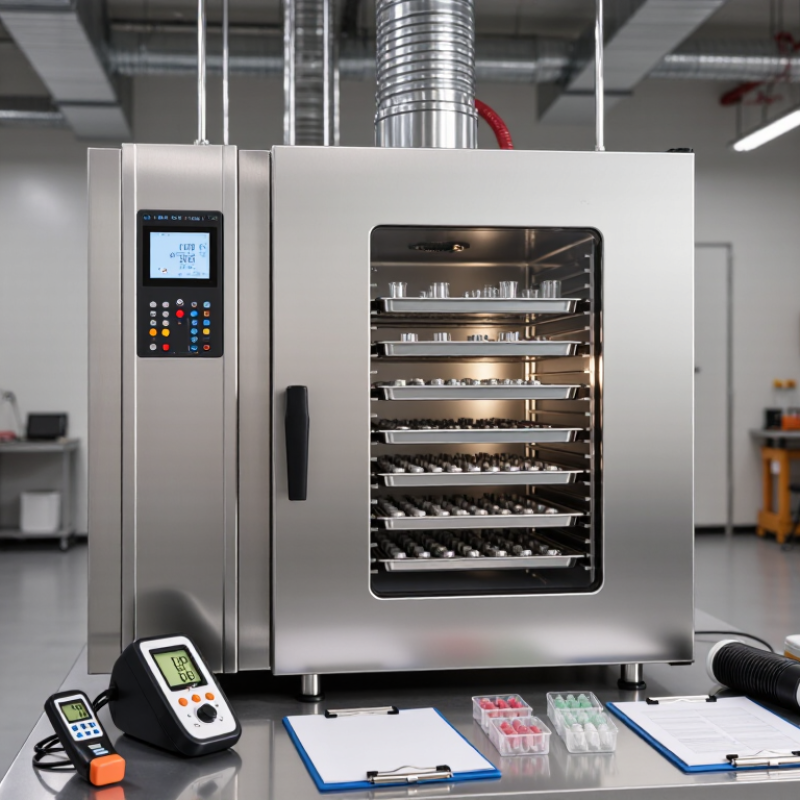
A drying oven should be selected around the material and the required result, not just its advertised temperature range. Define the moisture target, batch size, cycle time, and maximum safe product temperature. A tray of coated parts may need gentle, even airflow, while dense components may require longer heating and cooling. Record the load’s dimensions and how it sits on each shelf. Small details matter.
The U.S. Department of Energy’s Advanced Manufacturing Office reports that process heating uses about 17% of energy consumed by U.S. manufacturing. This figure covers more than drying ovens, but it shows why operating conditions deserve attention.
Ask suppliers for temperature-uniformity data at your actual working load, not only an empty-chamber specification. Also check airflow, exhaust needs, controls, and recovery time between batches. Test with representative material. A neat sample may dry well while a crowded production load stays damp at its center. That assumption can be wrong. Keep a record of temperature, cycle time, and product condition; use it to refine the operating recipe before setting routine production targets.
A drying oven should match the material and workload, not just the lowest quoted price. Forced-convection models circulate heated air and suit many routine drying tasks. Gravity-convection ovens move air more gently, which can help when samples are light or easily disturbed. Vacuum ovens operate at reduced pressure and may suit heat-sensitive materials, but they add setup and maintenance considerations. Small details matter. Check whether trays, shelves, and containers fit without blocking airflow.
Compare usable chamber capacity with the dimensions of your actual load. A large chamber can still perform poorly when shelves are packed tightly. Temperature range is only part of the specification; ask about control stability and temperature uniformity across the working space. These are different measurements. A unit may reach the target temperature while leaving cooler spots near the door or corners. Request test data for the intended operating range, and consider loaded-chamber testing if process consistency is important. It is easy to overvalue a wide temperature range. I would also verify power requirements and service support for the destination country before ordering. Sometimes the simplest choice is the better one. A slightly smaller oven with clear performance data may be more dependable than a larger model with vague specifications.
| Buying Tip | What to Compare | Typical Options or Considerations | Questions to Ask Before Purchase |
|---|---|---|---|
| 1. Choose the right oven type | Heating method and process requirements | Gravity-convection ovens use natural air circulation; mechanical-convection ovens use a fan for more active airflow; vacuum ovens reduce pressure to support drying of heat-sensitive or moisture-sensitive materials. | Does the process require forced airflow, reduced pressure, or a simpler general-purpose oven? |
| 2. Match usable capacity to the load | Internal volume, shelf area, and load size | Laboratory benchtop units commonly offer tens of liters of chamber volume, while larger floor-standing units may provide hundreds of liters. Usable space depends on shelves, airflow clearances, and the dimensions of the items being dried. | Will the largest routine batch fit with enough space around it for air circulation? |
| 3. Check the required temperature range | Minimum and maximum operating temperatures | Many general-purpose laboratory drying ovens operate from near ambient temperature to approximately 200–300°C, depending on design. Vacuum ovens are often selected for lower-temperature processes. Available ranges vary by model and configuration. | What are the process setpoint, ramp requirements, and maximum temperature needed? |
| 4. Review temperature uniformity | Temperature variation throughout the chamber | Uniformity is affected by airflow design, chamber size, shelf position, loading pattern, and operating temperature. Compare the manufacturer’s stated uniformity test conditions and measurement method rather than relying on a number alone. | Is uniformity specified for an empty chamber or a loaded chamber, and at which temperature? |
| 5. Evaluate airflow and load arrangement | Air circulation, shelf layout, and sample spacing | Fan-assisted circulation can help distribute heat, but blocked vents or tightly packed loads can affect drying and temperature distribution. Shelf adjustability and suitable accessories can make regular batch loading easier. | Can the shelves and airflow path accommodate the actual trays, containers, or components? |
| 6. Confirm utilities and installation needs | Electrical supply, footprint, ventilation, and operating environment | Voltage, frequency, current, plug or hard-wiring requirements, and power consumption vary by model and destination market. Some processes may also require suitable exhaust or room ventilation. | Does the installation site meet the oven’s electrical, clearance, and ventilation requirements? |
| 7. Check control, documentation, and service | Controller functions, records, calibration, and local support | Depending on the application, useful features may include programmable settings, over-temperature protection, alarms, data logging, and documented calibration or validation options. Requirements differ across industries and countries. | Are manuals, calibration services, spare parts, and technical support available in the destination market? |
Note: Temperature ranges and capacity descriptions are general market examples, not specifications for a particular oven. Confirm performance, test conditions, and compliance requirements with the supplier before purchase.
For global buyers, oven controls should match the work, not just look advanced. Check whether operators can set temperature, drying time, and ramp rates clearly. A readable display helps when staff wear gloves or work in a busy lab. Ask how the oven responds to a power interruption. Does it resume, stop, or require a manual reset? Small details matter.
Safety features deserve a close inspection. Look for independent over-temperature protection, clear alarms, and a door design that limits accidental contact with hot surfaces. If the unit uses forced airflow, ask how air moves around a full shelf load. Uneven loading can create temperature differences, even when the display shows a stable reading. Request test data for the intended operating range. Real loads behave differently.
Energy efficiency is more than a low power rating. Compare insulation, door-seal design, fan operation, and standby consumption. A short warm-up time may help, but frequent door openings can erase the gain. Check energy use under realistic cycles, not only ideal test conditions. The smallest number is not always the best choice. I would also review calibration and maintenance requirements; these are easy to overlook when comparing quotes. A simple trial with representative samples can reveal awkward controls or slow recovery after loading. It takes time, but skipping it may cost more later.
A drying oven can meet its technical specification and still be difficult to import. Ask for certificate numbers and test reports, then confirm they cover the exact model and destination market. Requirements differ by country and may depend on the oven’s electrical design or intended use. Check with your importer or local conformity-assessment body before placing an order. A certificate for a similar model may not be enough.
Power compatibility deserves a close check. Compare the nameplate with your site’s voltage, frequency, phase, and available current. Confirm the plug or hard-wiring arrangement, too. A small mismatch can mean extra installation work, delays, or an oven that cannot run as expected. Ask for a wiring diagram and rated power in writing; do not rely only on a sales-page summary. Small details matter.
Import planning should cover more than freight cost. Ask which documents will be supplied, such as the commercial invoice, packing list, product description, and certificate copies. Confirm the tariff classification and any destination-specific labeling or inspection steps with a qualified customs broker. Also check whether manuals and safety labels must use a local language. One easy-to-miss detail is delivery access: measure doorways and lifting limits before the crate arrives. I would recheck these items, even when a purchase feels routine.
When comparing drying oven suppliers, request a written quote that lists chamber size, temperature range, controls, and included accessories. Ask whether the quoted model has been tested at its stated operating temperature. A clear answer is useful; vague promises are not. That matters. Confirm the warranty period and what it covers, including heaters, controllers, and labor. Check whether parts must be shipped back for inspection, and who pays freight. Ask for the expected response time when a fault stops production. Warranty wording can look reassuring while leaving practical gaps.
Shipping can change the real price. Request the packed dimensions, gross weight, delivery estimate, and a breakdown of freight and handling charges. Confirm who arranges unloading, since a heavy oven may need a loading dock or suitable lifting equipment. Then calculate total cost: purchase price, delivery, installation, electrical requirements, calibration, and likely maintenance. Compare suppliers using the same assumptions. A cheaper unit may cost more if it needs site modifications or replacement parts sooner. I would still leave room for uncertainty: delivery estimates can slip, and service quality is hard to judge from a quotation alone. Ask for references or a sample service plan before deciding.
„Thanks to the LUVIR technology, the solder resist process could be switched directly from the previously used mask exposure to direct exposure. As an outstanding digital solution on the market, this technology has been able to demonstrate fast process times and superior quality on our certified conventional ink in production. This allowed us to fully digitize the solder mask process at low cost – without process or ink adjustments. An excellent benefit to our production in Rot am See.“
Ralf Göhringer (Head of Production WE Rot am See)
I would definitely recommend the Limata machine and team for a future company purchase
Michael Greenaway
Compunetics Inc.
“The Limata ldi has been amazing!! Best thing we did was buy this machine”
Richard Brady
GM
Circuitlabs
“Since 2019, we have been running the Limata X1000 LDI system (including LUVIR for solder mask imaging) in daily production as an addition to our current process with film. The machine was capable of properly exposing Taiyo PSR-4000 BN (DI) solder mask types on normal to high-copper boards using a new and unique direct imaging process. The machine operating interface is very user friendly which allowed for a quick technical training curve. The pre-registration processing reduced several seconds of production time at every print. Limata support and service staff is incomparable. They supported our team every step of the way at basically any time of the day or night, with literally, an immediate response time, customizing the software interface to best fit our Operations and needs.
We have exposed more than 8,000 prints since end of October, on various solder mask colors and some resist film panels. Limata, has proven to be very capable and innovative. They are a strong contender in the industry.
We have very much enjoyed this project, and working with the team!
Thank you Limata for the continued support and being a part of our growth.”
Bill Sezate
Vice President, GM
Summit Interconnect
As a replacement to our current contact exposure process with film, the LIMATA X2000 system including LUVIR-Technology was capable of properly exposing non-LDI solder mask types using a direct imaging process. The machine offers cutting edge software with a very intuitive operating interface which allowed for quick technician training curve. The dual drawer system combined with pre-registration processing reduced several seconds of production time at every machine cycle. Limata support and service staff is world class. They added software patches to keep production running at shortest possible response times, customized the software interface to best fit our in-house Operations system, and even wrote a step-by-step machine processing manual. As a result of the project, we have exposed more than 16,000 times on various product types and solder mask brands/colors. Limata, in a very short timeframe as a company, has definitely shown they are truly innovative and will be challenging the industry of direct imaging for the top spot.
Kevin Beattie
Process Engineer
TTM Technologies
Forest Grove Division
