Galvanized Corrugated Steel is used where builders need practical, lightweight panels for roofs, walls, and exterior enclosures. The corrugations create stiff ribs that help sheets span between supports, while the zinc coating helps protect the underlying steel from corrosion. Common applications include warehouses, workshops, agricultural buildings, equipment shelters, fencing, and temporary site structures. The exact choice depends on panel thickness, support spacing, weather exposure, and the finish.
The scale of the materials industry provides useful context. The World Steel Association’s World Steel in Figures 2024 reports global crude steel production of 1,892.2 million tonnes in 2023. The USGS Mineral Commodity Summaries 2024 identifies galvanizing as a major use of zinc, which is applied to protect steel. These reports describe the wider supply chain, not the performance of every corrugated panel. That distinction matters.
A sheet on a farm shed may face rain, dust, and occasional impact; a coastal wall faces harsher, salt-laden air. Galvanizing can slow corrosion, but it does not make steel maintenance-free. Scratches, cut edges, trapped moisture, and unsuitable fasteners can still create weak points. Not a cure-all. When selecting panels, buyers should check coating specifications, thickness, installation guidance, and the manufacturer’s stated exposure limits. This guide explains where the material works well, what affects its service life, and when another panel system may be more suitable. A careful choice begins with the site, not just the price per sheet.
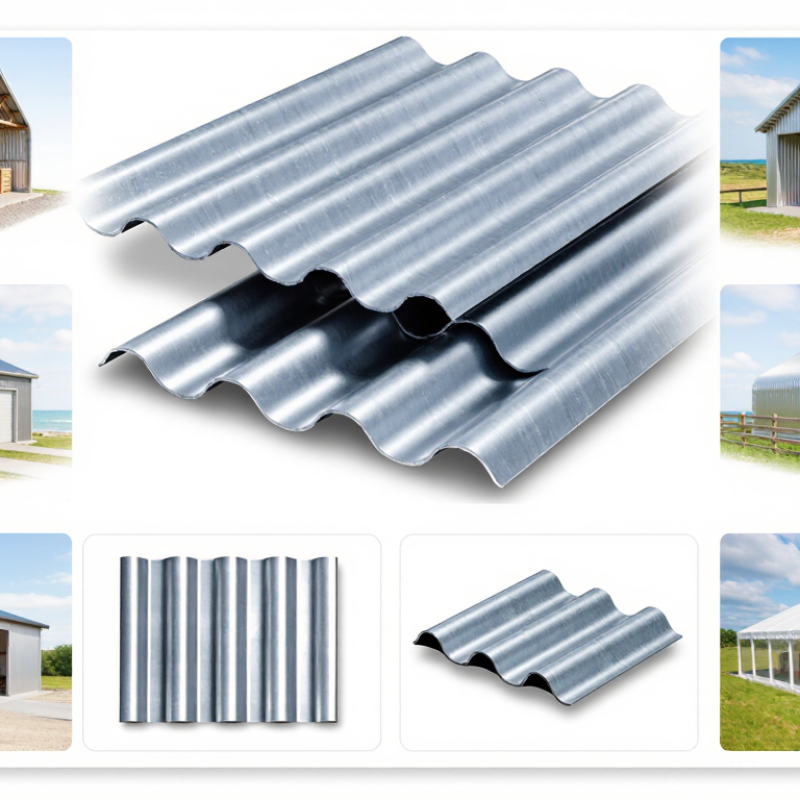
Galvanized corrugated steel is widely used for roofs on sheds, workshops, agricultural buildings, and utility structures. Its raised ribs stiffen thin sheets, helping them span between supports without becoming excessively heavy. The zinc coating slows corrosion, while the corrugated profile helps rainwater run off when sheets are installed at a suitable pitch. A detail worth checking: roof slope matters.
Builders also use these sheets for exterior wall cladding, lean-to shelters, carports, and covered storage areas. On a wall, the panels can shield framing from wind-driven rain and provide a durable, practical finish. Roof installation needs careful overlaps and compatible fasteners with sealing washers; poorly placed screws can create leak paths. Cut edges and scratches may corrode sooner, especially in damp or salty environments, so they deserve attention. I would not call the material maintenance-free. Check the sheet thickness, support spacing, and expected weather exposure before choosing it for a project. Even a sturdy-looking panel can flex or leak if its installation details are wrong.
Galvanized corrugated steel is zinc-coated steel formed into ridges for added stiffness. It is commonly used for roofs, walls, agricultural buildings, and other practical structures.
Each equal-length bar represents one common application category; the chart does not show market share or usage frequency. Suitability depends on the building design, local conditions, and the product’s coating and specifications.
Galvanized corrugated steel is used for fences because its ridges stiffen thin sheet, while zinc coating helps slow rust. Fence panels suit farm boundaries, work yards, and screened service areas. Their overlapping edges shed rain, and the sheets can be cut to fit uneven runs.
ASTM A653/A653M defines coating designations for continuously hot-dip-coated sheet, giving buyers a way to compare coating mass instead of relying on the word “galvanized” alone. That matters. A thin coating can still corrode faster near salt spray, standing water, or damaged cut edges.
For siding, corrugated panels provide a hard-wearing surface on sheds, workshops, and utility buildings. They are light enough to handle on site, though exposed fasteners and poorly sealed laps can become leak points.
Temporary structures use the same practical qualities: panels can form site screens, storage enclosures, or removable walls.
The American Galvanizers Association’s atmospheric exposure data estimates that an 85-micrometre hot-dip galvanized coating can reach first maintenance after more than 75 years in rural conditions, but around 20 years in harsher industrial or marine settings.
That figure is not a lifespan promise for every corrugated sheet; many sheet coatings are thinner. Check the coating specification, local exposure, and edge protection.
Even then, dents happen. A fence panel may need replacement sooner than expected.
In agricultural buildings, galvanized corrugated steel commonly forms roofs and wall cladding for barns, machinery sheds, and feed-storage buildings. Its ridges add stiffness, while the zinc coating helps protect the steel from rain and ordinary outdoor exposure. A practical choice. Sheets can cover large areas quickly, but sound framing and properly fixed fasteners still matter. Wind-driven rain can enter at poorly sealed overlaps, especially around roof edges and openings.
The material also appears in equipment shelters, grain-bin components, livestock enclosures, and partitions around work areas. It can help shield tractors, pumps, and stored tools from weather without making a shed overly complicated. In daily use, smooth panels are easy to rinse, though dust and feed residue can collect in corners and corrugations. That detail is easy to miss. Moisture trapped inside a poorly ventilated building may cause condensation, and manure or fertilizer exposure can accelerate corrosion. For those conditions, farmers should check panel coatings, choose compatible fasteners, and inspect cut edges and joints periodically. Galvanized steel is durable, but it is not maintenance-free. A small leak left through one wet season can damage framing beneath the sheet.
Galvanized corrugated steel is used in infrastructure because its ribs add strength while keeping sections relatively light. A zinc coating helps protect the steel from corrosion. In drainage networks, corrugated steel culverts carry runoff beneath roads, farm tracks, and rail crossings. Their rounded or arched profiles can fit beneath embankments without closing the route above.
Larger sections may serve as stormwater conduits, while smaller pipes move water through roadside ditches and beneath driveways. Corrugated steel can also form detention-tank components or channel linings where rapid water movement needs a defined path. Good performance depends on more than the pipe itself. Designers must consider expected flow, soil loads, bedding, joints, and the chemistry of the water and surrounding ground. A coating does not make the steel immune to wear. Abrasion, standing water, and damaged edges can shorten its service life. Not everywhere.
Tips: Check outlet and inlet areas after installation, where debris often collects. Confirm that the pipe has suitable cover and support. That detail is easy to underestimate. Review local site conditions before choosing a coating or section size.
Galvanized corrugated steel suits industrial buildings that need lightweight, rigid cladding. Its formed ridges help resist bending, while the zinc coating slows corrosion. Common uses include factory roofs, workshop walls, equipment shelters, grain bins, and storage enclosures. The sheets can be cut and fixed to steel framing with compatible fasteners.
The World Steel Association’s World Steel in Figures 2024 reports global crude steel production of 1,892.2 million tonnes in 2023. That figure covers all crude steel, not corrugated products, but it reflects the scale of the material supply behind industrial construction.
Specialty uses also include protective covers and partitions around machinery, where panels can be replaced without rebuilding a whole structure. Still, galvanized steel is not maintenance-free. Scratches, trapped moisture, and chemical exposure can damage the coating over time. That trade-off deserves attention.
Tips: Match the coating and sheet thickness to the site. Inspect cut edges, fasteners, and damp corners regularly. For coastal or chemically exposed locations, get a corrosion review before specifying the panels.
„Thanks to the LUVIR technology, the solder resist process could be switched directly from the previously used mask exposure to direct exposure. As an outstanding digital solution on the market, this technology has been able to demonstrate fast process times and superior quality on our certified conventional ink in production. This allowed us to fully digitize the solder mask process at low cost – without process or ink adjustments. An excellent benefit to our production in Rot am See.“
Ralf Göhringer (Head of Production WE Rot am See)
I would definitely recommend the Limata machine and team for a future company purchase
Michael Greenaway
Compunetics Inc.
“The Limata ldi has been amazing!! Best thing we did was buy this machine”
Richard Brady
GM
Circuitlabs
“Since 2019, we have been running the Limata X1000 LDI system (including LUVIR for solder mask imaging) in daily production as an addition to our current process with film. The machine was capable of properly exposing Taiyo PSR-4000 BN (DI) solder mask types on normal to high-copper boards using a new and unique direct imaging process. The machine operating interface is very user friendly which allowed for a quick technical training curve. The pre-registration processing reduced several seconds of production time at every print. Limata support and service staff is incomparable. They supported our team every step of the way at basically any time of the day or night, with literally, an immediate response time, customizing the software interface to best fit our Operations and needs.
We have exposed more than 8,000 prints since end of October, on various solder mask colors and some resist film panels. Limata, has proven to be very capable and innovative. They are a strong contender in the industry.
We have very much enjoyed this project, and working with the team!
Thank you Limata for the continued support and being a part of our growth.”
Bill Sezate
Vice President, GM
Summit Interconnect
As a replacement to our current contact exposure process with film, the LIMATA X2000 system including LUVIR-Technology was capable of properly exposing non-LDI solder mask types using a direct imaging process. The machine offers cutting edge software with a very intuitive operating interface which allowed for quick technician training curve. The dual drawer system combined with pre-registration processing reduced several seconds of production time at every machine cycle. Limata support and service staff is world class. They added software patches to keep production running at shortest possible response times, customized the software interface to best fit our in-house Operations system, and even wrote a step-by-step machine processing manual. As a result of the project, we have exposed more than 16,000 times on various product types and solder mask brands/colors. Limata, in a very short timeframe as a company, has definitely shown they are truly innovative and will be challenging the industry of direct imaging for the top spot.
Kevin Beattie
Process Engineer
TTM Technologies
Forest Grove Division
