In recent years, the demand for effective solid-liquid separation technologies has surged. This is particularly true in various industries such as construction, mining, and wastewater treatment. Experts emphasize the critical role of advanced equipment, like the High Efficiency Ultra-Fine Particle Desander. Dr. Emily Chen, a recognized authority in this field, remarks, "The High Efficiency Ultra-Fine Particle Desander is transforming how we approach particle removal in industrial processes."
This innovative desander utilizes cutting-edge technology to separate ultra-fine particles from liquids with remarkable efficiency. The design focuses on maximizing separation while minimizing energy consumption. Users often report significant improvements in product quality and operational efficiency after implementing this technology. However, some may overlook the importance of regular maintenance, which can lead to less optimal performance over time.
Moreover, while the benefits are substantial, challenges remain. Not all facilities have adopted this advanced technology yet. Some face budget constraints or lack the knowledge to implement such systems. The journey toward incorporating High Efficiency Ultra-Fine Particle Desanders requires careful planning and expert insight. Thus, as industries evolve, continuous learning and adaptation to technological advancements become crucial.
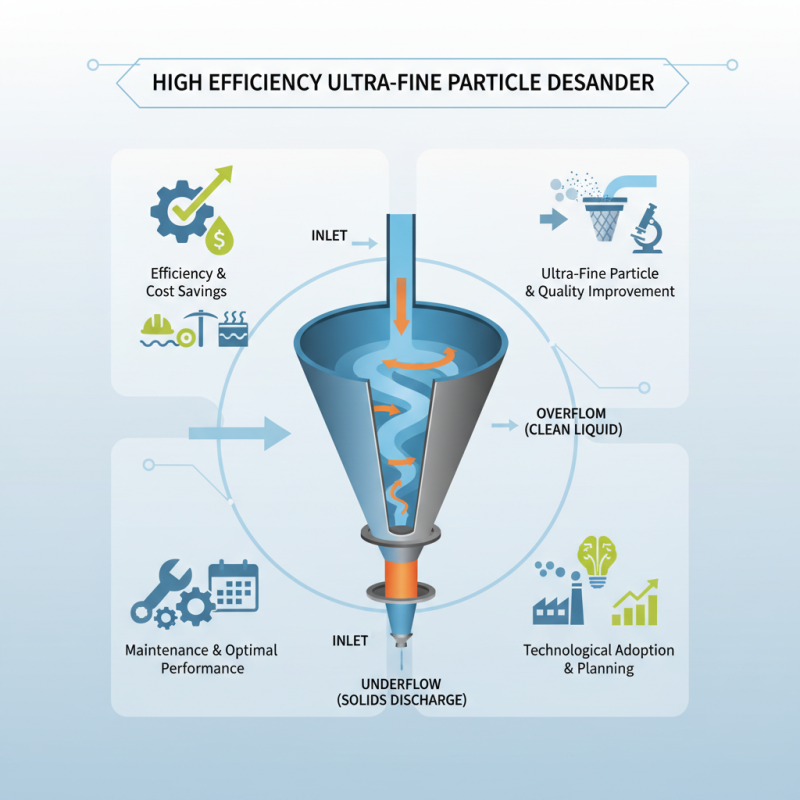
A High Efficiency Ultra-Fine Particle Desander is a specialized device designed for effective particle separation in various industrial applications. Its primary function is to remove ultra-fine particles from fluids. These particles can often lead to equipment wear and efficiency loss. Typically, this desander utilizes centrifugal force and sedimentation principles to enhance separation efficiency. The result is cleaner fluids, which contribute to overall system longevity.
When discussing the functionality of the desander, it's crucial to understand its design. The device generally includes a separator cone and a collection system. As the fluid enters, centrifugal forces push heavier particles outward. The finer particles subsequently separate and are expelled. This process is efficient, but challenges remain in optimizing particle sizes. The equipment may struggle with specific types of ultra-fine particles, requiring continuous improvement in design.
Many industries, such as oil and gas or water treatment, benefit from this technology. However, implementation can be tricky. The setup may require precise calibrations, and operators need training. Each application might pose unique challenges. Understanding these nuances is vital for achieving maximum efficiency. Reflection on past experiences can enhance operational strategies, ensuring that the High Efficiency Ultra-Fine Particle Desander fulfills its potential.
The chart above illustrates the separation efficiency of a High Efficiency Ultra-Fine Particle Desander across various particle sizes. As the particle size increases, the efficiency tends to decrease, demonstrating the desander’s capability in handling finer particles effectively.
High Efficiency Ultra-Fine Particle Desanders play an essential role in various industries. These devices are designed to remove fine particles from liquids. They are crucial in maintaining the quality of the product and equipment longevity. Effective separation of impurities can drastically improve efficiency and reduce maintenance costs.
Key components of desanding equipment include the cyclone separator and filtration systems. The cyclone separator uses centrifugal force to separate particles based on density. This separation is efficient and generates minimal waste. Filtration systems further ensure that even the smallest particles are captured. Regular inspection of these components is necessary. Wear and tear can affect performance over time.
Design features also contribute to their effectiveness. A well-designed inlet minimizes turbulence, enhancing separation efficiency. The outlet layout influences the flow rate and can impact overall function. While these features are beneficial, they require ongoing assessment. Adjustments may be needed as operational conditions change. Understanding these elements is crucial for optimized performance.
| Feature | Description | Material | Efficiency (%) |
|---|---|---|---|
| Separator Type | Cylindrical hydrocyclone | Polyurethane | 95 |
| Inlet Design | Tangential inlet for optimal flow | Stainless Steel | N/A |
| Particle Size Removal | Removes particles as small as 5 microns | Ceramic lining | 90 |
| Pressure Drop | Low pressure drop across the unit | N/A | N/A |
| Maintenance | Easy access for maintenance | Plastic composite | N/A |
High Efficiency Ultra-Fine Particle Desanders are increasingly vital in various industries. These devices effectively remove fine particles from liquid streams. They play a key role in sectors like oil and gas, water treatment, and pharmaceuticals.
In oil and gas, these desanders enhance production by minimizing equipment wear. They ensure cleaner output, improving overall efficiency. This leads to reduced operational costs and longer equipment life. In water treatment facilities, high efficiency desanders help maintain water quality. They filter out harmful impurities, ensuring cleaner water for communities.
Despite their benefits, challenges remain. Some systems struggle with clogging when dealing with certain types of particles. Regular maintenance can be a burden for operators. Understanding particle behavior is essential for maximizing their effectiveness. Continuous research is needed to further improve these technologies.
High Efficiency Ultra-Fine Particle Desanders are advanced filtration devices. They capture extremely small particles from liquids. This technology is essential in various industries, like oil and gas, water treatment, and more. The key advantage is their superior particle removal efficiency compared to traditional methods.
One major benefit of using these desanders is reduced maintenance costs. They require less frequent cleaning, saving time and resources. Moreover, they enhance the quality of the treated liquids. Clean liquids improve system performance and extend equipment lifespan. However, not every facility may need such advanced systems. Evaluating specific needs is crucial.
Another significant advantage is their adaptability. These desanders can be customized for different applications. They handle varying flow rates and particle sizes effectively. Yet, the investment may seem high initially. Long-term benefits often justify this cost. Regular evaluation of performance ensures they meet operational goals. Balancing efficiency and cost remains a challenge for many.
High Efficiency Ultra-Fine Particle Desander is reshaping the landscape of modern desanding technologies. Traditional desanding methods, such as cyclonic separation and hydrocyclones, often struggle to effectively remove ultra-fine particles. These conventional methods may miss smaller particles, leading to inefficient processes and potential complications downstream. In light of this, the High Efficiency Ultra-Fine Particle Desander emerges as a reliable alternative.
This innovative technology utilizes advanced filtration techniques to achieve superior removal rates. It effectively captures particles as small as a few microns, something traditional methods generally fail to do. Moreover, it minimizes the risk of equipment wear, which is prevalent with older techniques. Operators may still encounter challenges in optimizing the settings for specific fluids. Such factors require careful attention to achieve peak efficiency. High Efficiency Ultra-Fine Particle Desanders may also demand higher initial investments, raising questions about their cost-effectiveness in certain applications.
Despite these challenges, users find this technology beneficial in various industries, including oil and gas, mining, and water treatment. The ability to achieve higher efficiency and reliability makes this desander compelling. As the industry continues to evolve, it is essential for operators to assess their needs and consider the advantages of integrating high-efficiency solutions. The transition comes with learning curves, but the long-term benefits may outweigh initial hurdles.
„Thanks to the LUVIR technology, the solder resist process could be switched directly from the previously used mask exposure to direct exposure. As an outstanding digital solution on the market, this technology has been able to demonstrate fast process times and superior quality on our certified conventional ink in production. This allowed us to fully digitize the solder mask process at low cost – without process or ink adjustments. An excellent benefit to our production in Rot am See.“
Ralf Göhringer (Head of Production WE Rot am See)
I would definitely recommend the Limata machine and team for a future company purchase
Michael Greenaway
Compunetics Inc.
“The Limata ldi has been amazing!! Best thing we did was buy this machine”
Richard Brady
GM
Circuitlabs
“Since 2019, we have been running the Limata X1000 LDI system (including LUVIR for solder mask imaging) in daily production as an addition to our current process with film. The machine was capable of properly exposing Taiyo PSR-4000 BN (DI) solder mask types on normal to high-copper boards using a new and unique direct imaging process. The machine operating interface is very user friendly which allowed for a quick technical training curve. The pre-registration processing reduced several seconds of production time at every print. Limata support and service staff is incomparable. They supported our team every step of the way at basically any time of the day or night, with literally, an immediate response time, customizing the software interface to best fit our Operations and needs.
We have exposed more than 8,000 prints since end of October, on various solder mask colors and some resist film panels. Limata, has proven to be very capable and innovative. They are a strong contender in the industry.
We have very much enjoyed this project, and working with the team!
Thank you Limata for the continued support and being a part of our growth.”
Bill Sezate
Vice President, GM
Summit Interconnect
As a replacement to our current contact exposure process with film, the LIMATA X2000 system including LUVIR-Technology was capable of properly exposing non-LDI solder mask types using a direct imaging process. The machine offers cutting edge software with a very intuitive operating interface which allowed for quick technician training curve. The dual drawer system combined with pre-registration processing reduced several seconds of production time at every machine cycle. Limata support and service staff is world class. They added software patches to keep production running at shortest possible response times, customized the software interface to best fit our in-house Operations system, and even wrote a step-by-step machine processing manual. As a result of the project, we have exposed more than 16,000 times on various product types and solder mask brands/colors. Limata, in a very short timeframe as a company, has definitely shown they are truly innovative and will be challenging the industry of direct imaging for the top spot.
Kevin Beattie
Process Engineer
TTM Technologies
Forest Grove Division
