Choosing the right Hdmi Port Extender in 2026 is less simple than matching two familiar connectors. A dependable model must handle resolution, refresh rate, audio formats, HDCP, and modern gaming features. The wrong choice may show a blank screen, unstable audio, or random signal drops after several minutes.
Jeff Park, a technical expert associated with HDMI technology, offers a useful warning: “HDMI compatibility is about the entire signal chain, not the connector alone.” That principle matters in homes, classrooms, conference rooms, and digital signage installations. A television may support 4K at 120Hz, while an older extender only manages 4K at 30Hz. The difference becomes obvious during fast gameplay, where motion looks uneven and input response feels delayed.
Small details matter. Check the extender’s actual bandwidth, not only its advertised resolution. Confirm support for HDMI 2.1 features when required. Test the source device, display, cable length, and power supply together. EDID and HDCP behavior can also affect whether protected content appears correctly.
Do not trust impressive packaging alone.
An active extender may perform better over longer distances, but it can require stable power near the display. A passive adapter may be cheaper, yet its range is often limited. Installation experience shows that many failures come from cables, loose connections, or mismatched settings rather than the extender itself. This guide explains how to compare these factors carefully, while recognizing an uncomfortable truth: even a well-reviewed Hdmi Port Extender may need testing in your specific setup.
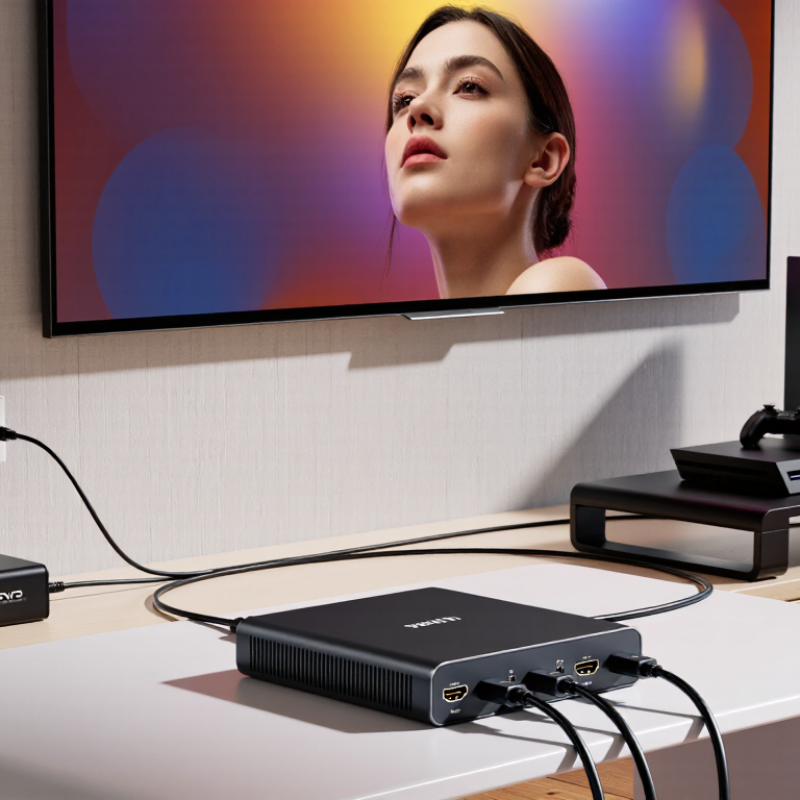
An HDMI port extender gives your display connection more reach or makes a hidden port easier to access. Some models are simple couplers, while others carry signals through longer cables or network wiring. The difference matters. A short coupler may suit a wall-mounted television, but it cannot replace a properly rated long-distance extender. Check the connector type, HDMI version, supported resolution, refresh rate, and audio format before buying.
You may need one when a television sits inside a cabinet, a monitor port is difficult to reach, or a computer connects across a large desk. Measure the route, including bends and spare length. A two-metre cable can become too short after routing around furniture.
Look for secure connectors and shielding, especially near power adapters, speakers, or wireless equipment. Loose connections often cause black screens, flickering, or intermittent audio.
In my experience, compatibility claims deserve careful reading. A device supporting high resolution at a low refresh rate may not handle modern gaming settings. I once assumed a longer connection would work because the image appeared during setup. Later, brief signal drops appeared under heavier use. That mistake taught me to test the complete setup for several minutes. Also check whether the extender needs external power. Some do, and a nearby outlet may not be available. Reducing unnecessary adapters usually improves reliability. A cleaner route helps, too.
Start with the distance between your source and display. A short extension may need only a high-quality passive cable. Longer runs usually require an active HDMI extender. For rooms with cable routes inside walls, HDMI over twisted-pair cable can offer a practical solution. It needs compatible transmitters, receivers, and suitable network-grade cable. Fiber-based HDMI extenders suit very long distances and areas with electrical interference. Wireless models help when drilling is impossible, but walls and nearby devices can affect stability.
Check your actual HDMI requirements before choosing a type. A gaming display may need 4K resolution, high refresh rates, and low latency. A home theater may depend more on HDR, HDCP support, and reliable audio return. If your setup uses ARC or eARC, confirm that the extender passes those signals. CEC control can also fail when devices use different handshaking methods. Small details matter.
I once assumed a longer cable would solve an intermittent black screen. The real problem was an extender that did not support the source’s video timing. That mistake was avoidable. Read the extender’s bandwidth rating, then compare it with your source and display. Leave some performance headroom instead of matching specifications exactly. Also consider power access, ventilation, cable bends, and connector strain. A careful test with your real devices is more reliable than a perfect-looking specification sheet.
How to Choose an HDMI Port Extender in 2026?
Choosing an HDMI port extender starts with the display’s actual requirements. HDMI 2.0 supports 4K at 60Hz with suitable bandwidth. HDMI 2.1 can handle 4K at 120Hz and, in compatible systems, 8K at 60Hz. Higher resolution alone is not enough. Check refresh rate, color depth, HDR support, and compression details together. Bandwidth matters.
In practical installations, cable length often causes more trouble than resolution. A long connection may need an active extender, optical transmission, or external power. Look for reliable support for HDCP, EDID management, and automatic signal recovery. Gamers should check VRR, low-latency performance, and eARC compatibility. Home theater users may need multichannel audio passthrough, including newer immersive formats. Test the whole signal chain.
Do not trust one impressive number. A device advertised for 8K may reduce refresh rate or disable HDR. I have found that small compatibility gaps can create a black screen, flickering, or missing audio. An extender with firmware updates is useful, but updates cannot fix weak hardware. Confirm the source, extender, cable, and display share the same standard. Leave some bandwidth overhead. Future-proofing sounds sensible, yet paying for unused features can be a poor choice. Measure twice.
| HDMI Standard | Maximum Signaling Bandwidth | Typical Maximum Video Capability | HDR and Color Support | Gaming Features | Audio Features | Best Use for a Port Extender |
|---|---|---|---|---|---|---|
| HDMI 1.4 / 1.4b | 10.2 Gbit/s | Up to 4K at 30 Hz; up to 1080p at higher refresh rates, depending on the source and display | Supports 8-bit 4:4:4 at common lower resolutions; limited 4K HDR capability because of bandwidth constraints | Suitable for basic 1080p gaming; not appropriate for 4K at 120 Hz, VRR, or modern high-refresh gaming | Supports multichannel compressed audio and standard lossless formats through compatible equipment; no eARC | Legacy equipment, office displays, projectors, and basic 1080p installations |
| HDMI 2.0 / 2.0b | 18 Gbit/s | Up to 4K at 60 Hz with 8-bit 4:4:4 in suitable modes | Supports HDR10 and other HDR formats on compatible devices; 10-bit 4K signals may require 4:2:2 or 4:2:0 chroma subsampling | Good for 4K at 60 Hz; generally not suitable for uncompressed 4K at 120 Hz | Supports ARC, object-based audio pass-through when the source, extender, and display are compatible, and up to 32 audio channels in the standard | Recommended for streaming, television, home theater, and standard 4K monitors |
| HDMI 2.1 / 2.1a / 2.1b | Up to 48 Gbit/s with Fixed Rate Link signaling | Up to 4K at 120 Hz and 8K at 60 Hz in supported configurations; higher modes may require DSC, chroma subsampling, or reduced color depth | Designed for higher-bandwidth HDR, including 10-bit and 12-bit workflows where supported; dynamic HDR support depends on the connected devices | Supports 4K at 120 Hz, Variable Refresh Rate, Auto Low Latency Mode, and Quick Frame Transport when the entire signal chain supports them | Supports eARC, which provides higher-bandwidth audio return than ARC, subject to source and display compatibility | Recommended for next-generation consoles, high-refresh PCs, 4K/8K displays, and long-term compatibility |
| HDMI 2.1 with DSC | Uses HDMI 2.1 FRL bandwidth together with Display Stream Compression | Can enable video modes such as 8K at 60 Hz or higher-resolution high-refresh signals that may exceed uncompressed bandwidth | Image quality depends on the implementation and the source/display support; verify DSC compatibility on all relevant ports | Useful for high-resolution, high-refresh PC gaming when the graphics source and display both support DSC | Audio support remains dependent on the extender's audio-return and pass-through design | Specialized high-end systems where uncompressed bandwidth is insufficient |
| Feature to Check | What It Does | Minimum Specification to Consider | When It Matters Most | Common Limitation | Selection Advice | Priority in 2026 |
| Port Version and Actual Bandwidth | Determines which resolution, refresh rate, color depth, and chroma combinations can pass through the extender | 18 Gbit/s for 4K at 60 Hz; 48 Gbit/s for 4K at 120 Hz and advanced 8K configurations | Every installation, especially when the source and display use different HDMI generations | A product may advertise an HDMI version without supporting every feature associated with that version | Confirm the stated bandwidth in Gbit/s, not only the HDMI version number | Essential |
| Resolution and Refresh Rate | Defines the maximum image detail and motion smoothness | Choose at least the target display mode, such as 4K at 60 Hz or 4K at 120 Hz | Gaming, sports, fast motion, desktop use, and high-refresh monitors | Some extenders support 4K but only at 24 or 30 Hz | Check the exact supported combination, not separate maximum values for resolution and refresh rate | Essential |
| HDR Pass-Through | Preserves expanded brightness and color information from HDR sources | HDR10 pass-through for basic HDR systems; broader dynamic HDR support for advanced installations | 4K streaming, gaming, UHD video, and HDR displays | HDR may fail if the extender, cable, source, or display does not support the required color depth and bandwidth | Verify HDR10, Dolby Vision, HDR10+, or other required formats individually | High |
| Chroma Subsampling and Color Depth | Controls color detail and the number of bits used for each pixel component | 4:4:4 8-bit for PC text and standard 4K; 10-bit or 12-bit support for HDR workflows where available | Computer monitors, color-critical work, HDR, and gaming | High-resolution HDR modes may reduce chroma to 4:2:2 or 4:2:0 to stay within bandwidth limits | Look for explicit support for 4:4:4, 10-bit, or 12-bit at the intended resolution and refresh rate | High |
| VRR and ALLM | VRR synchronizes display refresh with frame output; ALLM automatically selects a low-latency mode | Explicit support for the required VRR method and ALLM | Console and PC gaming | Passing a high refresh rate does not guarantee that VRR or ALLM will work | Choose an extender that lists these features separately rather than assuming they are included | High for gaming |
| ARC or eARC | Returns audio from a display to an AV receiver, soundbar, or audio device | ARC for standard audio needs; eARC for higher-bandwidth formats and advanced home theater | Televisions connected to external audio equipment | Many video extenders pass video correctly but do not support audio return | Check whether the extender supports eARC specifically, including the required audio formats | High for home theater |
| HDCP Version Support | Manages copy protection for protected movies, streaming content, and other digital media | HDCP 2.2 for most 4K protected content; HDCP 2.3 for newer 4K and 8K equipment where required | Streaming services, UHD players, set-top boxes, and protected video sources | A lower-HDCP device in the chain can cause a black screen or force a lower resolution | Match the extender's HDCP support with the source and display | Essential for protected 4K/8K content |
| CEC Pass-Through | Allows compatible devices to exchange control commands, such as power and input switching | CEC pass-through with a clear on/off option | Simple remote control and automatic input selection | CEC behavior can vary between devices and may cause unwanted input switching | Choose a model with a CEC control option if the system includes multiple HDMI devices | Medium |
| EDID Management | Controls how the source detects the display's supported formats | Manual or automatic EDID modes, preferably with selectable resolution and audio profiles | Mixed displays, matrix systems, capture devices, AV receivers, and troubleshooting | Incorrect EDID information can cause no signal, an unsupported resolution, or missing audio | Prioritize adjustable EDID when connecting devices with different capabilities | High for complex systems |
| Signal Regeneration and Cable Distance | Restores signal integrity so the HDMI signal can travel farther | Choose a tested distance at the intended resolution and refresh rate | Wall-mounted displays, conference rooms, racks, and long cable runs | Maximum distance decreases as resolution, refresh rate, color depth, and bandwidth increase | Use certified cables and check whether the extender requires a power supply | Essential for long runs |
| HDMI Cable Category | Indicates the cable's tested bandwidth class | High Speed for many 1080p and some 4K applications; Premium High Speed for reliable 18 Gbit/s use; Ultra High Speed for up to 48 Gbit/s use | Any installation where the cable is replaced or extended | A cable length or connector fault can reduce reliability even when the extender is capable of the target mode | Use a certified cable category that matches the required bandwidth and distance | Essential |
| Power and Installation Method | Determines whether the extender can maintain a stable signal and fit the installation | External power for long distances, active electronics, or demanding HDMI 2.1 modes | In-wall installations, ceiling displays, equipment racks, and long cable paths | Bus-powered units may be unreliable with long cables or high-bandwidth signals | Prefer accessible power connections, ventilation, and strain relief for permanent installations | High |
| Selection rule: Choose an extender whose verified bandwidth, HDCP version, HDR support, audio-return capability, and exact resolution/refresh combination meet or exceed every device in the signal chain. The weakest HDMI port, cable, or intermediate device can limit the final result. | ||||||
Start with the real cable path, not the distance between two rooms. Measure around walls, furniture, and ceiling channels. A five-meter route can become eight meters after installation. Check the extender’s certified range at your required resolution, refresh rate, and color depth. A device rated for standard high-definition video may struggle with high-resolution gaming or high dynamic range signals.
Compatibility requires more than matching HDMI connectors. Confirm the source and display support the same video format, copy-protection standard, audio channels, and refresh rate. Check whether the extender supports automatic display communication, often called EDID management. Without it, a screen may flicker, lose audio, or show no image. I once tested a system that worked perfectly at 60 Hz but failed at a higher refresh rate. The specification sheet had hidden that limitation in small print.
Installation details often decide reliability. Use the recommended cable category or optical line, and avoid sharp bends near the connectors. Keep power supplies accessible, provide airflow, and label both ends before closing the wall. Test the complete route before permanent mounting. Shorter cables are not always better. Cheap patch leads can weaken an otherwise capable system. I still recheck every connector because one loose plug can mimic a compatibility fault. Some installations need signal regeneration, while others need different equipment entirely.
How to Choose an HDMI Port Extender in 2026?
Reliability should lead your comparison, not the lowest online price. Grand View Research estimated the global HDMI cable market at about 2.9 billion dollars in 2023, showing continued demand for digital connections. More devices also increase failure points. Check the extender’s supported bandwidth, refresh rate, heat handling, and power method. A unit rated for 48 Gbps is better prepared for 4K at 120 Hz and some 8K applications. However, specifications alone do not guarantee stable performance. Test it with a long cable, a game console, and a streaming device. Watch for black screens, audio drops, or delayed signal recovery. Small detail, big failure.
Budget comparisons should include replacement cables, power adapters, and installation time. The Consumer Technology Association’s 2024 ownership research identified 4K televisions as a majority household product in the United States. That trend makes future display upgrades realistic, not theoretical. Still, paying for extreme specifications may be wasteful if your screen supports only 4K at 60 Hz. Select enough headroom for your next upgrade, but avoid paying for features you cannot use. I once chose a cheaper extender and ignored ventilation. It worked for weeks, then failed during a warm afternoon. My comparison missed operating temperature. Test conditions matter.
Compare reliability, budget, and future upgrade needs by matching the extender’s supported HDMI bandwidth to your display format and refresh-rate requirements.
The chart shows the maximum link bandwidth defined by each HDMI specification: HDMI 1.4 at 10.2 Gbps, HDMI 2.0 at 18 Gbps, HDMI 2.1 at 48 Gbps, and HDMI 2.2 at 96 Gbps. Actual extender performance also depends on cable quality, signal distance, HDCP, EDID handling, power, and installation conditions.
Choose an extender with stable EDID and HDCP support, adequate power, clear status indicators, and a bandwidth rating above your current requirement.
Avoid paying for maximum bandwidth that your source and display cannot use, but leave enough headroom to reduce compatibility problems.
For planned 4K high-refresh or 8K systems, select a higher-bandwidth extender and verify its resolution, refresh-rate, HDR, VRR, and HDCP specifications.
„Thanks to the LUVIR technology, the solder resist process could be switched directly from the previously used mask exposure to direct exposure. As an outstanding digital solution on the market, this technology has been able to demonstrate fast process times and superior quality on our certified conventional ink in production. This allowed us to fully digitize the solder mask process at low cost – without process or ink adjustments. An excellent benefit to our production in Rot am See.“
Ralf Göhringer (Head of Production WE Rot am See)
I would definitely recommend the Limata machine and team for a future company purchase
Michael Greenaway
Compunetics Inc.
“The Limata ldi has been amazing!! Best thing we did was buy this machine”
Richard Brady
GM
Circuitlabs
“Since 2019, we have been running the Limata X1000 LDI system (including LUVIR for solder mask imaging) in daily production as an addition to our current process with film. The machine was capable of properly exposing Taiyo PSR-4000 BN (DI) solder mask types on normal to high-copper boards using a new and unique direct imaging process. The machine operating interface is very user friendly which allowed for a quick technical training curve. The pre-registration processing reduced several seconds of production time at every print. Limata support and service staff is incomparable. They supported our team every step of the way at basically any time of the day or night, with literally, an immediate response time, customizing the software interface to best fit our Operations and needs.
We have exposed more than 8,000 prints since end of October, on various solder mask colors and some resist film panels. Limata, has proven to be very capable and innovative. They are a strong contender in the industry.
We have very much enjoyed this project, and working with the team!
Thank you Limata for the continued support and being a part of our growth.”
Bill Sezate
Vice President, GM
Summit Interconnect
As a replacement to our current contact exposure process with film, the LIMATA X2000 system including LUVIR-Technology was capable of properly exposing non-LDI solder mask types using a direct imaging process. The machine offers cutting edge software with a very intuitive operating interface which allowed for quick technician training curve. The dual drawer system combined with pre-registration processing reduced several seconds of production time at every machine cycle. Limata support and service staff is world class. They added software patches to keep production running at shortest possible response times, customized the software interface to best fit our in-house Operations system, and even wrote a step-by-step machine processing manual. As a result of the project, we have exposed more than 16,000 times on various product types and solder mask brands/colors. Limata, in a very short timeframe as a company, has definitely shown they are truly innovative and will be challenging the industry of direct imaging for the top spot.
Kevin Beattie
Process Engineer
TTM Technologies
Forest Grove Division
