Choosing the best Clamp On Water Meter from China requires more than comparing prices and catalog photographs. The correct model must match pipe material, diameter, wall thickness, fluid temperature, and expected flow range. A meter that performs well on a clean steel pipe may struggle on a lined or heavily scaled pipe. Small details matter.
Experienced installers usually inspect the pipe before selecting the instrument. They check for rust, paint layers, vibration, nearby valves, and sufficient straight pipe length. Ultrasonic sensors need stable contact and careful alignment. Coupling gel should cover the sensor faces without air pockets. A bright display is helpful, but accurate readings are more important. Ask suppliers for calibration records, measurement accuracy, repeatability data, and clear installation instructions. Reliable manufacturers should explain their testing process instead of making vague claims.
No meter is perfect.
Battery life, data storage, communication options, and enclosure protection also affect long-term value. Consider whether the meter will serve a temporary audit, a factory pipeline, or continuous municipal monitoring. Some Chinese suppliers offer useful customization, but customization may increase testing time and maintenance complexity. That point is often overlooked. Compare after-sales support, spare sensors, software updates, warranty terms, and response times before ordering. Independent verification is wise when water billing or process control depends on the result. The cheapest choice can become expensive after repeated installation adjustments, unstable readings, or difficult technical support. A careful evaluation creates a more dependable purchase and reduces avoidable field problems.
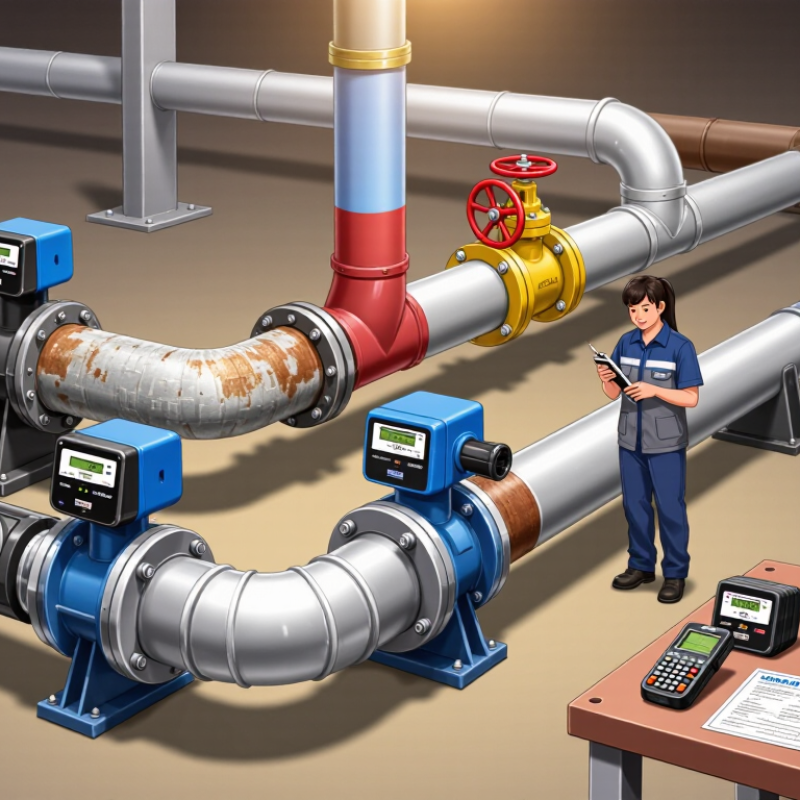
Choosing a clamp-on water meter starts with understanding ultrasonic measurement. Two sensors attach outside the pipe and send sound signals through the flowing water. The meter compares travel times in both directions. Flow moving downstream makes the signal arrive slightly faster. This difference produces the flow reading without cutting the pipe or stopping service.
A stated accuracy of ±1–2% is possible, but installation decides much of the result. Pipe diameter, wall thickness, material, lining, and water temperature all matter. Clean, full pipes usually provide stronger signals. Air bubbles, heavy scale, or partly filled pipes can reduce stability. Keep the sensors aligned and follow the recommended spacing. Technicians should also check a known flow point before trusting the display. Real installations are less tidy than manuals suggest. A small sensor mismatch can create a surprisingly large error.
Tips: Clean the pipe surface before mounting. Confirm the pipe material manually. Avoid placing sensors beside pumps, valves, or sharp bends. Leave enough straight pipe where possible. Record the initial reading and compare it with a tank, reference meter, or operating log. If results wander, inspect coupling, sensor position, and air in the line before changing settings. Accuracy claims need verification, not blind confidence.
| Selection Dimension | Recommended Specification or Checkpoint | Why It Matters | Practical Selection Guidance |
|---|---|---|---|
| Measurement Principle | Transit-time ultrasonic measurement using two external transducers | Measures the difference in ultrasonic travel time with and against the flow direction. | Choose transit-time technology for relatively clean water and closed, full pipes. |
| Target Accuracy | Typically ±1% to ±2% of reading under specified installation and flow conditions | Accuracy depends on pipe condition, installation, flow profile, signal quality, and calibration. | For billing or custody-transfer use, request a traceable calibration certificate and confirm the applicable standard. |
| Pipe Diameter | Common clamp-on coverage: approximately DN15 to DN600; larger sizes may be available | Transducer spacing and acoustic signal strength change with pipe size. | Provide the exact outside diameter, wall thickness, liner thickness, and pipe material before ordering. |
| Pipe Material | Compatible options commonly include carbon steel, stainless steel, ductile iron, copper, PVC, and other plastics | Ultrasonic transmission varies according to acoustic velocity, wall thickness, and liner properties. | Confirm material selection in the meter menu and verify compatibility with lined or heavily corroded pipes. |
| Water Quality | Best suited to clean or moderately clean water with limited suspended solids and bubbles | Air bubbles and excessive solids can weaken or scatter the ultrasonic signal. | For aerated, slurry-like, or highly contaminated water, conduct an on-site signal test before purchase. |
| Flow Direction | Bidirectional measurement is commonly available | The meter compares upstream and downstream transit times to determine flow direction and velocity. | Select a bidirectional model when the pipeline can reverse or when return-flow monitoring is required. |
| Typical Flow Velocity | Approximately 0.01 to 12 m/s, depending on meter design and pipe conditions | The usable range is affected by signal quality, pipe diameter, fluid properties, and required accuracy. | Compare the expected minimum, normal, and maximum flow with the manufacturer’s calibrated range. |
| Pipe-Full Requirement | The pipe should remain completely full at the measurement point | Partially filled pipes can interrupt the acoustic path and cause unstable or invalid readings. | Avoid the highest point of a pipeline, free-discharge outlets, and locations where air can accumulate. |
| Straight-Pipe Installation | A representative starting point is about 10D upstream and 5D downstream; follow the meter manual | Elbows, valves, pumps, and reducers can create turbulence and an uneven velocity profile. | Use the longest available straight section and keep the sensors away from strong flow disturbances. |
| Temperature Range | Typical water applications: approximately 0°C to 80°C; wider ranges depend on transducer type | Sensor coupling, electronics, and pipe conditions change with temperature. | Specify the minimum and maximum process temperature, including short-term peaks. |
| Installation Method | External mounting with straps, rails, couplant, and adjustable transducer spacing | No pipe cutting, welding, or process shutdown is normally required. | Choose clamp-on installation for temporary surveys, retrofit projects, and non-invasive monitoring. |
| Output and Communication | Common options include pulse output, relay, 4–20 mA, RS-485, and Modbus RTU | Outputs determine how flow data can be connected to a PLC, data logger, or building management system. | Match the interface, pulse scale, isolation requirements, and communication protocol to the control system. |
| Power Supply | Common configurations include 12–24 VDC, 85–265 VAC, or battery operation | Power availability affects installation cost, operating continuity, and portability. | Use battery power for temporary measurement and a fixed supply for continuous plant monitoring. |
| Enclosure Protection | Select an enclosure rating appropriate to the environment, such as IP65 or IP67 | Dust, washdown water, condensation, and outdoor exposure can damage electronics. | Use a higher protection level for outdoor, wet, dusty, or washdown locations. |
| Display and Data Logging | Look for instantaneous flow, totalized volume, signal strength, diagnostics, and stored records | Diagnostic information helps identify poor coupling, air in the line, or an unsuitable installation point. | Choose onboard logging when readings must be reviewed without a separate data-acquisition system. |
| Verification Before Purchase | Confirm pipe data, fluid conditions, expected flow range, installation space, outputs, and calibration requirements | A suitable meter can still perform poorly if the installation point or application data is incorrect. | Request an application review or site trial when the pipe is lined, corroded, partially full, or aerated. |
Note: The specifications above are representative ranges for clamp-on ultrasonic water meters, not guaranteed values for every model. Always verify the final accuracy, flow range, temperature rating, pipe-size coverage, installation requirements, and calibration conditions in the selected product documentation.
Choosing the best clamp-on water meter starts with the pipe, not the meter cabinet. Measure the outside diameter carefully, then confirm the actual pipe size. Nominal pipe labels can mislead. A 100 mm pipe may differ slightly after years of service.
Wall thickness matters because ultrasonic signals must pass through it. Thick steel, corrosion, paint, or scale can weaken the signal. Record the pipe material and inspect the surface before installation. Remove loose coating where possible, but do not damage the protective liner. The liner is equally important. Rubber, plastic, cement, and epoxy liners change the sound path and require accurate settings. Incorrect liner data can create stable-looking, unreliable readings.
Flow range needs honest evaluation. A meter rated from 0.01 to 12 m/s covers many water applications, but the lowest flow is difficult to verify. At 0.01 m/s, vibration, air bubbles, and pump cycling may influence the result. At high velocity, poor alignment can increase error. Keep the sensors level, use suitable spacing, and provide a straight pipe section when the site allows. Field experience shows that clean signals are more valuable than impressive specifications. I have also seen readings accepted too quickly. Check them against a known flow or temporary reference meter. Review the result after temperature and operating conditions change. Pipe data is often incomplete. That is worth admitting before choosing.
China Best Clamp On Water Meter How To Choose?
Choosing a China-made clamp-on water meter requires more than checking the display. ISO 4064 provides a useful accuracy framework for potable-water measurement. Under common Class 2 requirements, maximum permissible error is typically ±5% at low flow and ±2% at higher flow. Confirm the actual test certificate, not only the printed claim. The 2024 WHO/UNICEF JMP report estimates that 2.2 billion people lacked safely managed drinking water in 2022. Accurate flow data therefore supports maintenance, allocation, and leakage control.
IP68 is valuable in flooded pits, but it is not a universal guarantee. Ask for the tested immersion depth and duration. Then inspect the cable glands and sensor housing. They often fail before the sensor. Temperature ratings also need careful comparison. A meter marked T50 may suit water up to 50°C, while electronics could have a different ambient limit. ISO 4064 references temperature classes, but suppliers may publish separate fluid and ambient ranges. Read both.
Field experience shows pipe wall thickness, lining, rust, and poor sensor spacing can reduce stability. Keep the transducers aligned on clean pipe sections. Measure the pipe circumference first. Small installation errors matter. The MarketsandMarkets 2024 smart water management report identifies leakage reduction as a major adoption driver, yet reports do not replace site testing. Request calibration records, uncertainty data, and a trial measurement. A perfect specification can still perform poorly on an old pipe.
How to read the chart: ISO 4064 accuracy Class 1 meters have a maximum permissible error of ±3% in the lower flow-rate zone and ±1% in the upper zone. Class 2 meters allow ±5% and ±2%, respectively.
Selection checks: IP68 means the enclosure is dust-tight and suitable for continuous water immersion under the conditions specified by the manufacturer. Common ISO 4064 temperature classes include T30, T50, T70, T90, and T130, indicating maximum water temperatures of 30°C, 50°C, 70°C, 90°C, and 130°C. Confirm the exact temperature class and IP test conditions in the product certificate before purchase.
Choosing the best clamp-on water meter starts with the pipe, not the display. Measure pipe diameter, wall thickness, and material before ordering. A clean, straight section improves ultrasonic readings. Keep the sensor away from pumps, elbows, and valves when possible. I once installed a sensor too close to a pump. The readings fluctuated badly.
Installation pressure also matters. Use the recommended coupling compound and tighten the clamps evenly. The sensor must sit firmly against the pipe surface. Air gaps can weaken the signal. Check the pipe for rust, paint, or insulation. These details seem minor. They are not.
Signal quality should remain stable during low and high flow. Compare the meter reading with a trusted reference meter during testing. Battery life depends on measurement frequency, screen use, temperature, and wireless transmission. A meter sending data every minute may need more maintenance. Choose replaceable batteries for remote locations. Consider output options carefully. Pulse output suits basic controllers, while RS485 or wireless communication supports monitoring systems. Confirm wiring, protocol, and data format before installation. Compatibility is often overlooked. It should not be. A sealed enclosure helps in damp areas, but no housing remains perfect forever. Plan regular inspections and record unusual readings, even when the system appears normal.
China Best Clamp On Water Meter How To Choose?
Choose a clamp-on water meter by accuracy, total cost, certification, and support. Do not judge by purchase price alone. The World Bank estimated global non-revenue water at 48 billion cubic meters annually, showing why reliable measurement matters. A meter with poor signal quality can create expensive decisions. Check its stated accuracy across pipe diameters, flow rates, temperatures, and water conditions. Transit-time ultrasonic models need clean sensor contact, correct spacing, and stable installation. Air bubbles, rust, lining, and weak straight runs can reduce performance. Small details matter.
Tip: Request a real calibration report, not only a product brochure. Ask for test conditions and uncertainty values. Confirm whether the meter meets ISO 4064 or OIML R49 requirements where applicable. For drinking-water systems, also verify materials certification, such as NSF/ANSI/CAN 61, and local legal approval. Certification is not decoration. It supports purchasing decisions and future audits.
Calculate total cost over five years. Include sensors, mounting kits, batteries, gateways, calibration, technician time, and replacement parts. The U.S. Environmental Protection Agency reports that household leaks waste over one trillion gallons of water annually, proving that unnoticed measurement problems can scale quickly. Support may be the overlooked cost. Confirm installation training, spare sensor availability, software updates, and response times. A lower-cost meter may still win, but only after these checks. My earlier assumption that “easy to install” meant “maintenance-free” was wrong. Field conditions are rarely that kind.
„Thanks to the LUVIR technology, the solder resist process could be switched directly from the previously used mask exposure to direct exposure. As an outstanding digital solution on the market, this technology has been able to demonstrate fast process times and superior quality on our certified conventional ink in production. This allowed us to fully digitize the solder mask process at low cost – without process or ink adjustments. An excellent benefit to our production in Rot am See.“
Ralf Göhringer (Head of Production WE Rot am See)
I would definitely recommend the Limata machine and team for a future company purchase
Michael Greenaway
Compunetics Inc.
“The Limata ldi has been amazing!! Best thing we did was buy this machine”
Richard Brady
GM
Circuitlabs
“Since 2019, we have been running the Limata X1000 LDI system (including LUVIR for solder mask imaging) in daily production as an addition to our current process with film. The machine was capable of properly exposing Taiyo PSR-4000 BN (DI) solder mask types on normal to high-copper boards using a new and unique direct imaging process. The machine operating interface is very user friendly which allowed for a quick technical training curve. The pre-registration processing reduced several seconds of production time at every print. Limata support and service staff is incomparable. They supported our team every step of the way at basically any time of the day or night, with literally, an immediate response time, customizing the software interface to best fit our Operations and needs.
We have exposed more than 8,000 prints since end of October, on various solder mask colors and some resist film panels. Limata, has proven to be very capable and innovative. They are a strong contender in the industry.
We have very much enjoyed this project, and working with the team!
Thank you Limata for the continued support and being a part of our growth.”
Bill Sezate
Vice President, GM
Summit Interconnect
As a replacement to our current contact exposure process with film, the LIMATA X2000 system including LUVIR-Technology was capable of properly exposing non-LDI solder mask types using a direct imaging process. The machine offers cutting edge software with a very intuitive operating interface which allowed for quick technician training curve. The dual drawer system combined with pre-registration processing reduced several seconds of production time at every machine cycle. Limata support and service staff is world class. They added software patches to keep production running at shortest possible response times, customized the software interface to best fit our in-house Operations system, and even wrote a step-by-step machine processing manual. As a result of the project, we have exposed more than 16,000 times on various product types and solder mask brands/colors. Limata, in a very short timeframe as a company, has definitely shown they are truly innovative and will be challenging the industry of direct imaging for the top spot.
Kevin Beattie
Process Engineer
TTM Technologies
Forest Grove Division
