A Bubble Pendant Lamp can make a room feel softer without relying on heavy ornament. Its glass globes catch daylight, reflect warm bulbs, and create a clear focal point above a dining table or kitchen island. Yet the right choice depends on more than appearance. Ceiling height, globe size, light output, and cleaning access all matter. A pendant that looks delicate online may feel oversized above a small table.
In 2026, compare the fixture’s dimensions with your room before judging its finish. Measure the table, note the ceiling height, and check how low the globes hang. For an island, consider whether the lamp leaves enough room for sightlines and daily tasks. Small details count. Check whether replacement bulbs are easy to find and whether the dimmer is compatible with the specified light source. These checks are unglamorous, but useful.
Energy performance deserves attention, too. The U.S. Department of Energy reports that LED bulbs use at least 75% less energy and can last up to 25 times longer than incandescent bulbs. That comparison applies to bulbs, not every pendant fixture, so verify the product’s actual specifications. A well-chosen Bubble Pendant Lamp should balance scale, practical illumination, and dependable materials. The photos may not tell the whole story. Glass can show fingerprints, and a beautiful cluster can cast uneven light if its bulbs are poorly matched. Check the details before buying.
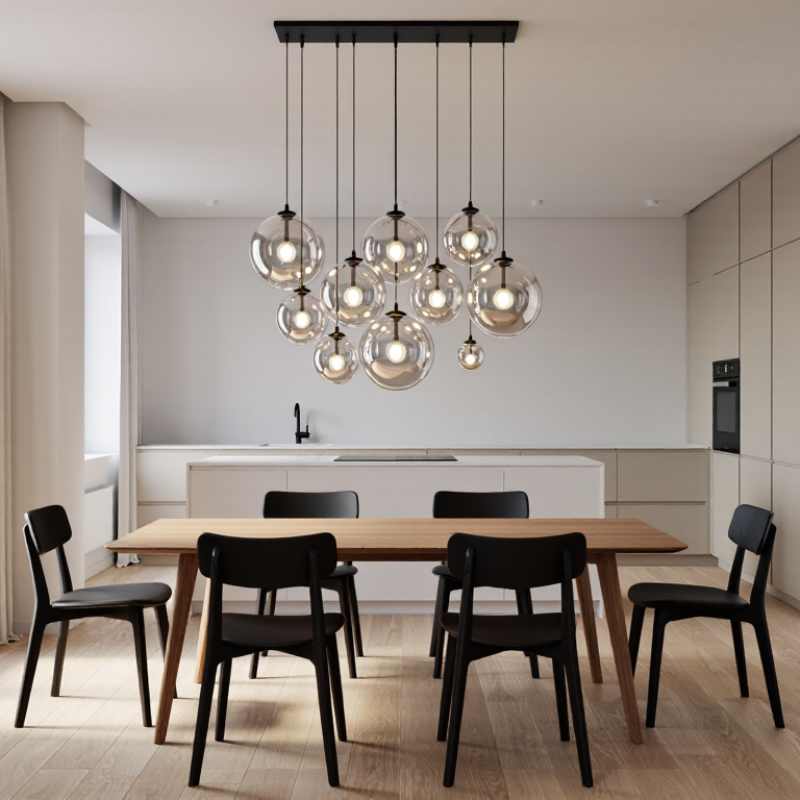
Bubble pendant lamps use spherical shades that can feel light and sculptural without taking over a room. Clear glass keeps the fixture visually open, while frosted glass softens the bulb and spreads a gentler glow. Tinted shades add color, but they can also make a room feel dimmer than expected. Shape matters, too: a cluster of small globes creates a lively focal point, while one larger globe gives a quieter look. Small details matter. Check how the globes attach and whether they can be cleaned easily; dust shows quickly on clear glass.
Lighting performance depends on more than appearance. Look at the fixture’s bulb count, maximum wattage, and compatibility with dimmer switches. A warm color temperature often feels comfortable over a dining table, while a brighter, neutral tone may suit a kitchen island. Match the lamp’s output to the task, and consider where light will land: a downward-facing bulb can leave corners dark. Measure the ceiling and table before choosing drop length. Too low, and the lamp interrupts sightlines; too high, and its shape may lose presence. I once underestimated how much a dark shade changed the room’s feel. It is worth checking samples in your actual lighting, since showroom conditions can be misleading.
Room size matters, but the surface below the pendant matters more. For a dining table, choose a bubble pendant roughly half to two-thirds of the table’s width. This keeps the fixture visually connected to the furniture without overwhelming it. A long table may suit a wider fixture or a balanced row of smaller pendants.
Over a dining table or kitchen island, position the lowest glass globe about 30 to 36 inches above the surface. Adjust for tall occupants and clear sightlines. Check the view while seated. A pendant that looks perfect from the doorway may block conversation across the table. Not always easy to spot in a showroom.
Before buying, mark the proposed fixture’s width on the ceiling with painter’s tape. You can also hang a paper outline at the intended height. This simple test helps reveal whether the lamp crowds cabinets, doorways, or nearby seating. In a foyer, keep the lowest point around seven feet above the floor where people walk beneath it. Ceiling height and the fixture’s shape can change what feels comfortable, so treat these measurements as starting points, not rules. A little extra clearance may feel less dramatic, but daily use usually wins.
A bubble pendant’s material changes more than its appearance. Clear glass gives a crisp view of the bulb and casts sharper highlights across a table. Opal glass softens the source, making it easier to look toward during dinner. Acrylic is lighter and less fragile, though some finishes can look less substantial up close. Check the shade in daylight and after dark; its color may shift under warm bulbs. Small detail, big difference.
Bulb choice shapes both comfort and usefulness. LED bulbs use less energy than traditional incandescent options and are available in warm or cool tones. For a relaxed dining area, try a warm white around 2700K to 3000K. A high color-rendering index can help food, wood, and skin tones look more natural. Look for a dimmable bulb only if the fixture and wall control support dimming. Compatibility is easy to overlook.
Light quality depends on the whole setup, not just the bulb. A clear globe with a bright, exposed filament may create glare when seated below it. Frosted bulbs or opal shades can reduce that effect, but they may also hide the lamp’s sparkling edges. I’d test the pendant at its intended hanging height before settling on a bulb. That choice can still feel wrong at first. Adjust the brightness and observe the room at night, when reflections on glass and polished surfaces become more noticeable.
Before choosing a bubble pendant lamp, check how it will attach to your ceiling. A glass globe may look light, yet several globes can add real weight. Confirm that the ceiling box and mounting hardware can support the fixture. Measure twice. Leave enough clearance above tables and walkways, and consider whether the globes might catch passing shoulders. For hardwired installation, switch off power at the breaker and follow the fixture instructions. If wiring or ceiling support is uncertain, ask a qualified electrician. A neat canopy cannot make an unsuitable ceiling connection safe.
Energy use depends on the bulbs, not just the shape of the lamp. Check the recommended bulb type and maximum wattage, then compare light output in lumens rather than relying on watts alone. Efficient LEDs can reduce energy use, but compatibility matters: some dimmers may cause flickering or uneven brightness. Look for a suitable color temperature too. Warm light often feels gentler over a dining table, while cooler light can seem stark against clear glass. Small details matter. A perfectly matched fixture may still cast glare, and there is no single setting that suits every room. Test the light at night before settling on its final height and bulb choice.
A bubble pendant lamp can look affordable until you add the canopy, compatible dimmer, and installation. Set a complete budget before comparing fixtures. Include the bulb, delivery, and any ceiling work. A cluster with several glass globes may cost more to install than a single pendant. Check whether replacement globes are sold separately; one cracked shade should not force you to replace the whole lamp. This estimate will not be perfect. Older wiring or a high ceiling can change the final cost.
Maintenance affects value, too. Clear glass shows dust and fingerprints, especially above a kitchen island. A soft microfiber cloth and a stable step stool make routine cleaning easier. Avoid abrasive pads, which can scratch glass or finishes. If the globes detach, check how they are secured before buying; awkward clips can turn a quick wipe into a chore. Small detail, big difference. LED bulbs generally need less frequent replacement, but confirm the fixture’s limits and dimmer compatibility. A cheaper lamp may still be the right choice if its parts are accessible and its finish suits your cleaning routine. I would not pay extra for a dramatic shape I dread dusting.
„Thanks to the LUVIR technology, the solder resist process could be switched directly from the previously used mask exposure to direct exposure. As an outstanding digital solution on the market, this technology has been able to demonstrate fast process times and superior quality on our certified conventional ink in production. This allowed us to fully digitize the solder mask process at low cost – without process or ink adjustments. An excellent benefit to our production in Rot am See.“
Ralf Göhringer (Head of Production WE Rot am See)
I would definitely recommend the Limata machine and team for a future company purchase
Michael Greenaway
Compunetics Inc.
“The Limata ldi has been amazing!! Best thing we did was buy this machine”
Richard Brady
GM
Circuitlabs
“Since 2019, we have been running the Limata X1000 LDI system (including LUVIR for solder mask imaging) in daily production as an addition to our current process with film. The machine was capable of properly exposing Taiyo PSR-4000 BN (DI) solder mask types on normal to high-copper boards using a new and unique direct imaging process. The machine operating interface is very user friendly which allowed for a quick technical training curve. The pre-registration processing reduced several seconds of production time at every print. Limata support and service staff is incomparable. They supported our team every step of the way at basically any time of the day or night, with literally, an immediate response time, customizing the software interface to best fit our Operations and needs.
We have exposed more than 8,000 prints since end of October, on various solder mask colors and some resist film panels. Limata, has proven to be very capable and innovative. They are a strong contender in the industry.
We have very much enjoyed this project, and working with the team!
Thank you Limata for the continued support and being a part of our growth.”
Bill Sezate
Vice President, GM
Summit Interconnect
As a replacement to our current contact exposure process with film, the LIMATA X2000 system including LUVIR-Technology was capable of properly exposing non-LDI solder mask types using a direct imaging process. The machine offers cutting edge software with a very intuitive operating interface which allowed for quick technician training curve. The dual drawer system combined with pre-registration processing reduced several seconds of production time at every machine cycle. Limata support and service staff is world class. They added software patches to keep production running at shortest possible response times, customized the software interface to best fit our in-house Operations system, and even wrote a step-by-step machine processing manual. As a result of the project, we have exposed more than 16,000 times on various product types and solder mask brands/colors. Limata, in a very short timeframe as a company, has definitely shown they are truly innovative and will be challenging the industry of direct imaging for the top spot.
Kevin Beattie
Process Engineer
TTM Technologies
Forest Grove Division
