Choosing the right Scooter Motors setup is less about chasing the biggest number and more about matching the motor to your route, rider weight, and daily range. A compact motor may feel calm on flat streets but struggle on steep hills. A more powerful option can climb confidently, yet it may add weight, cost, and energy use. Small details matter: tire size, controller settings, battery voltage, and cooling can all change how a scooter feels at the throttle.
As electric-mobility engineer Alex Morgan puts it, “Choose a motor for the ride you actually take, not the ride you imagine.” That is a useful rule, though real-world performance depends on the whole system—not the motor alone. A motor’s wattage is only one clue. Torque, continuous output, heat management, and compatibility with the battery deserve equal attention. Even a specification sheet can leave questions unanswered.
This guide will help you compare motor types and interpret the figures manufacturers publish. You’ll see how hub and mid-drive designs differ, what power ratings can—and cannot—tell you, and which trade-offs matter for commuting, hills, or carrying extra loads. Think about your usual trip: a long incline, a short stop-and-go ride, or a wet morning commute. Be honest about your needs. That part is easy to overlook. A sensible choice should deliver predictable acceleration, manageable heat, and enough range without paying for capacity you rarely use.
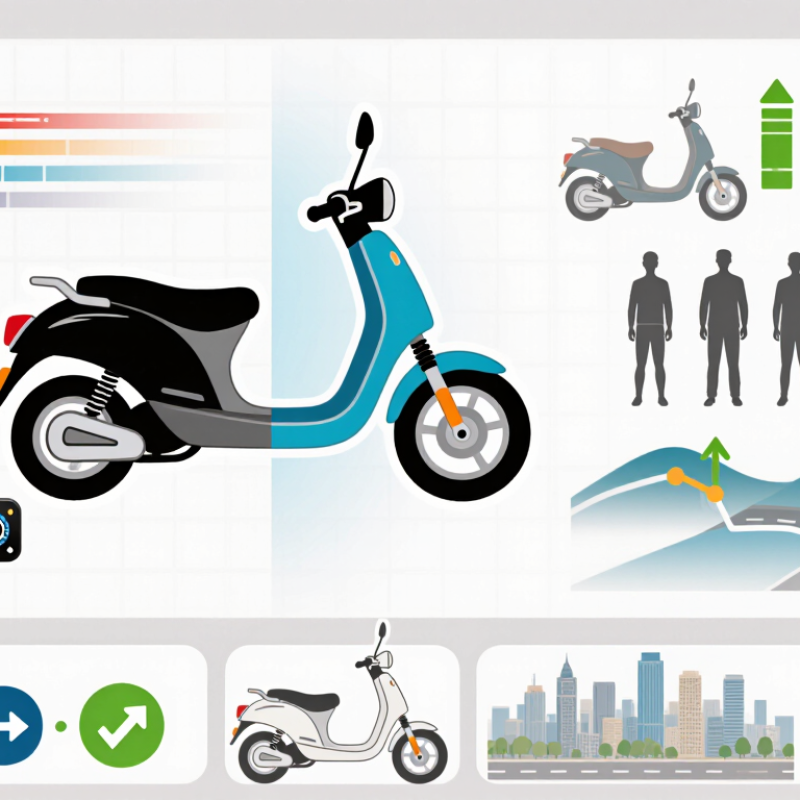
Scooter motors differ by how they create power and deliver it to the wheel. Many use a brushless DC motor, often built into the front or rear hub. With no brushes to wear down, it generally needs less routine maintenance. Hub designs also have fewer moving parts between motor and tire. Quiet, usually.
Brushed DC motors use physical brushes to transfer current. Their construction is straightforward, but brushes gradually wear and may need replacement. Some scooters use a motor mounted away from the wheel, driving it through a belt or chain. This layout can make servicing the motor easier, though the extra transmission parts need inspection. A loose belt can feel rough under acceleration. Check for it.
Motor type alone does not tell you how a scooter will climb or accelerate. Battery output, controller settings, wheel size, rider weight, and hill steepness all affect performance. Look at the manufacturer’s continuous power rating, not only a brief peak figure. On a test ride, notice whether power delivery feels smooth and whether the motor becomes unusually hot after a short hill. I would not judge a motor by speed claims alone; real routes can be less predictable than a showroom floor.
| Motor Type | How It Works | Main Advantages | Potential Limitations | Best Suited To | What to Check Before Choosing |
|---|---|---|---|---|---|
| Brushed DC hub motor | Uses brushes and a commutator to switch current in the motor windings. The motor is built into a wheel hub. | Relatively simple design; straightforward control and repair; can be a practical option for basic, cost-conscious scooters. | Brushes wear and need eventual replacement. Friction can create more maintenance and reduce efficiency compared with many brushless designs. | Basic scooters and applications where simple construction and ease of servicing are priorities. | Availability of replacement brushes and service parts, rated voltage, controller compatibility, and the manufacturer’s maintenance guidance. |
| Brushless geared hub motor | A brushless motor drives the wheel through internal reduction gears. The gears allow the motor to spin faster than the wheel. | Often provides useful starting and climbing torque for its size and weight. The motor can freewheel with relatively low drag when unpowered. | Internal gears can wear or become noisy over time. The drivetrain adds components that may require service. | Everyday riding, stop-and-go routes, and moderate hills where compact size and responsive acceleration matter. | Gear durability, replacement-part support, rated continuous power, controller settings, and suitability for the rider’s load and route. |
| Brushless direct-drive hub motor | A brushless motor is integrated into the wheel without a reduction gearbox; the motor turns at wheel speed. | Fewer moving drivetrain parts than a geared hub motor; generally quiet and low-maintenance. Some systems can support regenerative braking when the controller and battery allow it. | Can be heavier and may provide less low-speed torque than a geared motor of similar size. Unpowered rolling resistance can be more noticeable on some designs. | Riders seeking a simple, durable hub system, especially for flatter routes and steady cruising. | Motor and wheel weight, low-speed performance, controller support for regenerative braking, and the impact on range when the motor is not powered. |
| Mid-drive motor | The motor is mounted near the scooter’s chassis or drivetrain and transfers power to the wheel through a belt, chain, or gears. | Can make effective use of gearing for acceleration and climbs. Keeping the motor off the wheel may help manage wheel mass and handling. | More drivetrain components can mean added complexity, maintenance, and noise. Compatibility and repair may be more specialized. | Performance-focused scooters and routes with frequent hills, when the drivetrain is designed for the expected load. | Drive-belt or chain service requirements, gearing, transmission durability, ground clearance, and access to qualified service. |
Selection tip: Compare the complete motor system, not just its type. Continuous power, peak power, battery capacity, controller tuning, wheel size, rider weight, terrain, and local speed regulations all affect real-world performance and range.
Before comparing scooter motors, describe the rides you actually take. Record your usual distance, rider and cargo weight, and the steepest hill on your route. A flat, short commute places different demands on a motor than frequent climbs or longer trips. Think about how quickly you need to accelerate, too. Smooth starts may matter more than high top speed in crowded areas.
Check continuous power, not just peak power. Peak output can describe a brief burst, while continuous ratings better indicate sustained performance. Match motor demands with the scooter’s battery and controller specifications; mismatched components can reduce efficiency or cause overheating. If you carry a backpack or ride in cold weather, allow extra range and power margin. I learned this the practical way: a route that looks easy on a map can feel very different with a headwind. Your estimate may still be imperfect, so track real trips before choosing a larger motor.
Tips: Write down your route and load for a typical week. Compare motor ratings against the scooter maker’s stated limits, and ask a qualified technician if specifications are unclear. Bigger is not always better. A heavier motor can add weight and drain the battery faster.
Motor power describes how quickly a scooter can deliver work, but peak watts are not the whole story. Check continuous power too: a high peak rating may last only briefly. Torque matters when starting on a slope or carrying a backpack; wheel size and gearing affect how that torque feels at the road. The U.S. Department of Energy’s 2014 motor-systems sourcebook estimates motor-driven systems use about 68% of U.S. manufacturing electricity. That figure is not scooter-specific, but it shows why efficiency deserves attention alongside power. I still find advertised peak watts easy to overvalue.
Top speed is useful only if the motor can sustain it with your weight, route, and battery charge. Compare models under similar conditions, then check energy use in watt-hours per kilometre, not just claimed range. A heavier rider climbing a long hill may see very different results from a flat-road test. Small details matter. Tire pressure, temperature, and stop-start traffic can all shift efficiency. Look for test methods and continuous ratings in the technical specifications; if those details are missing, treat headline figures cautiously. A short test ride can reveal a weakness a chart cannot.
Before comparing motor wattage, match its rated voltage to the scooter’s battery. A 36-volt motor on a 48-volt system may overheat or fail; a lower-voltage setup can feel sluggish. Check the battery label, then verify the motor’s operating range in its technical sheet. Small details matter.
The controller must also support the motor’s voltage and continuous current. A motor’s peak power rating is not the same as its steady demand. Compare the controller’s current limit with the motor specification, and check connector type, sensor wiring, and brake cut-off compatibility. One mismatch can leave a scooter that powers on but cuts out under load. Check the label.
Battery capacity affects range, not direct motor fit. BloombergNEF reported an average lithium-ion battery-pack price of $139 per kilowatt-hour in 2023, down 14 percent from 2022. That broad market figure is not a scooter-specific price, but it shows why replacing a pack can be costly. I still double-check the actual pack voltage and controller limits; listings sometimes omit useful details. If specifications conflict, pause and ask a qualified technician to verify the system before installation.
Choosing a scooter motor is a balance between upfront price and the work it must handle. A commuter crossing steep streets needs different torque and heat tolerance from someone riding short, flat routes. Check the motor’s rated output, cooling design, and protection against water and dust. A larger motor is not automatically better; extra capacity can add weight and cost without improving an easy daily trip.
Durability matters when rides are frequent. NACTO’s 2023 Shared Micromobility in the U.S. report recorded 133 million shared micromobility trips nationwide. That figure does not measure motor failures, but it shows how repeated use can strain fleet components. For personal scooters, ask about replacement-part availability, warranty coverage, and whether the motor can be serviced without replacing the wheel assembly. Small details count. A noisy bearing or damaged cable can turn a modest repair into a costly one.
Compare total ownership cost, not just the purchase price. Include expected servicing, replacement parts, and energy use over your likely riding distance. A technically impressive motor may be poor value if local repair options are limited. I would also be cautious about treating advertised range as a promise; hills, rider weight, temperature, and stop-start traffic change real results. A short test ride on your usual route can reveal more than a specification sheet, though it cannot predict years of wear.
„Thanks to the LUVIR technology, the solder resist process could be switched directly from the previously used mask exposure to direct exposure. As an outstanding digital solution on the market, this technology has been able to demonstrate fast process times and superior quality on our certified conventional ink in production. This allowed us to fully digitize the solder mask process at low cost – without process or ink adjustments. An excellent benefit to our production in Rot am See.“
Ralf Göhringer (Head of Production WE Rot am See)
I would definitely recommend the Limata machine and team for a future company purchase
Michael Greenaway
Compunetics Inc.
“The Limata ldi has been amazing!! Best thing we did was buy this machine”
Richard Brady
GM
Circuitlabs
“Since 2019, we have been running the Limata X1000 LDI system (including LUVIR for solder mask imaging) in daily production as an addition to our current process with film. The machine was capable of properly exposing Taiyo PSR-4000 BN (DI) solder mask types on normal to high-copper boards using a new and unique direct imaging process. The machine operating interface is very user friendly which allowed for a quick technical training curve. The pre-registration processing reduced several seconds of production time at every print. Limata support and service staff is incomparable. They supported our team every step of the way at basically any time of the day or night, with literally, an immediate response time, customizing the software interface to best fit our Operations and needs.
We have exposed more than 8,000 prints since end of October, on various solder mask colors and some resist film panels. Limata, has proven to be very capable and innovative. They are a strong contender in the industry.
We have very much enjoyed this project, and working with the team!
Thank you Limata for the continued support and being a part of our growth.”
Bill Sezate
Vice President, GM
Summit Interconnect
As a replacement to our current contact exposure process with film, the LIMATA X2000 system including LUVIR-Technology was capable of properly exposing non-LDI solder mask types using a direct imaging process. The machine offers cutting edge software with a very intuitive operating interface which allowed for quick technician training curve. The dual drawer system combined with pre-registration processing reduced several seconds of production time at every machine cycle. Limata support and service staff is world class. They added software patches to keep production running at shortest possible response times, customized the software interface to best fit our in-house Operations system, and even wrote a step-by-step machine processing manual. As a result of the project, we have exposed more than 16,000 times on various product types and solder mask brands/colors. Limata, in a very short timeframe as a company, has definitely shown they are truly innovative and will be challenging the industry of direct imaging for the top spot.
Kevin Beattie
Process Engineer
TTM Technologies
Forest Grove Division
