Choosing the right Sludge Sensor starts with the process, not the product brochure. Sludge changes with solids concentration, temperature, flow, and tank conditions. A sensor that performs well in a clean test channel may struggle in a dense clarifier blanket. Ask what you need to measure: blanket level, suspended solids, or sludge concentration. These are related, but they are not interchangeable.
The measurement principle often attributed to physicist Lord Kelvin is, “When you can measure what you are speaking about...” For sludge monitoring, that means defining the measurement and its operating range before comparing instruments. Consider the tank’s depth, the sludge’s tendency to build up on probes, and whether operators can reach the sensor for cleaning. A clear display matters, too. At 6 a.m., a stable reading is more useful than a complicated menu.
Look closely at installation and maintenance requirements. Ultrasonic, optical, and mechanical designs each respond differently to bubbles, foam, turbulence, and changing sludge properties. Ask suppliers for performance data from conditions close to yours, then confirm how calibration and cleaning work in practice. No sensor is maintenance-free. That detail is easy to underestimate. A careful choice balances measurement needs, site conditions, service access, and total operating cost. This guide examines those factors and the trade-offs behind them, so you can choose a Sludge Sensor with realistic expectations—not just an appealing specification sheet.
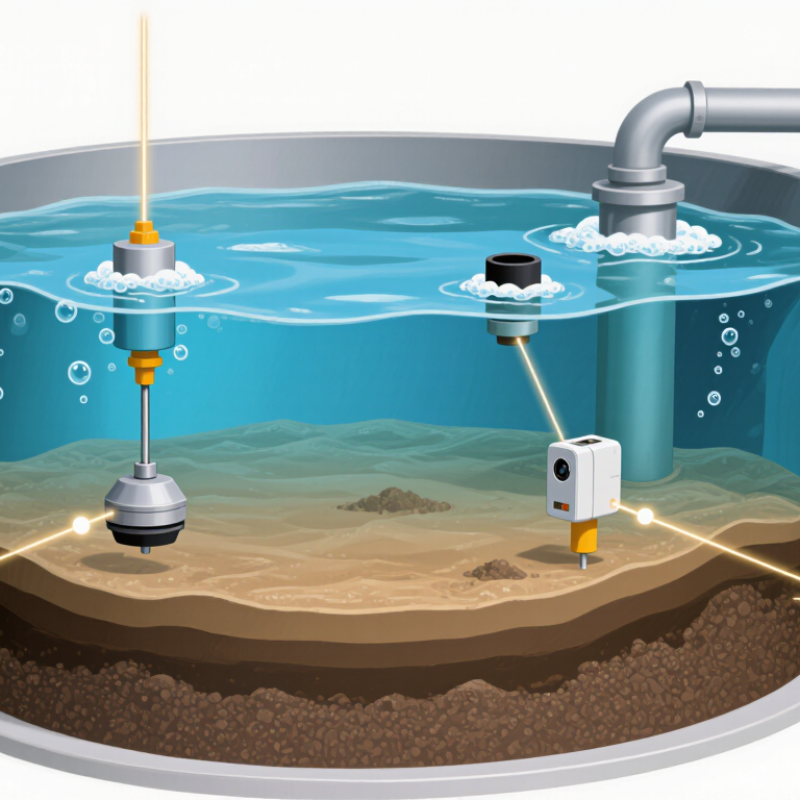
Sludge sensors do not all measure the same thing. Ultrasonic models send sound pulses through water and detect echoes from the boundary between clearer liquid and settled solids. The measured travel time helps estimate blanket depth. Optical sensors use light scattering or absorption to indicate suspended-solids concentration. They can be useful in a flowing sample, but concentration is not the same as sludge-layer height. Some systems use pressure to estimate depth, though changing sludge density can affect the reading.
The measurement principle should match the process. For a settling tank, an ultrasonic sensor may track a visible sludge blanket as it rises or falls. Foam, turbulence, and trapped air can weaken or confuse echoes. In a thickener, high solids and uneven layers may complicate readings. An optical probe can provide useful concentration trends, but dirty windows need regular cleaning. Small details matter.
Before choosing, consider tank depth, expected solids range, temperature, and maintenance access. Ask how the instrument handles calibration and signal loss, then compare its output with a manual sample or site reference. Keep a record. One limitation is easy to miss: a sensor reports conditions at its measuring point, not across the whole tank. Placement may need review after the process changes. A perfect reading is not guaranteed. The right choice is the one whose measurement fits the decision operators need to make.
Choosing a sludge sensor starts with the process, not the catalogue. Define what you need to measure: blanket level, suspended solids, or sludge density. These are different measurements, and a sensor suited to one may give misleading results for another. Check the expected range and how quickly the reading must respond to changing conditions. A clarifier with a slowly settling blanket has different needs from a fast-flowing treatment channel.
Look closely at the operating environment. Note tank depth, flow speed, temperature, pressure, and how much grit or fibrous material enters the process. Those details affect sensor placement and the chance of fouling. For example, a probe mounted near a scraper may experience vibration, while a sensor placed too close to an inlet may see unstable readings. Small details matter. Review cleaning access, cable routing, and compatibility with your control system before installation. If possible, compare readings with manual samples during commissioning; this can reveal an offset that is easy to miss on a screen. I have seen teams focus heavily on measurement accuracy and overlook routine cleaning time. That trade-off deserves a second look, especially when staff access is limited. Keep a record of normal readings and maintenance conditions, even if the first log feels incomplete.
Sludge sensors differ in what they detect. Ultrasonic units track the sludge blanket by timing reflected sound, making them useful in clarifiers with changing water levels. Optical sensors detect suspended solids near the probe, but bubbles, color, and deposits can distort readings. Hydrostatic devices infer depth from pressure; they are simple, though density changes can affect results. No single method fits every tank.
Check the measurement range against the actual process, not just the tank depth. A blanket sensor should cover the expected interface position, with room for seasonal variation. For solids concentration, confirm the stated range in mg/L and compare it with grab-sample results across low and high loads. Also inspect response time, cleaning needs, mounting clearance, and signal output. Small details matter. A probe hidden behind a scraper may report a neat number, but not a useful one.
The US EPA’s 2022 Clean Watersheds Needs Survey estimates $630.1 billion in wastewater infrastructure needs over 20 years. That figure reflects broad system needs, not sensor spending, but it underscores why dependable monitoring matters. Ask suppliers for calibration procedures and field performance data under similar sludge conditions. Lab accuracy is helpful; plant-floor repeatability is harder. I would still verify readings manually during commissioning, because settling behavior can surprise you.
Choosing a sludge sensor starts with the installation site, not the specification sheet. Check tank depth, mounting clearance, flow patterns, and whether staff can safely reach the probe for cleaning. In a narrow channel, a sensor that needs frequent manual wiping may become a poor fit. Small details matter. Match the measurement principle to the sludge: suspended-solids sensors suit concentration monitoring, while sludge-blanket sensors locate the interface between settled solids and clearer water. Confirm signal and protocol compatibility with the existing PLC or SCADA system before ordering. A technically accurate reading is useless if the control system cannot receive it.
Maintenance needs deserve equal attention. Ask how deposits, grease, and rags affect readings, and whether the sensor supports automatic cleaning or simple field calibration. The U.S. EPA’s 2013 energy-efficiency review estimates that water and wastewater facilities use about 3% of U.S. electricity, underscoring the value of dependable process monitoring. Yet a sensor alone cannot guarantee efficient operation. The EPA’s 2022 Clean Watersheds Needs Survey identified about $630 billion in water-quality infrastructure needs over 20 years, making retrofit compatibility a practical concern. Check available power, mounting hardware, cable routing, and data interfaces against the plant’s actual setup. One uncertainty remains: site fouling can differ sharply between seasons, so a short pilot may reveal problems a datasheet misses.
Selecting a Sensor Based on Performance and Total Cost of Ownership
A sludge sensor should fit the process, not just the purchase budget. Identify the measurement you need, such as blanket level or solids concentration, and check the expected range. Tank depth, turbulence, bubbles, and coating can affect readings. Ask for performance data under conditions similar to yours, not only clean-water demonstrations. Shorter response times may help control processes, but they may not justify higher costs at every site.
Compare total ownership costs over a realistic service period. Include installation, wiring, cleaning, calibration, staff time, replacement parts, and production interruptions. A low-priced probe can become expensive if it needs frequent cleaning. Small costs accumulate.
The U.S. EPA’s Energy Efficiency in Water and Wastewater Facilities report estimates that water and wastewater services use about 3% of U.S. electricity. This figure is not sensor-specific, but it highlights why reliable process measurements matter in energy-intensive facilities. Request maintenance intervals and expected sensor life in writing, then compare options using the same assumptions. No spreadsheet captures every upset. Site trials can expose gaps between quoted performance and actual sludge conditions. A trial takes time, but skipping one may be the costlier choice.
„Thanks to the LUVIR technology, the solder resist process could be switched directly from the previously used mask exposure to direct exposure. As an outstanding digital solution on the market, this technology has been able to demonstrate fast process times and superior quality on our certified conventional ink in production. This allowed us to fully digitize the solder mask process at low cost – without process or ink adjustments. An excellent benefit to our production in Rot am See.“
Ralf Göhringer (Head of Production WE Rot am See)
I would definitely recommend the Limata machine and team for a future company purchase
Michael Greenaway
Compunetics Inc.
“The Limata ldi has been amazing!! Best thing we did was buy this machine”
Richard Brady
GM
Circuitlabs
“Since 2019, we have been running the Limata X1000 LDI system (including LUVIR for solder mask imaging) in daily production as an addition to our current process with film. The machine was capable of properly exposing Taiyo PSR-4000 BN (DI) solder mask types on normal to high-copper boards using a new and unique direct imaging process. The machine operating interface is very user friendly which allowed for a quick technical training curve. The pre-registration processing reduced several seconds of production time at every print. Limata support and service staff is incomparable. They supported our team every step of the way at basically any time of the day or night, with literally, an immediate response time, customizing the software interface to best fit our Operations and needs.
We have exposed more than 8,000 prints since end of October, on various solder mask colors and some resist film panels. Limata, has proven to be very capable and innovative. They are a strong contender in the industry.
We have very much enjoyed this project, and working with the team!
Thank you Limata for the continued support and being a part of our growth.”
Bill Sezate
Vice President, GM
Summit Interconnect
As a replacement to our current contact exposure process with film, the LIMATA X2000 system including LUVIR-Technology was capable of properly exposing non-LDI solder mask types using a direct imaging process. The machine offers cutting edge software with a very intuitive operating interface which allowed for quick technician training curve. The dual drawer system combined with pre-registration processing reduced several seconds of production time at every machine cycle. Limata support and service staff is world class. They added software patches to keep production running at shortest possible response times, customized the software interface to best fit our in-house Operations system, and even wrote a step-by-step machine processing manual. As a result of the project, we have exposed more than 16,000 times on various product types and solder mask brands/colors. Limata, in a very short timeframe as a company, has definitely shown they are truly innovative and will be challenging the industry of direct imaging for the top spot.
Kevin Beattie
Process Engineer
TTM Technologies
Forest Grove Division
