Choosing Shelf Racking for a warehouse in 2026 is not simply a matter of adding more beams. The right system must suit the building, inventory, handling equipment, and daily picking patterns. A rack that looks efficient on a floor plan can still create awkward forklift turns or hard-to-reach stock. Small details matter.
The MHI 2024 Annual Industry Report found that 55% of surveyed supply-chain professionals planned to increase technology investment. That finding reflects a broader push for more responsive operations, though it does not prove every warehouse needs automation. Racking decisions should start with measured facts: clear building height, aisle width, pallet dimensions, load weights, SKU turnover, and expected growth. The Rack Manufacturers Institute’s ANSI MH16.1 standard provides engineering requirements for industrial steel storage racks. OSHA’s materials-handling guidance also emphasizes stable, secure storage. These references help frame the decision; they do not replace a site-specific review by qualified professionals.
This guide compares common rack types and explains how to match them to real warehouse conditions. It also covers capacity, access, safety checks, and future flexibility. A useful plan should leave room for change, not just today’s pallet count. That assumption can be wrong. Before choosing a layout, confirm actual loads and equipment clearances with your rack supplier and facility team. One overlooked beam level, sprinkler clearance, or turning radius can undermine an otherwise sensible design.
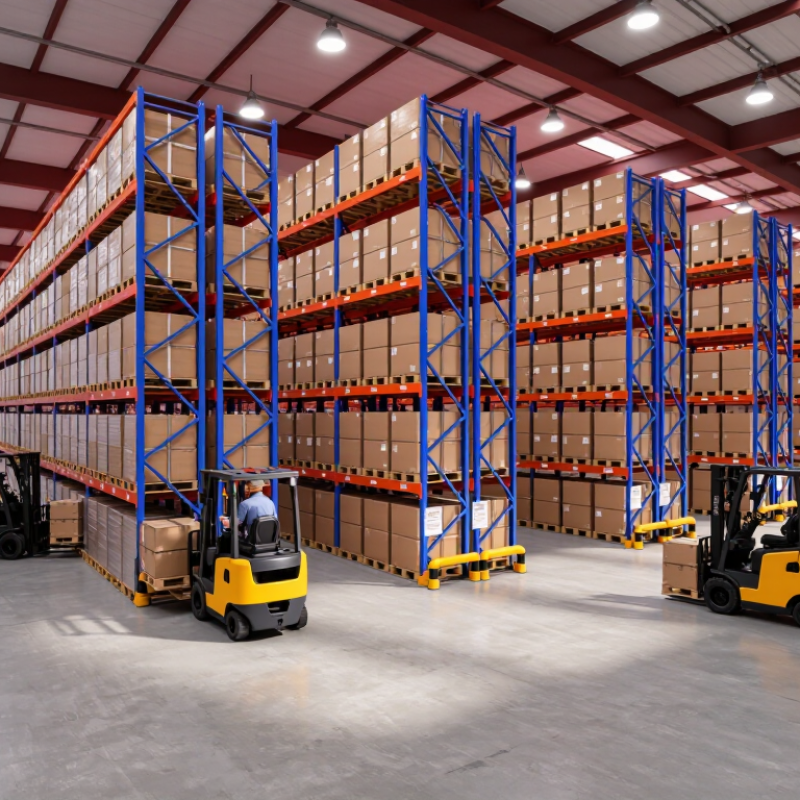
Before choosing shelf racking, map your SKU mix and the busiest inventory period, not an average week. Count each item’s storage units, dimensions, weight, and picking frequency. Measure usable floor space, aisle clearances, doorways, and sprinkler or lighting obstructions. Measure at the peak. A layout that fits today’s stock may become cramped after a seasonal delivery.
Separate fast-moving items from slow sellers, then estimate peak quantities for each group. Fast movers usually need clear access near picking areas, while slower stock can use denser storage farther away. Check whether cartons, bins, or pallets will sit on the shelves, and confirm their loaded weights. A density estimate can look excellent on a spreadsheet but still slow picking when workers need frequent access. Recheck the assumptions with warehouse staff; they often know where congestion actually forms.
Tips: Record peak stock by SKU, not just total pallet count. Leave room for replenishment and safe equipment movement. Review the plan with a sample aisle marked on the floor. It may feel conservative, but a little unused space is often less costly than constant reshuffling.
Choosing rack by pallet positions per aisle can be misleading. Selective racks provide direct access to every pallet, making them practical for warehouses with many SKUs or frequent picking. For a simple comparison, imagine ten bays on each side of an aisle, two pallet locations per bay, and five storage levels. That gives about 200 positions. Check the actual bay layout, beam spacing, and clearances before using this estimate.
Double-deep racks can roughly double those positions in the same bay arrangement, but rear pallets require a deep-reach truck. Selectivity drops. Drive-in racks can store more pallets in each lane, especially when a lane holds one SKU, but operators may need to move front pallets to reach those behind. That trade-off matters. A dense aisle is not automatically a faster aisle.
MHI’s 2024 Annual Industry Report found that 55% of surveyed supply-chain professionals were using or piloting robotics and automation. That is not a rack-capacity benchmark, but it signals why future equipment access deserves attention. A narrow aisle may suit guided vehicles, while conventional forklifts need more turning room. Numbers need context. Recheck the comparison using your SKU count, pallet dimensions, replenishment pattern, and usable building height; a small change in aisle width can alter total warehouse capacity.
When choosing warehouse shelving in 2026, verify the installed rack configuration against ANSI/RMI MH16.1-2023, the industrial steel storage rack design and evaluation standard. Capacity is not determined by beam thickness alone. Check beam span and connector type, upright-frame details, bracing, anchors, and the actual load layout. Calculate pallet weight with products and packaging included, then confirm the permitted load for each beam level and bay with a qualified rack professional. Small changes matter. A different beam height or uneven pallet loading can change how forces reach the uprights. A spreadsheet can look precise and still describe the wrong bay.
The U.S. Bureau of Labor Statistics reported 2.6 million nonfatal workplace injury and illness cases in private industry in 2023. That figure is not specific to rack failures, but it underlines why safe storage deserves careful attention. Keep the rack drawings, load calculations, and posted capacity information aligned with the warehouse’s real configuration. If records are missing, do not guess from a neighboring bay; verify before loading.
Tips: Photograph each bay, measure beam spans, and weigh a representative loaded pallet. Record changes after reconfiguration. If a frame is bent or a connector is damaged, isolate the affected area and arrange a competent inspection. One detail is easy to overlook: old drawings may no longer match the floor.
When planning shelf racking, set aisle widths from the lift truck you will actually use, not a generic warehouse diagram. Check its right-angle stacking dimensions, turning radius, and load capacity in the manufacturer’s specifications. Then account for pallet size, load overhang, and how the truck approaches each rack face. A wide pallet can change the clearance you need. So can a long load.
OSHA 1910.176(b) requires sufficient safe clearance in aisles and at turns, doorways, and loading docks; it does not prescribe one universal aisle width. Permanent aisles must also be appropriately marked and kept clear.
Measure the route with the truck carrying a typical load, including tight turns near end frames and cross aisles. Leave room for small tracking errors, but avoid guessing at a safety margin without testing the layout. A drawing can look tidy and still be wrong. If possible, mark the proposed aisle edges on the floor and conduct a controlled trial with trained operators. Watch for pallet corners nearing uprights, pedestrians entering the travel path, and loads that block sightlines. Record the truck model, load dimensions, and test conditions so future changes can be checked. Honestly, this step may expose a layout flaw late. Better to find it before racks are anchored and inventory fills the bays.
When choosing shelf racking for a 2026 warehouse, plan around the sprinkler system as well as the available floor space. NFPA 13’s 18-inch clearance is not a universal rule for every rack and sprinkler arrangement. Where the applicable code edition and approved design require it, maintain at least 18 inches between sprinkler deflectors and the top of stored goods. Measure from the deflectors, not the ceiling panels. A high carton can use up that gap.
Set rack heights and beam levels for the tallest expected loads, including seasonal cartons and pallet overhang. Keep a clear storage limit that workers can see from the aisle. Painted markers help, but they do not replace routine checks. Measure it twice. A slightly uneven pallet may be enough to cross the line.
Before installation, confirm the required clearance for your sprinkler type, storage arrangement, and adopted code edition with a qualified fire-protection professional. Ask the local authority having jurisdiction to verify the applicable requirements. Recheck after changing rack levels or storing different products. Drawings can look tidy; busy aisles are less predictable. That part is easy to underestimate.
„Thanks to the LUVIR technology, the solder resist process could be switched directly from the previously used mask exposure to direct exposure. As an outstanding digital solution on the market, this technology has been able to demonstrate fast process times and superior quality on our certified conventional ink in production. This allowed us to fully digitize the solder mask process at low cost – without process or ink adjustments. An excellent benefit to our production in Rot am See.“
Ralf Göhringer (Head of Production WE Rot am See)
I would definitely recommend the Limata machine and team for a future company purchase
Michael Greenaway
Compunetics Inc.
“The Limata ldi has been amazing!! Best thing we did was buy this machine”
Richard Brady
GM
Circuitlabs
“Since 2019, we have been running the Limata X1000 LDI system (including LUVIR for solder mask imaging) in daily production as an addition to our current process with film. The machine was capable of properly exposing Taiyo PSR-4000 BN (DI) solder mask types on normal to high-copper boards using a new and unique direct imaging process. The machine operating interface is very user friendly which allowed for a quick technical training curve. The pre-registration processing reduced several seconds of production time at every print. Limata support and service staff is incomparable. They supported our team every step of the way at basically any time of the day or night, with literally, an immediate response time, customizing the software interface to best fit our Operations and needs.
We have exposed more than 8,000 prints since end of October, on various solder mask colors and some resist film panels. Limata, has proven to be very capable and innovative. They are a strong contender in the industry.
We have very much enjoyed this project, and working with the team!
Thank you Limata for the continued support and being a part of our growth.”
Bill Sezate
Vice President, GM
Summit Interconnect
As a replacement to our current contact exposure process with film, the LIMATA X2000 system including LUVIR-Technology was capable of properly exposing non-LDI solder mask types using a direct imaging process. The machine offers cutting edge software with a very intuitive operating interface which allowed for quick technician training curve. The dual drawer system combined with pre-registration processing reduced several seconds of production time at every machine cycle. Limata support and service staff is world class. They added software patches to keep production running at shortest possible response times, customized the software interface to best fit our in-house Operations system, and even wrote a step-by-step machine processing manual. As a result of the project, we have exposed more than 16,000 times on various product types and solder mask brands/colors. Limata, in a very short timeframe as a company, has definitely shown they are truly innovative and will be challenging the industry of direct imaging for the top spot.
Kevin Beattie
Process Engineer
TTM Technologies
Forest Grove Division
